
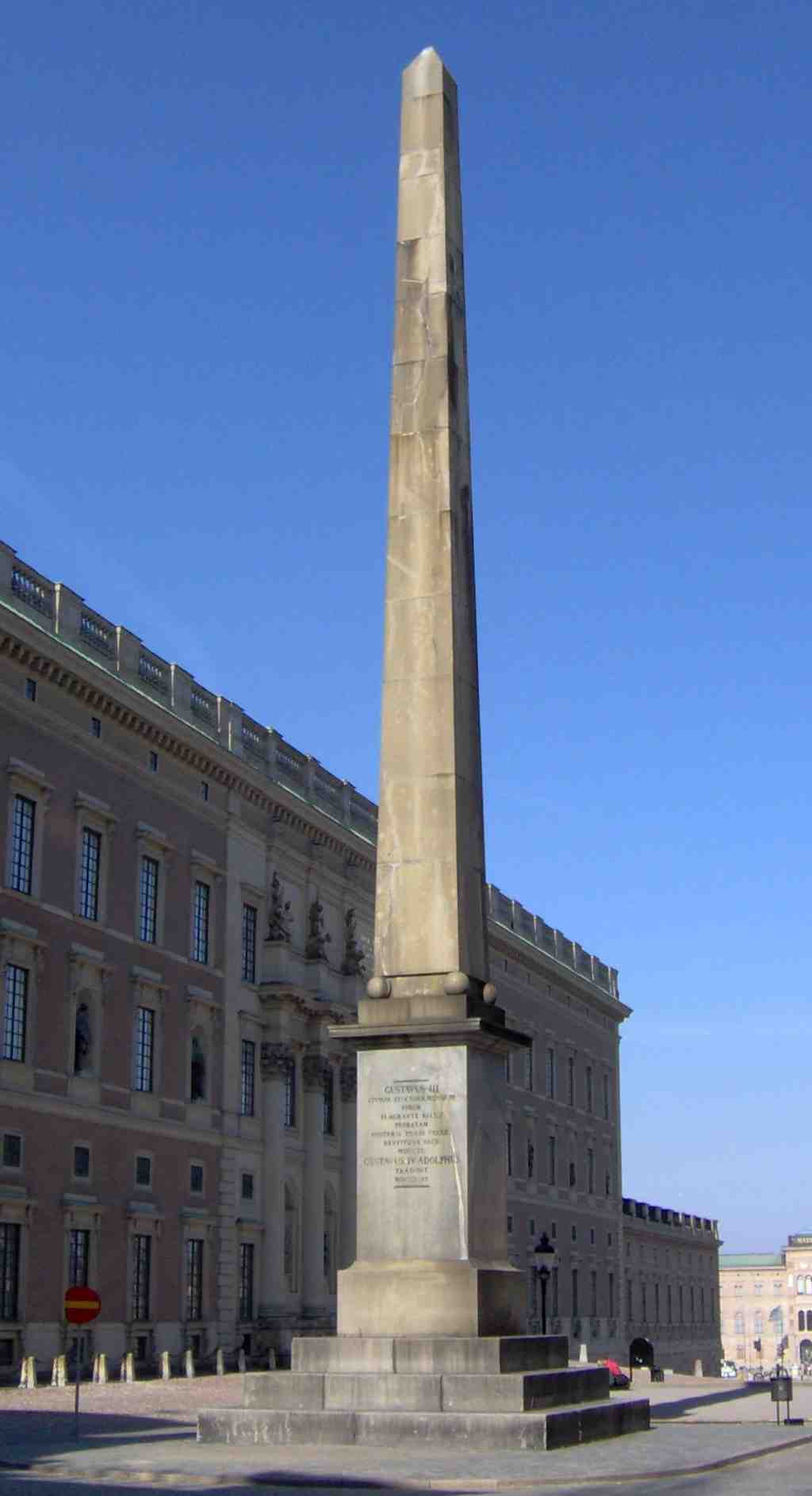
In front of you, standing tall and slender against the sky, is a pale stone pillar-a nearly 30-meter-high obelisk with a pointed top, set on a sturdy square base right at the center of the square outside the Royal Palace.
Imagine stepping onto this cobblestone square more than 200 years ago. The air is crisp, and the entire area hums with excitement as the city gathers around a great new monument. This obelisk-soaring almost 30 meters high-wasn’t just plucked out of ancient Egypt, though it surely has that mysterious aura; instead, its story begins with gratitude, war, and kings.
It was the late summer of 1790, and King Gustav III stood before the city’s officials, their faces dappled in the golden light filtering through the windows of the old City Hall. Stockholm had just survived the Russian War of 1788 to 1790, and the city’s citizens-ordinary shopkeepers, craftsmen, bakers, and their families-had been crucial in defending their home. The king, struck by their loyalty and effort, promised them a lasting symbol of gratitude, announcing for the very first time that he would gift them “an Obelisk,” carved from stone shaped by Swedish hands. It would be an enduring reminder that, when faced with peril, the city had stood proud and united.
Planning dragged out for years and the king himself never saw the project finished. But his son, Gustav IV Adolf, kept the promise. In 1798, Stockholm’s best engineers and craftsmen, led by Jonas Lidströmer, broke ground at this very spot. Lidströmer was a true Renaissance man-a master mechanic dubbed “his era's Polhem”-and this was his crowning achievement. Imagine the noise and commotion as the pieces took shape: seventeen colossal rings of granite, quarried from the local bedrock, were set one on top of the other, each stone joined with iron clamps. The largest block alone weighed 40 tons, and the monument as a whole was like a giant puzzle, almost trembling under its own weight.
When the obelisk was finally ready in October 1800, the city buzzed again. On inauguration day, the square was tightly packed. Soldiers stood in neat lines, forming a square around the obelisk. Inside the ranks, important figures shimmered in uniforms and medals. Suddenly, the crowd parted as King Gustav IV Adolf himself arrived, resplendent on horseback and escorted by elegant cavalrymen. He dismounted, climbed the third step, and with a steady voice, handed this monument over to the grateful city.
There’s a little secret detail that sharp-eyed visitors still notice: the name Gustav IV Adolf is carved on the obelisk’s base. After his deposition, every public place with his name was scrubbed clean-except here. So while he was erased elsewhere, his gratitude to Stockholm lived on, untouched, as a quiet defiance against history’s erasure.
But Stockholm’s harsh winters and rainy springs weren’t kind to the stone. The iron inside began to rust, cracks spread, and repairs became frequent and increasingly desperate. By 2012, the risk of collapse forced authorities to fence it off. Finally, in 2017, the monument was carefully dismantled. The city couldn’t use the same “Stockholm granite,” so a new obelisk took form from Bohus granite, a beautiful silvery stone, this time with a solid steel heart inside, stronger than ever before. In 2020, to much celebration, the new obelisk was unveiled, virtually identical to the original, standing as both a replica and a brand-new chapter.
Even the making of this obelisk had a quirky prequel: before it was built here, a full-size wooden model was assembled just north of the city, so King Gustav III could glimpse its shape from his planned palace in Haga Park. Today, only its stone foundation remains, a ghostly footnote to this remarkable city landmark.
So as you look up at the obelisk, imagine centuries of Stockholmers gathering around, each generation layering new stories over the old, united under this silent pillar of granite-a monument built from gratitude, remade from endurance, and standing resolute in the heart of the city.
Yearning to grasp further insights on the history, construction and appearance or the inauguration? Dive into the chat section below and ask away.




