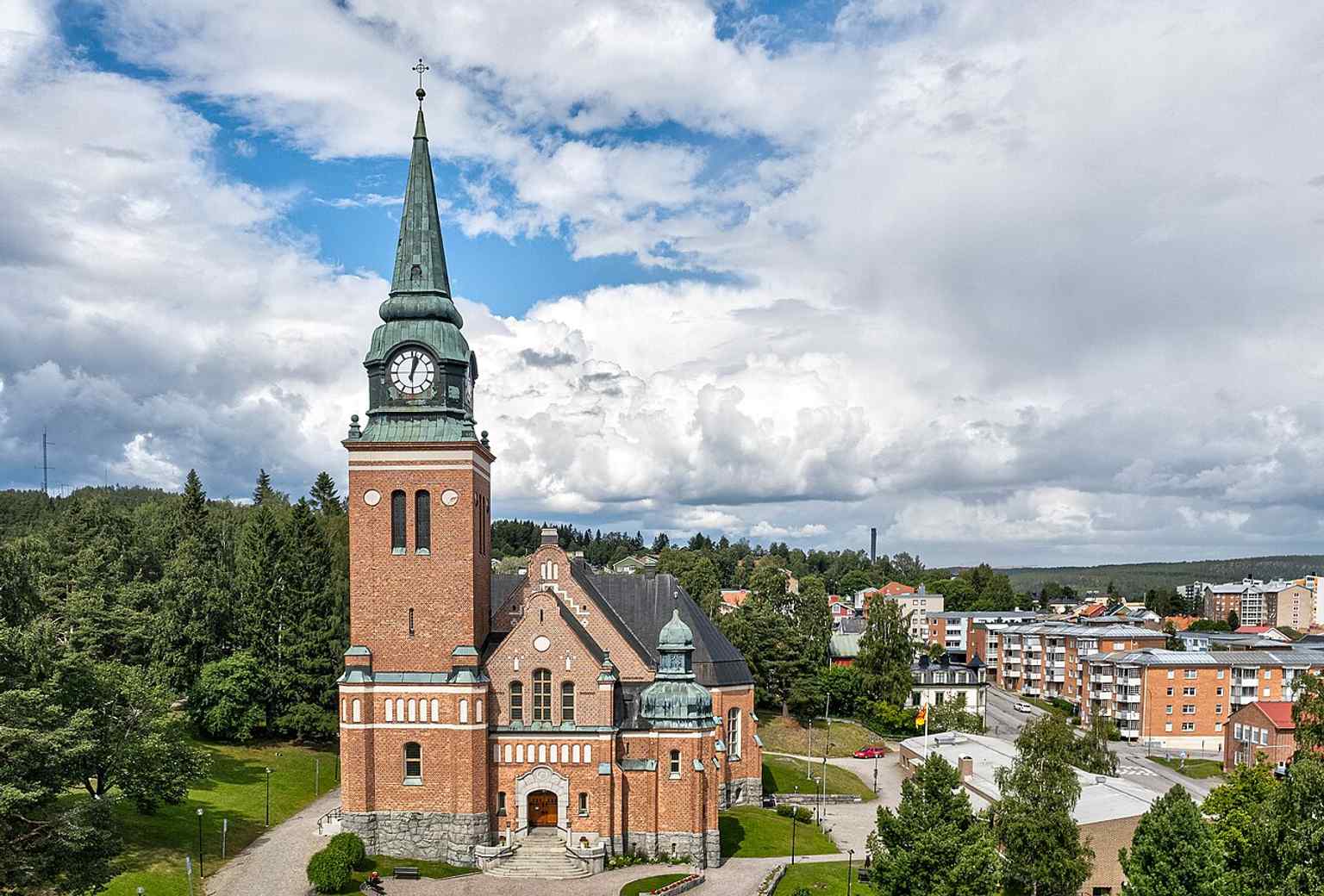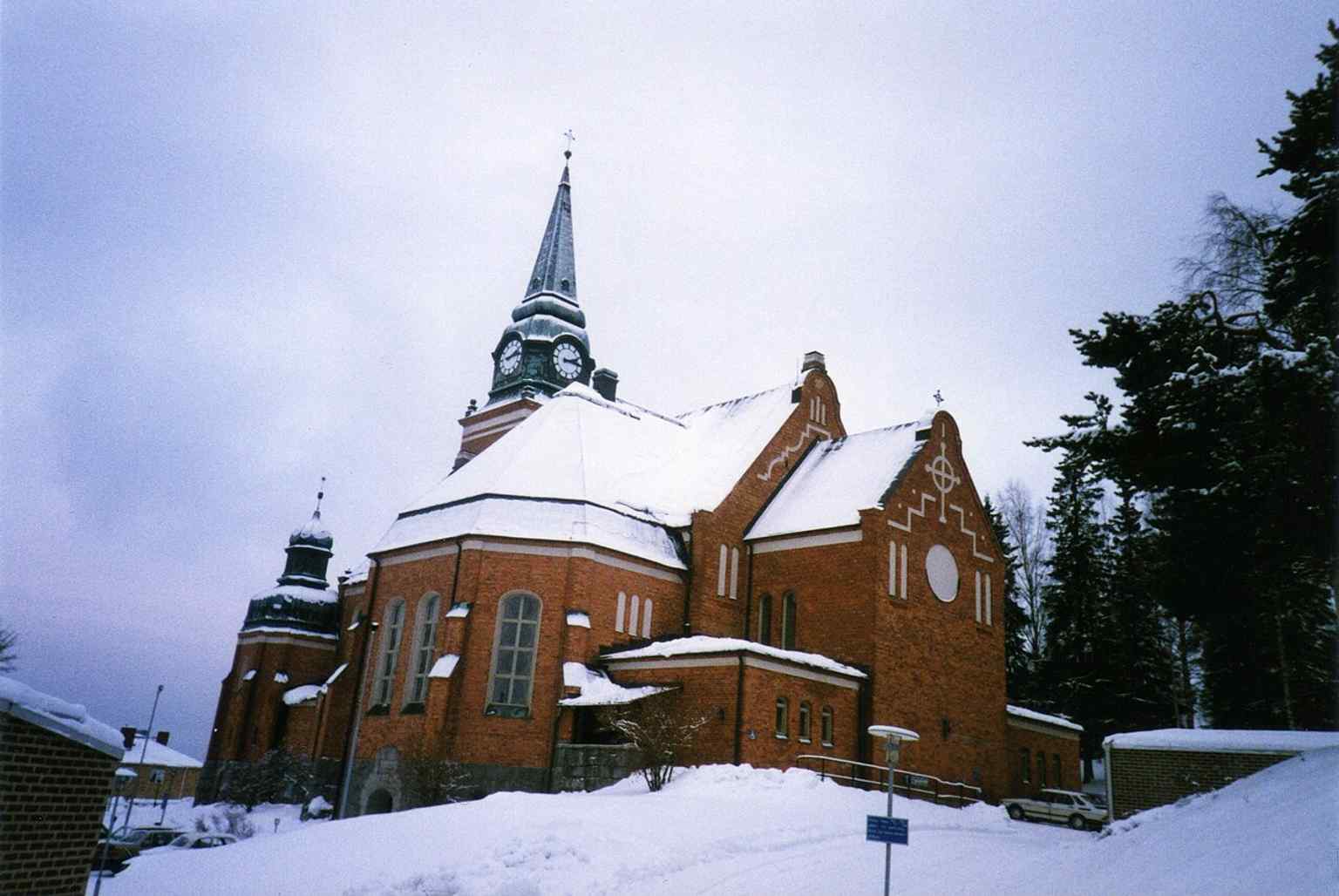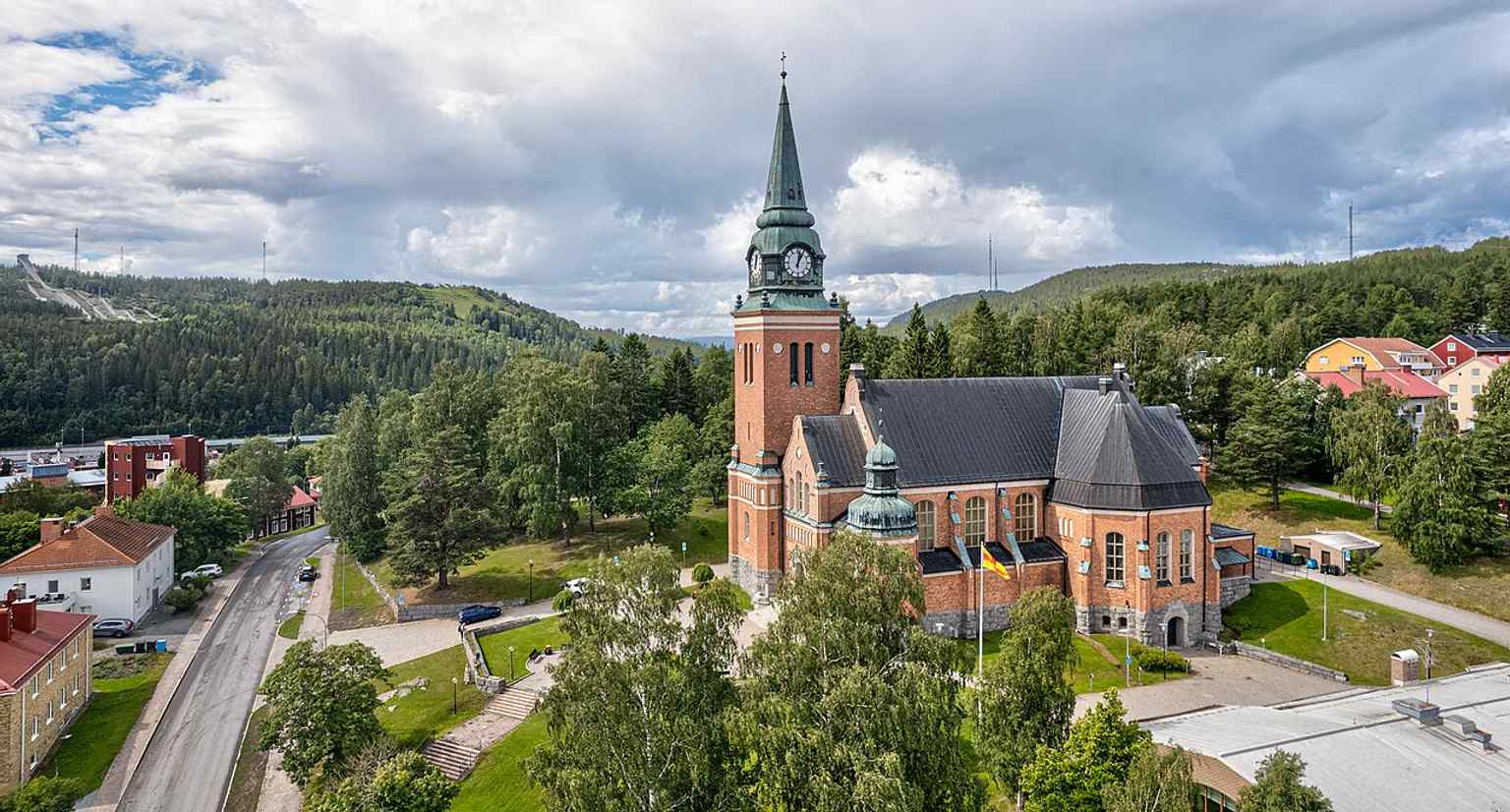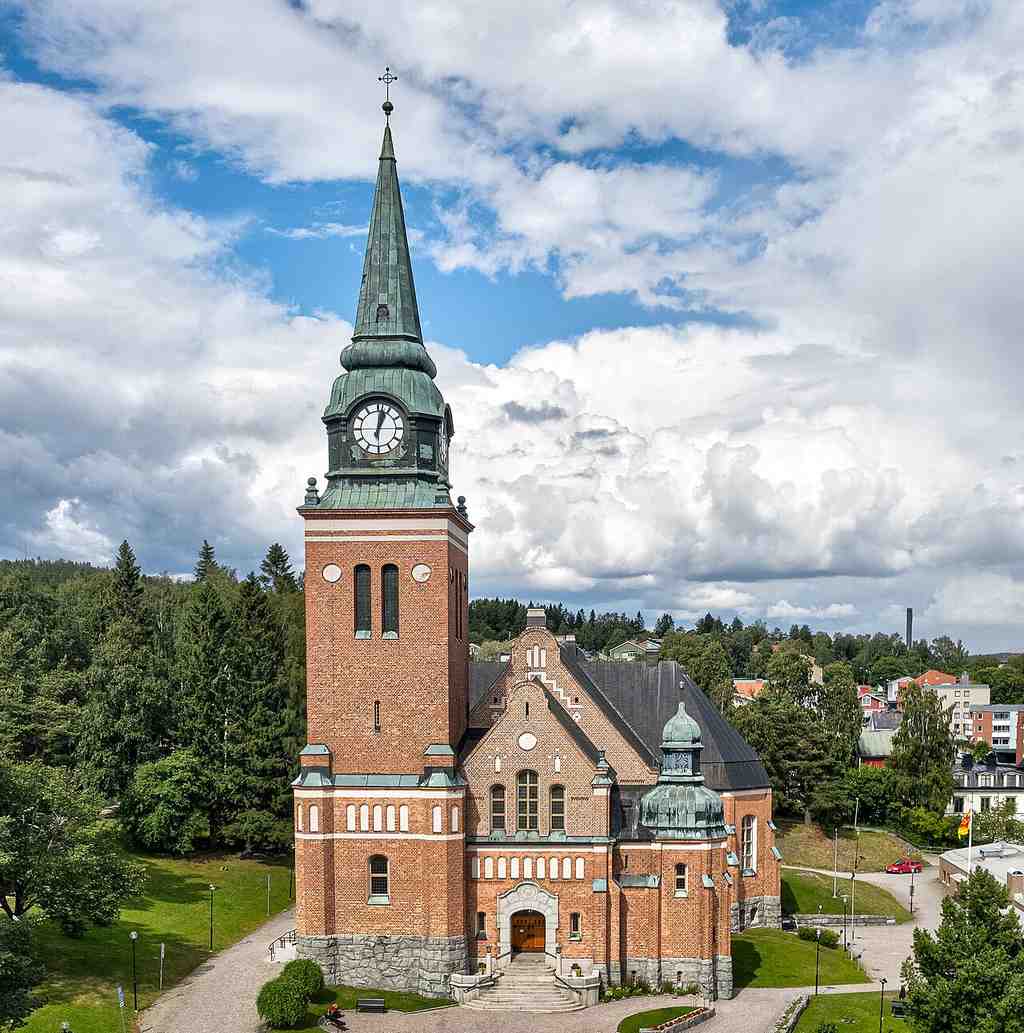
On your right, look for the light masonry church with its tall square tower, steep rooflines, and the carved stone relief set above the main entrance.
Örnsköldsvik gave itself this church in nineteen ten, and architect Gustaf Améen designed it to feel steady rather than showy... a landmark that could gather a growing town around one shared center. The church opened on the eleventh of December, nineteen ten, the third Sunday in Advent, and that timing matters. It entered local life not as a monument standing apart, but as part of the yearly rhythm of worship, work, and memory.
Above the main doors, the relief tells you a great deal about the building’s purpose. At its center is Christ, described here as the sun of grace, gentle and radiant. Around him are the four ancient symbols of the Evangelists, the writers of the Gospels: the lion for Mark, the angel for Matthew, the eagle for John, and the ox for Luke. Even before anyone steps inside, the message is clear. This is a church that teaches in images.
And inside, it keeps doing that. Much of the interior you would see today comes from a major restoration between nineteen fifty-three and nineteen fifty-five, when architect Martin Westerberg reshaped parts of the church, changed the colors, and introduced new furnishings. If you glance at the image on your screen, you can see the bright chancel painting, the space around the altar, called The Great Banquet. Sigurd Möller painted it in a dry fresco technique, showing Jesus’ parable of an open feast where the invited guests do not all come, and others are welcomed in instead.
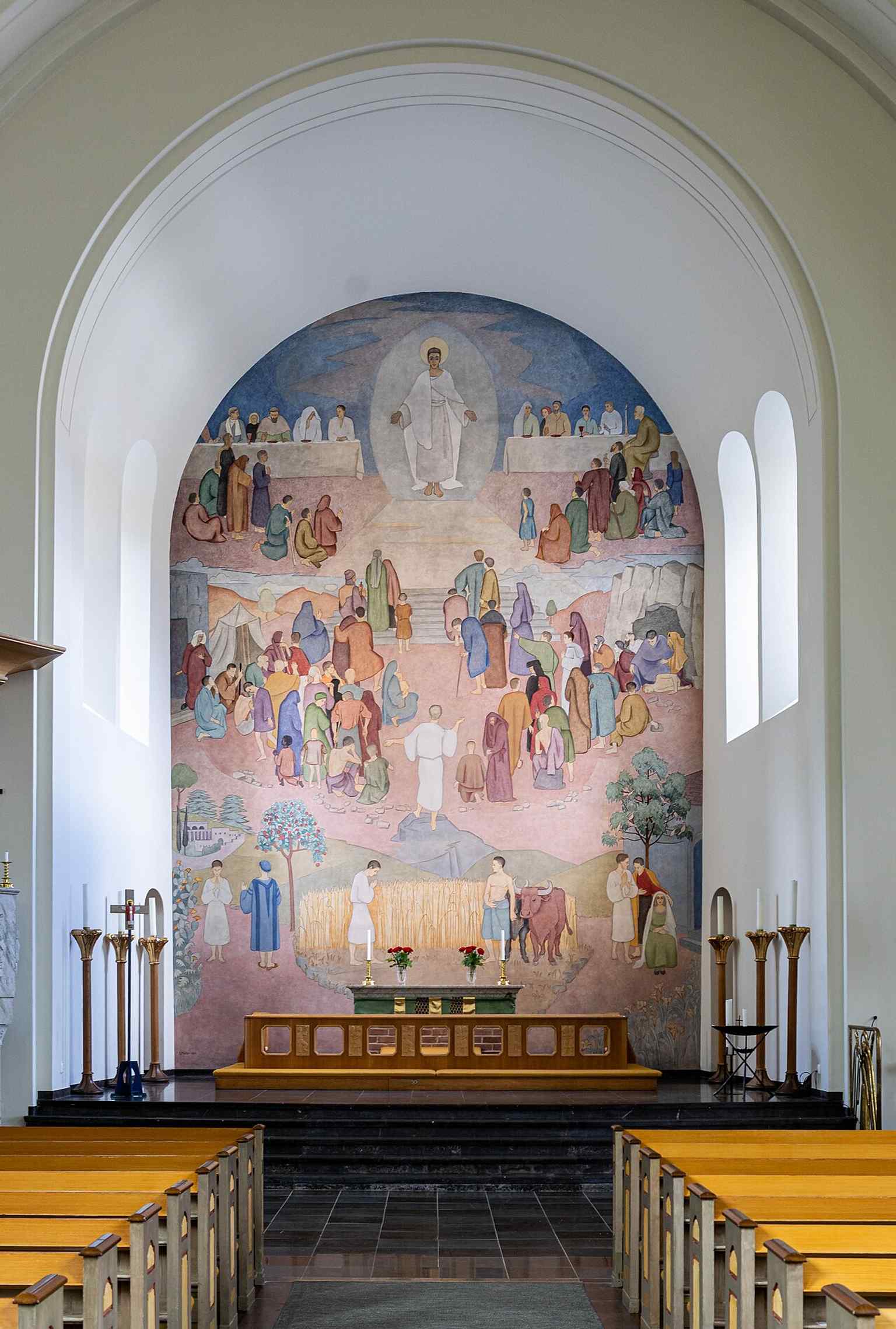
That spirit of welcome echoes through the details. Clarence Blum designed the sculpted panels of the altar rail, where a young woman carries grain and a young man gathers grapes, ordinary harvest turned into symbols of communion. The baptismal font, carved in granite by A-F Berg, stands beneath a votive ship, a model vessel hung in the church. In coastal Sweden, that ship remembers both the sea that sustained the region and an older Christian image: the believer carried across the rough waters of time toward safety.
One of the loveliest changes came later. In nineteen seventy-two, the north transept arm became a smaller chapel, often called the Sköld Chapel, after professor Otte Sköld’s sixteen medallion windows showing the miracles of Jesus. If you're curious, the before-and-after image in the app is worth a quick look; the church itself stays reassuringly familiar while the world around it shifts almost without announcing it.
Up in the tower, three bells still define the building’s public voice. They weigh one thousand six hundred and fifty, one thousand four hundred, and eight hundred and fifty kilograms, and their notes ring out as C sharp, E flat, and F... not just to call people to worship, but to mark the border between ordinary time and something set apart.
If you want to step inside later, the church is usually open weekdays from eight to four, and on Sundays from ten to noon.
This church holds the town’s faith, craft, and memory in one calm body. Take a moment with it... and when you’re ready, we can continue to the next stop.