
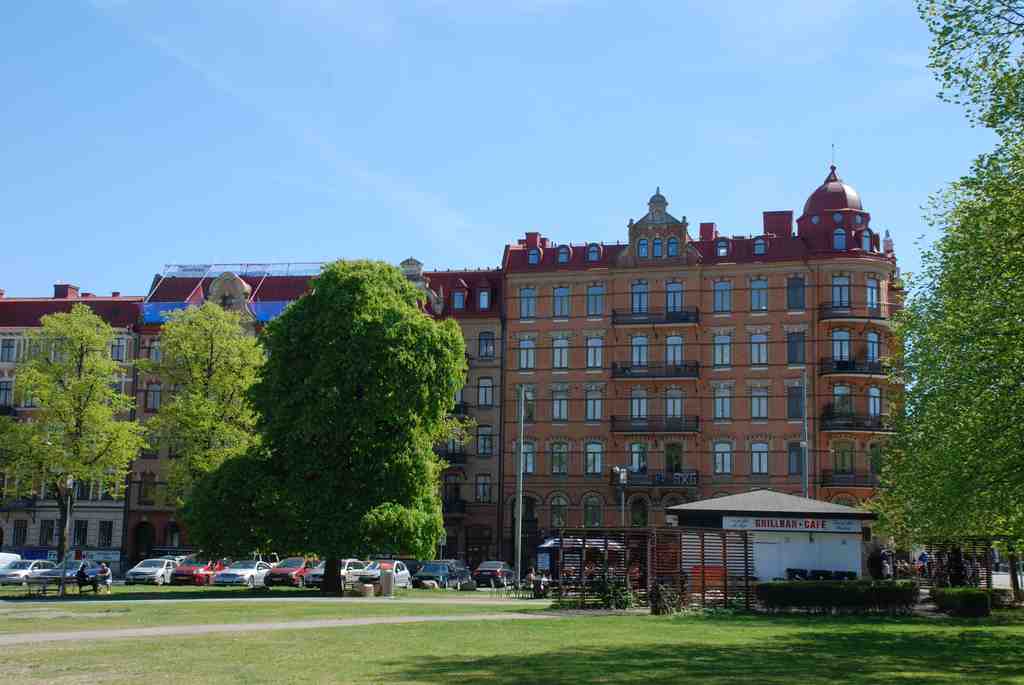
As you approach Heden, you'll notice a spacious green area surrounded by charming, multi-story buildings with beautiful red rooftops. Take a look at those red-roofed beauties, especially the ones adorned with turrets and decorative stonework. You'll see them standing tall around the lush greenery, making them easy to spot.
Now, let's dive into the story of Heden. This area, known originally as Exercisheden, is a district and a primary area in the Centrum district of Gothenburg. It borders Gårda and Bö to the east, Lorensberg to the west, Krokslätt to the south, and Inom Vallgraven and Stampen to the north. Its boundaries include Vallgraven, Fattighusån, Mölndalsån, Getebergs led, and Södra Vägen.
Covering 123 hectares, Heden has quite the history. It was once called Tegelbruksängen, where a Dutchman named Dr. Pieter á Naaldwyck established a brickworks in the 1620s. The brickworks was sold to the city of Gothenburg in 1629, and it wasn't until the 1850s that this activity ceased.
In the mid-1700s, the military started using Exercisheden. Over time, Gothenburg city acquired the land in 1892. With the dismantling of the fortifications along Vallgraven in the early 1800s, the area saw new developments, including Gamla Allén and Parkgatan, as well as Trädgårdsföreningen park in 1842. The first buildings along Sten Sturegatan were erected in the early 1880s.
In the '60s and '70s, many older structures were replaced with new developments, including the residential area east of Heden built in 1987. Skandia Insurance built its office in the mid-'70s in the central part of Heden.
A veritable melting pot of history and modernity, today Heden is home to landmarks such as Gamla Ullevi, Ullevi, Scandinavium, Valhallabadet, Filmstaden Bergakungen, Svenska Mässan, Liseberg, Universeum, and the Museum of World Culture along Eventstråket.
So, take a minute to soak in the vibrant blend of the past and present in Heden-where history, sports, and culture come alive!




