
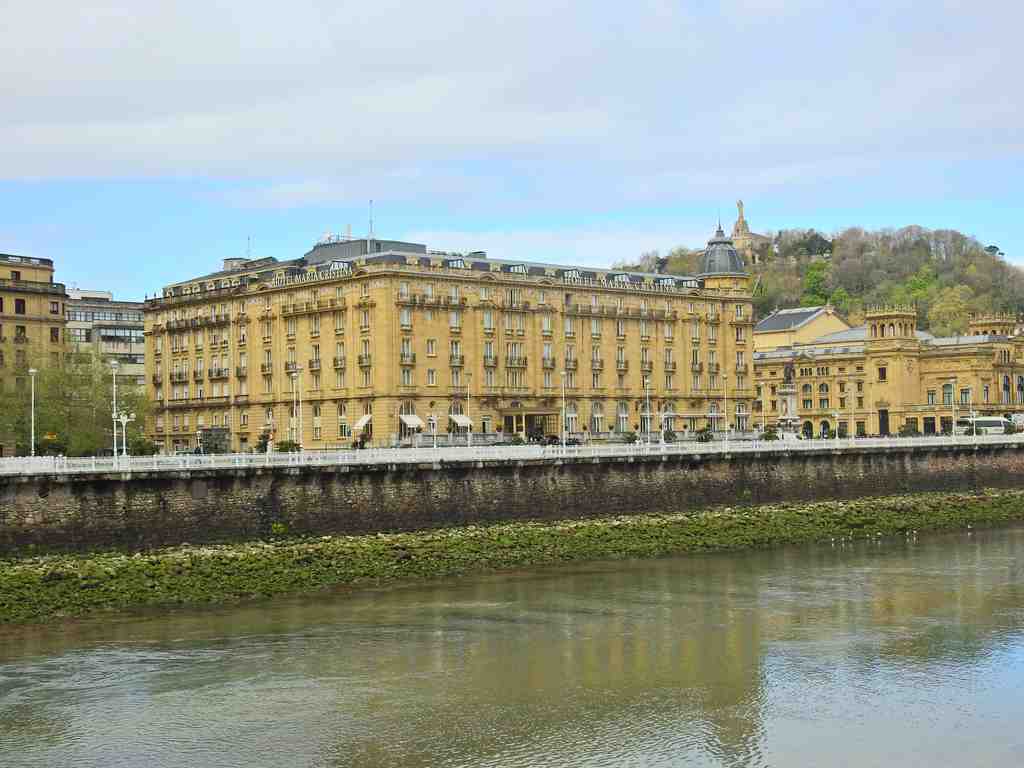
On your left, look for a long pale-stone façade with rows of tall rectangular windows, dark mansard roofs, and wrought-iron balconies, crowned by the name Hotel María Cristina above the entrance.
This is the moment when San Sebastián stopped behaving like a pleasant seaside town and began presenting itself, quite deliberately, to the world. Here, the city learned to perform in public through architecture: a grand hotel to receive the important visitor, a theatre beside it to display culture, and a riverfront setting broad enough for everyone to witness the entrance. It is not just a building you are looking at. It is a carefully arranged scene.
At the start of the twentieth century, San Sebastián was turning into one of the great playgrounds of the Spanish and European upper classes. The new planned expansion of the city had given it orderly streets and a distinctly French flavour, and a group of ambitious locals decided that style alone was not enough. In nineteen oh two, they formed the Society for the Promotion of San Sebastián and set themselves a clear task: give the city a luxury hotel and a major theatre, built together, as proof that it belonged among Europe’s fashionable resorts.
They chose this site in the old Zurriola gardens by the mouth of the Urumea. The city council handed over the land on one condition: after seventy years, both buildings would pass into municipal ownership. Construction began in nineteen oh nine. Charles Mewes, the architect known for several Ritz hotels in Europe, conceived the hotel; Francisco de Urcola directed the project and shaped the neighbouring theatre. Urcola matters here because he understood that these were not isolated commissions. They were a pair, a ceremonial urban partnership.
When the hotel opened in nineteen twelve, Queen María Cristina herself attended. That opening announced more than a business. It announced an era. During the Belle Époque, those decades of elegant confidence before Europe tore itself apart, San Sebastián became a meeting place for the well-heeled and well-known. Later, the hotel gathered an astonishing guest list: Trotsky, Mata Hari, Maurice Ravel, Coco Chanel, Bette Davis, Audrey Hepburn, Alfred Hitchcock, Steven Spielberg, Mick Jagger.
Then came the film festival, and the city’s performance acquired a new cast. Because the hotel stands so close to the theatre, stars could move from one to the other in a ritual procession that helped define San Sebastián’s international image. One of the people who knew that threshold best was the doorman Miguel Ángel Aldazábal. He started here in nineteen ninety and, in his first days alone, opened the door for Jerry Lewis and Peter O’Toole. In time he greeted Robert De Niro, Emma Thompson, and the Coen brothers, becoming almost part of the ceremony himself.
Yet this place has played more than one role. In July nineteen thirty-six, during the military uprising that opened the Civil War, the hotel briefly served as an improvised stronghold for right-wing sympathisers under Carrasco. In twenty twelve, it closed for nine months for a major restoration of about twenty million euros, polishing its Belle Époque character for a new century. And in twenty twenty, rooms once reserved for celebrities sheltered patients recovering from covid.
That, really, is the pattern here: the façade keeps its poise, while the city behind it keeps adapting. And just beside it stands the other half of this grand plan, the building that gave the visitors somewhere to be seen after they arrived. In about two minutes, we’ll step to the Victoria Eugenia Theatre.




