
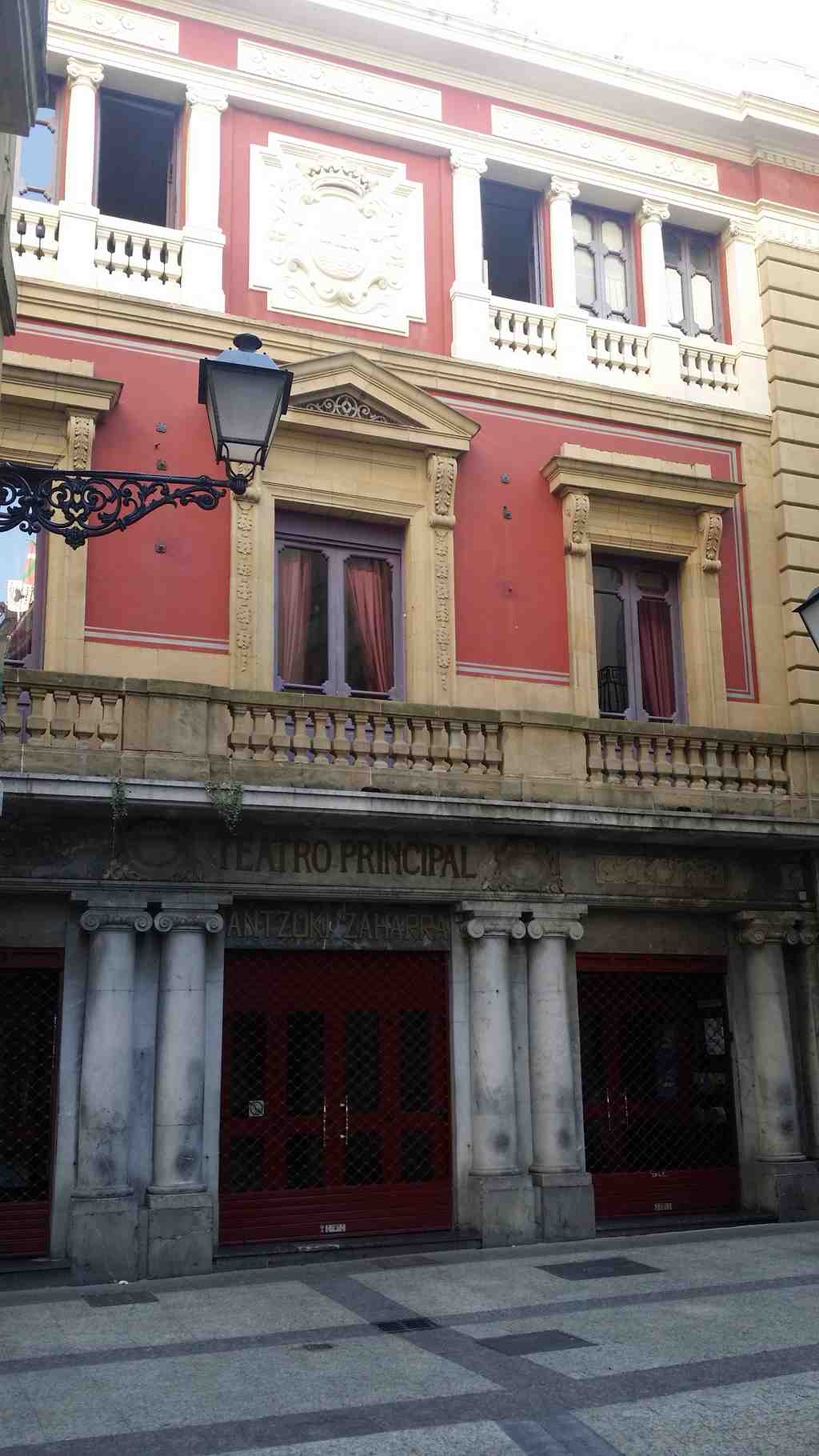
Look for a pale stone façade with three broad arched openings, a neatly balanced classical front, and the name Teatro Principal set above the entrance.
This theatre carries itself with modest confidence, and that suits its story rather well. Long before San Sebastián dressed culture in the grand elegance of Victoria Eugenia, the city already wanted a place to gather, watch, argue, applaud, and imagine together. In fact, one of its earliest theatres sat, from eighteen twenty-eight, inside a vault of the old wall - a cramped arched chamber with room for only about three hundred people and a stage so short that performers could hardly stride before meeting the edge of it. That detail matters. It tells you that theatre here did not begin in luxury. It began in necessity.
City leaders quickly decided that the little wall theatre was too small, too unsafe, and too remote for a growing town. So in November of eighteen forty-three, the municipal architect Joaquín Ramón Echeveste presented plans for a new theatre on this very site. Work began in eighteen forty-four, finished in eighteen forty-five, and even then the opening had to wait; the city still needed to buy the house next door to complete the plot. That practical shuffle feels very San Sebastián: culture advancing by inches, one wall at a time.
The first Principal opened in the eighteen forties and became the city’s oldest theatre. Then came repairs, fashions, and hard use. In January of eighteen eighty-three, José de Goicoa led a major interior reform. He replaced timber with more resistant materials to improve safety, pushed the stage deeper, and renewed the decoration. It helped, but not enough to save the old structure forever. By nineteen thirty, the building had deteriorated so badly that the city demolished it. A year later, Juan Rafael Alday completed the theatre you see now, giving it this restrained, classical air.
One man ties the place to flesh-and-blood memory more than any architect does: Bilintx, the poet and bertsolari - a maker of improvised Basque verse. He worked here for years, and he also lived in the theatre. During the Carlist siege, on the twentieth of January, eighteen seventy-six, a grenade burst through the window of his home here. There, in one brutal instant, performance and war collided. That is one of San Sebastián’s oldest habits: taking spaces shaped by danger, damage, and daily life, and turning them back toward shared experience.
And shared experience still defines the Principal. It seats five hundred and seventy-six people, with seven dressing rooms tucked behind the stage, and it hosts theatre, dance, music, children’s performances, and a vital strand of work in Euskera, the Basque language. From nineteen fifty-three until nineteen ninety-nine, it also served as one of the central homes of the San Sebastián International Film Festival, before that chapter shifted to the Kursaal. Even now, cinema keeps returning here through festivals and cycles like the Horror and Fantasy Week, Nosferatu, Surfilm, and Dock of the Bay.
From here, the story leans toward the harbor. In this city, public life rarely stays indoors for long; sooner or later, it spills toward the water. When you are ready, continue to Paseo del Muelle, about seven minutes away.




