
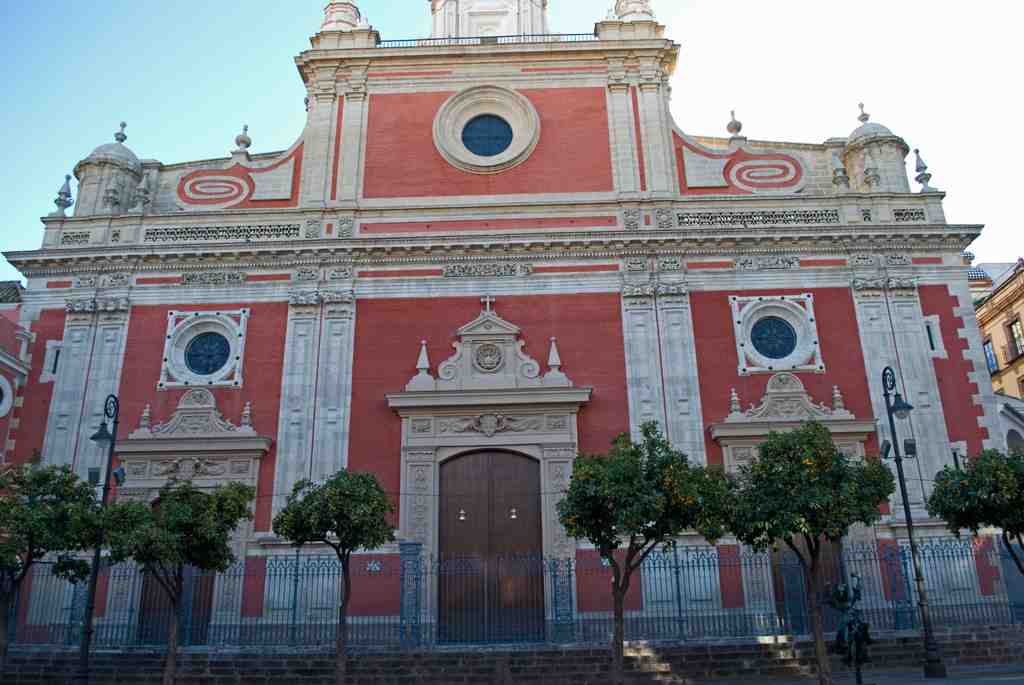
Look straight ahead for a tall, bold red-and-beige church with an imposing rectangular façade, decorated with white stone trim, circular windows, and guarded by rows of orange trees just outside a spiked iron fence.
Alright, you’ve made it to the dazzling Church of the Saviour! Picture the busy Plaza del Salvador just outside, alive with chatter and the sweet citrus scent drifting from the orange trees. Imagine this spot centuries ago, when the earth beneath your feet was still echoing with Roman steps and Moorish prayers. Legend once whispered there was a grand Roman basilica right here, though not a single archaeologist has found so much as a dusty brick from that era-talk about ancient fake news!
Now, let's add some drama! In the early 800s, a powerful mosque called Ibn Adabbás rose here, filling the air with the call to prayer each day. This was the heart of Islamic Seville for over three centuries, until in 1182, the local rulers decided there needed to be an even bigger mosque. The original was shut down, reopened, and by 1248-a thunderous year-King Ferdinand III of Castile swept into the city, taking the mosque and transforming it into a church dedicated to the Divine Saviour. Suddenly, monks and priests were bustling about, hammering altars into place and singing out sacred hymns that echoed off the new stonework.
Over the centuries, this church wasn’t just a house of worship-it became the city’s big musical hangout! In the 1500s, the choir swelled with voices, a huge wooden organ thundered beneath fingers, and even the local master builder was asked to whip up a new organ-though he had the misfortune of dying mid-project. Don’t worry, his replacement finished the job, and from the 16th to well into the 19th century, soaring melodies of sacred music rolled out over Seville, enough to make rival churches a bit jealous.
But time and gravity have a wicked sense of humor. By the 1600s, this whole building had sunken so far below the ever-rising street that folks had to walk down twenty steps just to get inside-and if you jumped high enough, you could smack the roof from ground level. Eventually, enough was enough-so in 1671, the old church was demolished. The next attempt, in 1679, ended in disaster when the entire building collapsed because the supports were taken away just a little too soon. Oops. Persistence pays, though! By 1712, under the creative eyes of two star architects from Granada and Seville, the church you see before you now rose elegant and proud.
Check out the main façade: its dramatic red walls, white trims, playful curves and swirls, all completed in a mix of baroque and a style called ‘mannerism.’ Inside, it’s a one-of-a-kind giant rectangular hall with columns decorated with castles and lions, topped by a dazzling octagonal dome that lets sunlight dance in and out.
Seville’s favorite saints and stories are everywhere here. There are 14 intricate altarpieces within. In the grandest is the amazing ‘Transfiguration of Jesus’ scene, flanked by golden angels and mighty archangels with names that sound like they belong in a Marvel movie (Jegudiel, Barachiel, Sealtiel, and friends). There’s also a revered Christ of Love, a beautiful Madonna called the Virgin of the Waters, and a silver-embellished altar once called upon for help during storms, floods, and droughts. The local people would gather here, voices tense and hopeful, when the rain wouldn’t stop, the clouds wouldn’t come, or when ships needed protection far across the seas.
Over time, the church’s status flip-flopped from ultra-important 'collegiate' church back to regular parish, and survived more near-calamities than you can shake a hymnal at. Even in modern times, the church needed a superhero-style restoration, finished in 2008 and celebrated by royal visitors and the city’s grandest leaders.
Want even more secrets? Behind the main altar, there’s a tiny museum packed with extravagant 17th-century art. And outside, you’ll find a wooden cross at the corner-legend says it never had anything to do with snakes, despite what modern myths claim.
This is no quiet corner of the past-it’s a spot where civilizations and centuries collide, and a street artist or two might still strum a guitar in the shadow of that incredible Baroque façade. Seville wouldn’t be Seville without it!
For a more comprehensive understanding of the description, brotherhoods or the see also, engage with me in the chat section below.




