
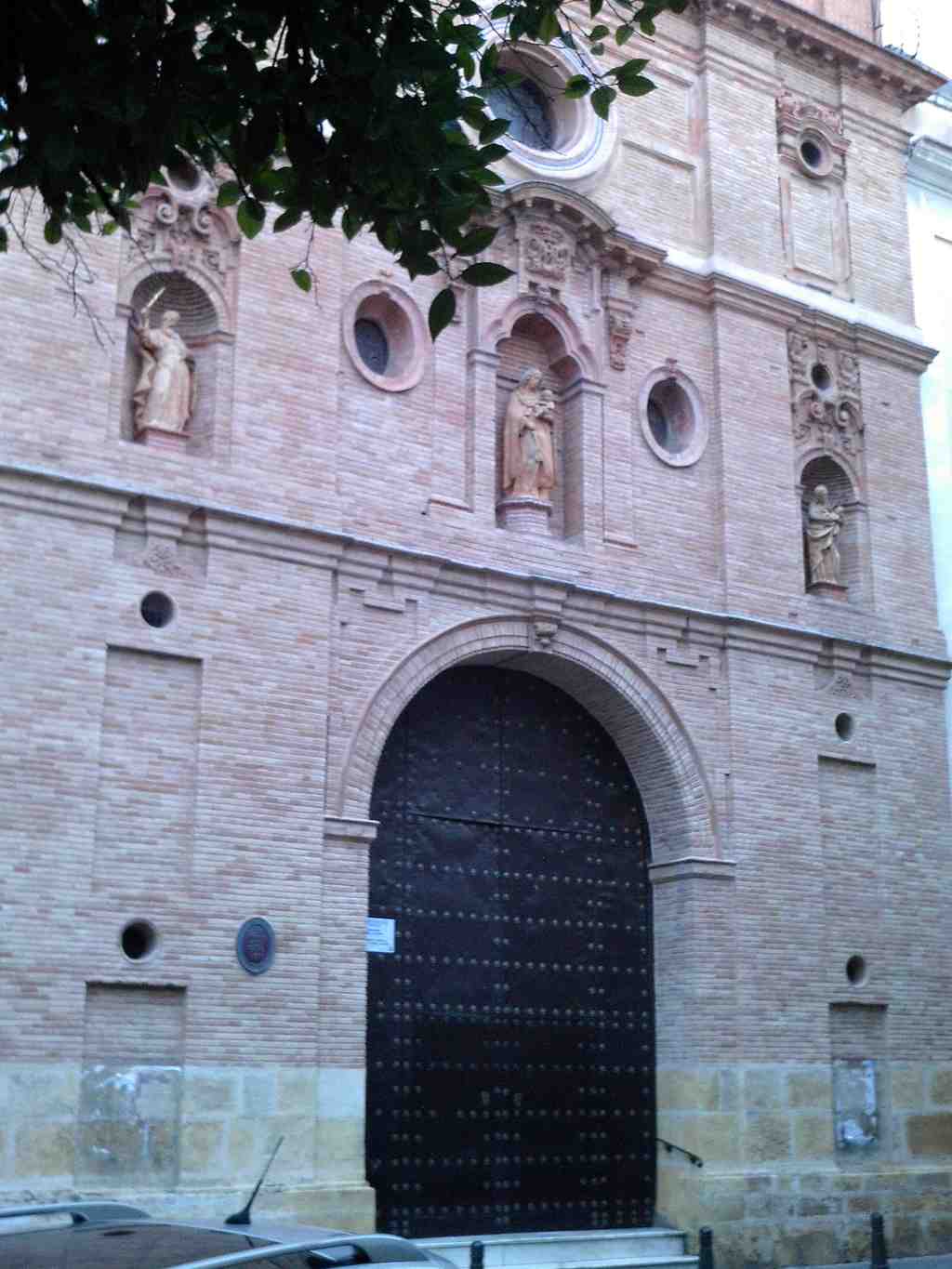
Just ahead, you'll spot the Church of Buen Suceso by its striking, warm brick façade with three levels, round windows, and three statues perched above a grand, dark wooden arched doorway-like guardians from another era keeping watch over the street.
Now, imagine for a moment the swirl of centuries right where you’re standing-the Church of Buen Suceso has watched Seville change, endure, and reinvent itself since the eighteenth century. Take in the beautifully restored brickwork, dotted with round windows and framed by those three statues: the Virgin of Carmen is in the center, flanked by Saint Joseph with the Child and the Prophet Elijah. These figures, sculpted much later by a local artist, add a dash of modern spirit to this age-old façade-because apparently, even churches like a makeover every few centuries!
Originally, this wasn’t just a church. Back in the 1600s, the site buzzed with the compassionate chaos of a hospital run by the Brothers Hospitallers-local folks called them "los obregones," following the vision of Bernardino de Obregón, who believed that recovering patients deserved dignity, care, and a bit of hope. Their mission took them from Madrid, where they cared for convalescents, all the way here to Seville. And just wait for this twist: as two of their brothers made a nerve-wracking journey to Rome to get approval for their habits, a wild storm forced them to hide among rocks in the mountains near Traiguera. There, they stumbled upon a statue of the Virgin Mary. When they presented this statue to Pope Paul V, he declared, “Brothers, you’ve had good success on your journey; may your request have the same!”-and gave them a golden cross for the statue as a symbol of their new luck. From this miraculous discovery, the devotion to the Virgin of Buen Suceso was born-a story worthy of its own adventure novel!
The hospital’s first chapel crumbled so badly that it was demolished in 1690 (talk about calling for a renovation). The new church, the one you see here, was inaugurated in 1730 with eight straight days of festivities-the city probably ran out of confetti by the end. The red marble columns inside, carved by the renowned Pedro Roldán and his son, prop up a nave that sparkles with thirty-six vivid canvases by Domingo Martínez. The main altar once held the legendary statue of the Virgin of Buen Suceso, a symbol of the original miracle, which sadly vanished in the 1800s. Like the best mysteries, nobody knows where she went.
This building has survived more plot twists than a soap opera. When the hospital was closed in 1835, the church faced demolition, but was saved thanks to the town’s charity board. It turned into a boarding house (with a church attached, naturally) and later even served as a meeting hall for local militias. Monks, nuns, even revolutionaries-every decade, someone new claimed these walls as their own.
Since 1896, the Carmelite Order has called this place home. They’ve seen hard times, especially in 1931 when the church was looted during political unrest, and priceless artworks were lost or destroyed. Yet the spirit of Buen Suceso remains strong. The current statue of the Virgin of Carmen-by Rafael Barbero-processes through the neighborhood every November, sharing hope, memory, and just a bit of theatrical flair.
Inside, if you ever step out of the busy street and into the cool hush, you’ll find sculptures by legends like Alonso Cano and Juan Martínez Montañés. Their saints, still gazing faithfully through centuries of change, prove that caring for the sick and the suffering is never out of fashion-even after all this time.
So whether you’re here for architecture, art, or just a good story, the Church of Buen Suceso never runs out of surprises. And that’s no accident-it’s just what happens when miracles, mystery, and a little bit of stubbornness all come together, right in the heart of Seville.




