
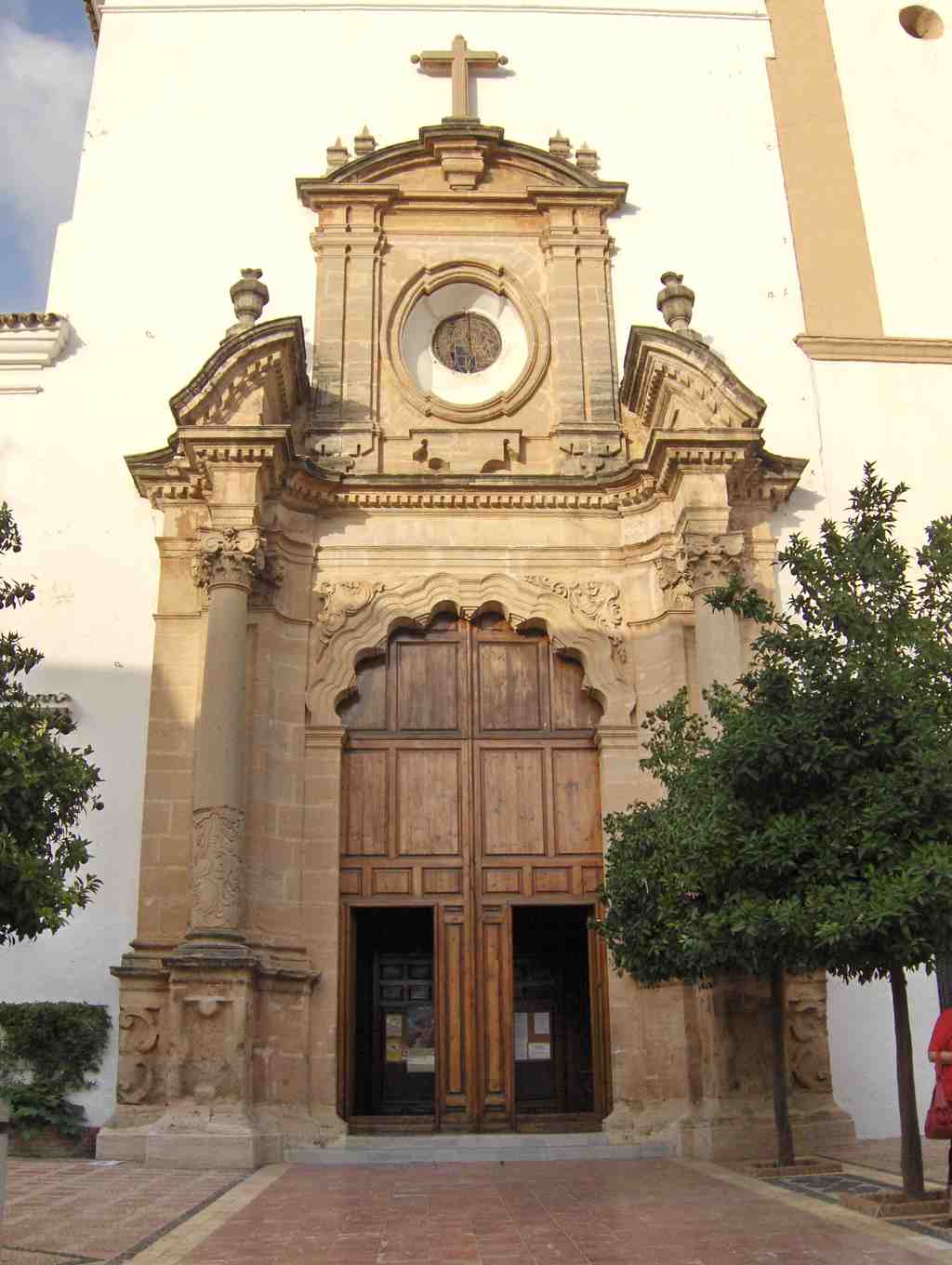
In front of you, you’ll spot the Church of the Incarnation by its grand ochre stone entrance with tall, wooden doors framed by decorative columns, set into a pristine white wall-just look for the impressive cross above the doorway and you’ve found it.
Welcome to one of Marbella’s true treasures! Standing before this mighty façade, imagine the air thick with centuries of stories. Right here, after Marbella was retaken in 1485 by King Ferdinand the Catholic, everything changed-and not with the usual clanging of swords, but with the scratching of pens and rustle of parchment. Where you’re standing was once likely a mosque, but after the Christian conquest, its walls were claimed for a new purpose. In honor of the kings’ devotion to the mystery of the Incarnation, the church took its name-and its role as the town’s spiritual heart.
By 1505, the Archbishop of Seville gave it the official thumbs-up, and just a few years later, it grabbed the prestigious title of “big boss” as the main church of the area. They wasted no time jazzing it up: a gorgeous altarpiece was carved in 1594 (commissioned for the whopping sum of 25 escudos-how’s that for a bargain?), bringing more than a dash of splendor to the now Christian sanctuary.
But Marbella’s luck, like the church’s ceilings, was prone to cracks. By 1618, a bishop from Cordoba, Luis Fernández de Córdoba, decided it was time for a showstopper. He either stretched the old minaret skyward or built a brand-new bell tower, hoping his name (and a bit of Latin flair) would live forever on a stone plaque. This was a spot meant to be seen-and heard, with the four-tier bell tower reaching about 50 meters high, topped by a pyramid-shaped spire and a weather vane shaped like an angel-a symbol of faith forever spinning in the gusty Andalusian winds.
Still, by the 1700s, the church was showing its age. Leaky roofs, crumbling sections, and a desperate need for more elbow room led to a whole new rebuild starting in 1750. Imagine the clatter of chisels and lifting of massive stone slabs dragged from a local quarry-so famous that years later, the name stuck even as the quarry itself vanished beneath new homes. By 1767, the new church swung open its doors, ready for a grand debut. If you were here then, you’d hear the hubbub of townsfolk as the Eucharist was placed in its new home-though probably also the groans when the vaults started falling in and the upper part of the tower collapsed just years later. Let’s just say, construction projects never go quite as planned, even in the 18th century.
Through wars and revolutions, the Church of the Incarnation was both sanctuary and casualty. In 1813, the town clock arrived from England and found its home in the bell tower. Just imagine the tolling each hour, keeping time for generations. Then, disaster struck in the 1930s during the violent ‘burning of the convents’, when flames engulfed precious art, records, and memories, collapsing part of the building itself. But Marbella rallied-locals, rich and poor alike, brought their money, stones, and sweat, patching up their beloved church by 1937, making it stand proud once more.
Innovation marched on. By the 1970s, the church gained one of Spain’s finest organs, with pipes of tin, copper, and wood-built not just for music, but for awe. The great organ’s thunderous sound fills the air to this day, echoing the devotion-and determination-of locals determined to keep their heritage alive.
Changes kept coming-new marble floors, fresh paint, stronger structures for the bells, and more. In recent years, screens were installed along the side aisles so everyone, even those packed in on festival days, could catch every moment. The silver lamps shining above? Restored to perfection. Even the angel atop the tower got a new lease on life, rotating gently in the breeze, a true local celebrity of the skies.
And here’s a twist-the church’s elegant exterior was chosen as a filming spot for the Netflix series Warrior Nun in 2020. Now, its story is known not just to Marbella, but to the world.
So as you gaze at the proud ochre stone portal and feel the hum of history around you, imagine bells chiming, candles flickering, and the flutter of ancient pages-this is a place that has seen empires, miracles, and enough drama to fill a cathedral-sized soap opera!




