
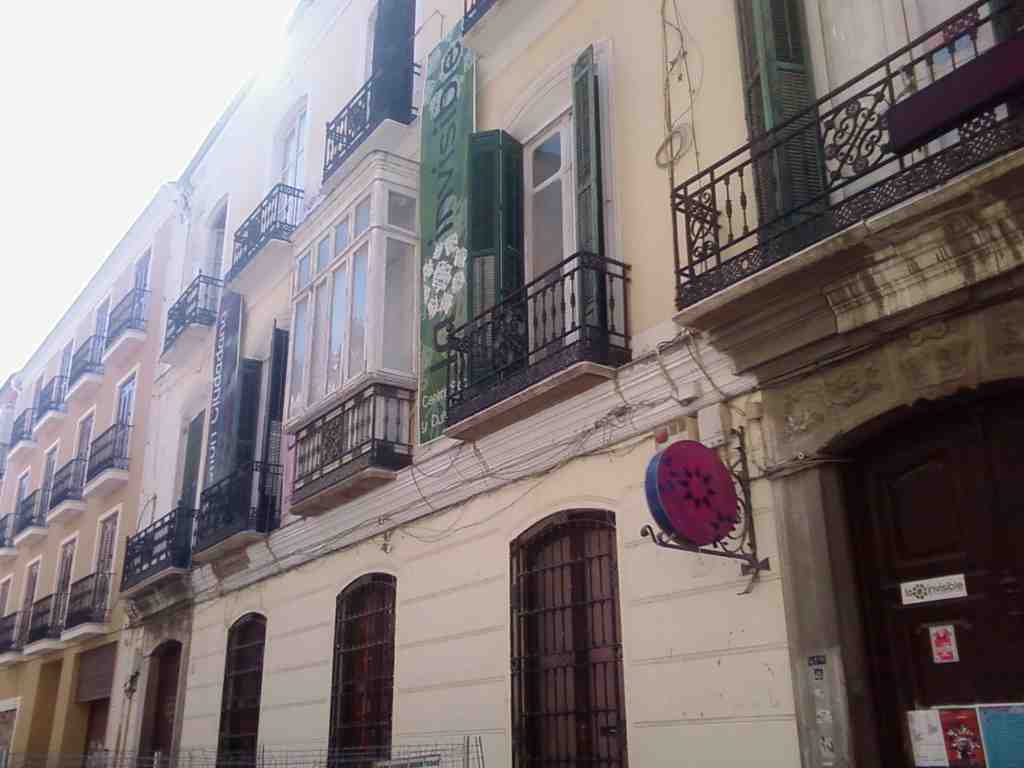
To spot The Invisible House, look for a tall, elegant 19th-century building with cream walls, long green shutters, wrought iron balconies, and banners draped from the upper floors-all right here on Nosquera street.
Alright, take a moment to soak in this rather “invisible” sight-don’t worry, it’s just a name, not a magic trick! Strange as it might sound, The Invisible House has become one of Málaga’s most spirited landmarks, hiding in plain sight with a flair for making noise right where you’re standing.
Picture it: the year is 2007, and a wave of creative energy is stirring here on Nosquera street. The building in front of you, finished in 1876 for Málaga’s nineteenth-century bourgeoisie, is suddenly buzzing as a network of neighbors, artists, and dreamers decides to “occupy” its forgotten corridors. What these citizens want isn't secrecy or silence, but to spark real change. They turn this classic townhouse, right inside the city’s old Muslim walls, into a social and cultural laboratory-one fueled by debates, music, dance, and activism.
It might look peaceful now, but imagine the bustle inside: 2,000 square meters split between historic salons and a sun-splashed courtyard-home to a mighty mulberry tree, ivy twisting up the walls, and a gathering of all sorts of plants. Locals and visitors gather under the greenery, exchanging ideas and plotting how to make their voices heard. In a city quickly modernizing and changing, with many older spaces bulldozed or glossed over for new shops, The Invisible House stubbornly refuses to become another anonymous facade.
After their bold occupation, the group faced a tug-of-war with Málaga’s city council. Endless meetings, complex paperwork, promises made and retracted-all the bureaucratic drama you could imagine. There was even a temporary agreement reached in 2011: the city, the region, and even the National Museum Reina Sofía recognized the space’s worth. In exchange for detailed reports and forming a foundation, Casa Invisible would stay open, becoming a beacon of creativity and dialogue. For years, the place pulsed with life: seminars, classes, debates, music, theater-you name it. Diverse collectives found a home, from the “Invisible Creators” to housing activists. Each spring after its founding, the Casa hosts the Free Culture Festival, challenging the city’s more commercial cinema scene and celebrating freedom of expression.
Not everyone has loved its rebellious streak. In 2014, for example, the city sent in police to shut down all open-invitation events over “safety” issues-right before Christmas, as a not-so-merry gift. The Casa fought back, holding a press conference the next day in the street and promising to reopen with renewed determination. Legal battles and the threat of eviction have loomed ever since, even as official reports support the Casa’s mission. The tension only sharpens its reputation as a defiant heart of the city, sheltering people and ideas that might otherwise be swept away.
What makes it special isn’t just the drama, though-it’s the layers of life within its walls. The Casa’s courtyard has become one of the most loved corners in all Málaga, offering not just shade but a sense of belonging. The House’s self-managed structure is a marvel in itself. Everything runs on open assemblies-democracy in action, quirkiness included. If you want to dive into culture, politics, new technologies, or just hear some wild ideas, this is your lab. And don’t be surprised if you bump into someone famous; artists, philosophers, even Nobel laureates have passed through, lending their voices and support.
Here, you can almost hear the clatter of late-night debates and the buzz of another big idea taking shape. The Invisible House isn’t invisible at all-it's just been waiting for another curious mind like yours to step inside and see Málaga’s living history unfold. Shall we move on before it disappears again?
Intrigued by the building, objectives or the activities? Make your way to the chat section and I'll be happy to provide further details.




