
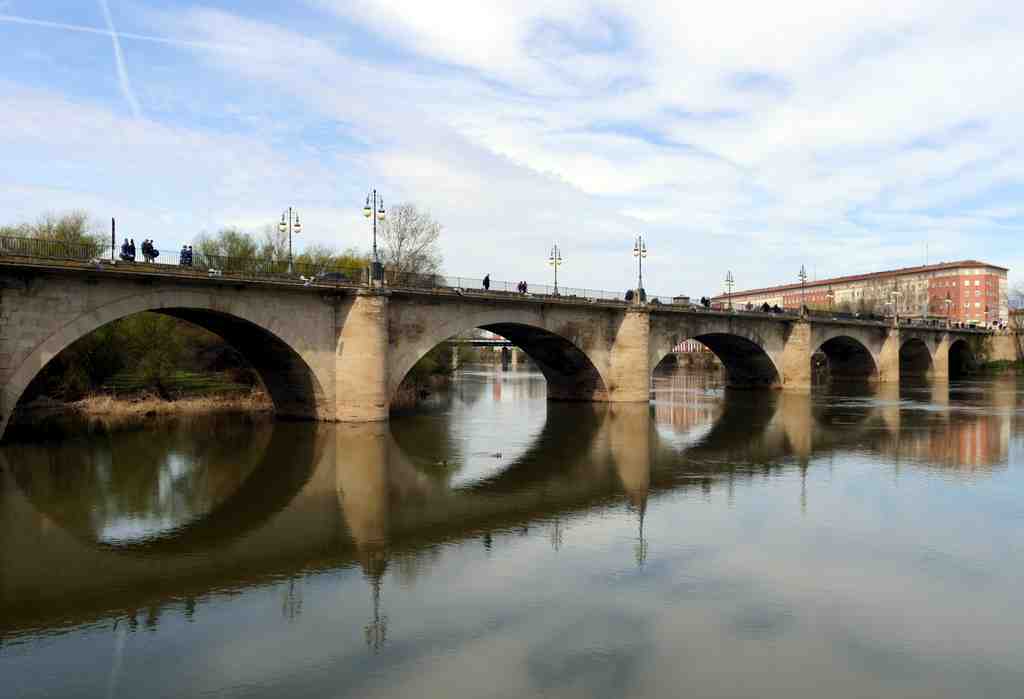
To spot the Stone Bridge ahead, look for a long, gently curved structure made of pale grey stone with seven large arches stretching across the wide river and crowned by classic-style streetlamps.
Welcome to the legendary Stone Bridge of Logroño, where history whispers with every step and the old stones could probably tell you more stories than your grandma-if only you spoke “bridge.” As you stand here, take a moment to imagine the swift current of the Ebro at your feet, and the echo of centuries passing overhead.
This isn’t just any bridge; it’s the grand gateway of Logroño and a proud symbol of the city itself-you’ll even spot it on the town’s coat of arms. Hundreds of thousands have crossed here, from medieval pilgrims weary on their way to Santiago de Compostela to everyday locals searching for the city’s best churros. But centuries ago, if you’d arrived in Logroño, you might have found a bridge of a very different shape-one bristling with twelve mighty arches, three imposing towers, and at times even a drawbridge, ready for knights, merchants, and maybe a stray goose parade.
In fact, no one really knows exactly when the very first bridge graced this spot. The oldest record dates all the way back to 1095-so if these stones creak in the wind, it might just be their knees. Legends say it was Saint John of Ortega, namesake of a vanished chapel on the far bank, who oversaw the bridge’s earliest construction, making sure pilgrims could cross safely on their epic journeys.
Centuries of war and water did their best to unseat the Stone Bridge. Medieval chroniclers marvelled at the twelve arches-each one 46 feet wide-spread like giant stone wings over the river. The bridge’s three towers acted as sentinels; the story goes they could house up to 40 armed men, keeping lookouts through narrow slits and storing heavy chains for a drawbridge, just in case any unfriendly visitors tried to pop by uninvited. Imagine the shouts of guards and the clanking of iron-crossing here must’ve evoked more nerves than a school exam!
But water always wins in the end. In June of 1775, the Ebro rose up, drowning the bridge beneath its wild torrent and crashing down the first tower. Then came wars-when one arch was torn out and swapped with a rickety wooden substitute. By the time the 19th century rolled around, the bridge’s towers were gone and its fate hung by a thread, until finally, in 1871, another flood claimed three more arches. At this point, the city’s patience was wearing thinner than a tourist’s flip-flops.
Resourceful locals built a temporary wooden crossing-sometimes using little more than boats and planks! There’s even a tragic tale: in 1880, a group of artillery men crossing on a floating platform lost their balance. The vessel tipped, pitching the soldiers into shallow water. Despite the river being only waist-deep, panic and chaos struck; ninety lives were lost that day, and the whole city was shaken.
Seeing how vital this crossing was, the government acted swiftly. There was a short-lived “Sagasta Bridge” made of wood, then a bold, elegant iron bridge. But Logroño couldn’t let go of its “stone stronghold” heritage! Enter engineer Fermín Manso de Zúñiga, a name as sturdy as his plans. He set about building the structure you see now, completed in 1884 and designed with seven graceful arches, elliptical vaults, and stone brought in part from the ancient remains and in part from quarries near Laguardia.
The bridge stretches almost 200 meters long, its arches anchored by stout, round pillars-ready to meet any stubborn flood. The city didn’t stop there: in 1917, they widened the passage with cantilevered walkways so today’s traffic (and tired pilgrims) have plenty of room. Over the decades, the Stone Bridge has seen more face-lifts than a movie star. The latest upgrades, as recent as 2020, added glowing, color-changing lights-so some nights, the bridge looks like it’s celebrating a festival just for you.
Take in the views, listen to the river, close your eyes for a second. You’re standing at the true heart of Logroño-the path of pilgrims and conquerors, the stage for age-old dramas, the stone spine of the city. Cross this bridge, and you’re walking in the footsteps of a thousand years. Now, onward to our next stop, where science awaits-just don’t try to build your own bridge on the way, alright?


