
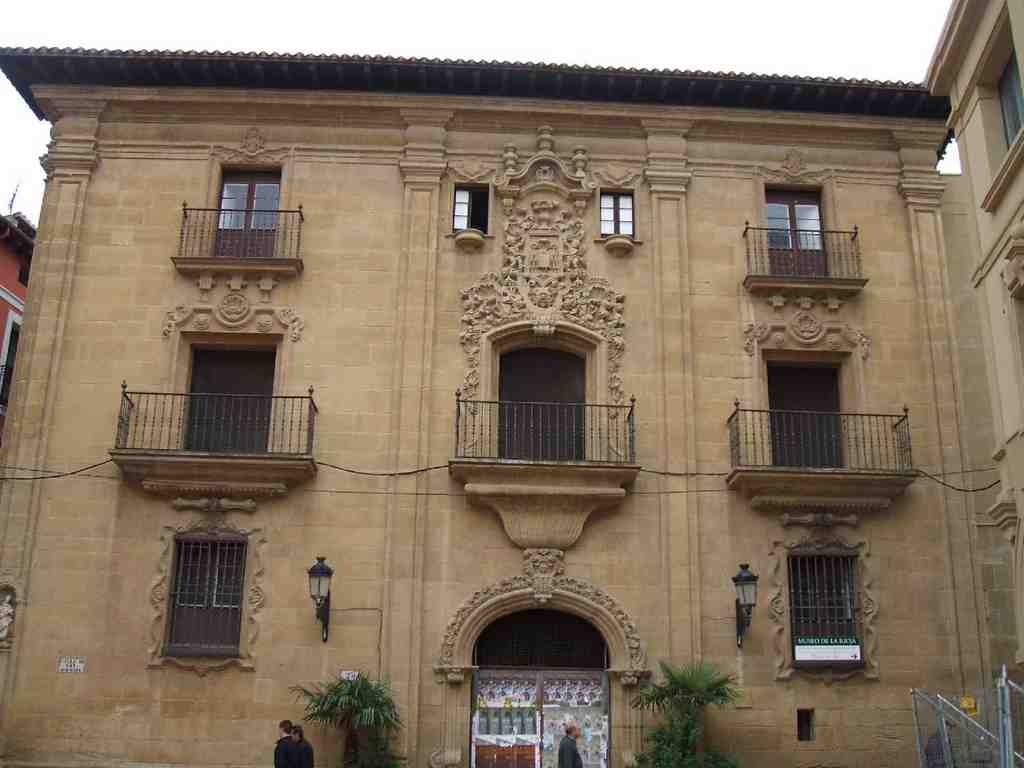
Right in front of you, you’ll spot a grand, stone building with a strikingly ornate central balcony crowned by a large decorative coat of arms-just look for the neoclassical façade with symmetrical windows and wrought iron balconies standing out proudly in the heart of Logroño!
Now, take a deep breath and picture this: it’s the 18th century, and the air is buzzing with the sounds of construction--as Pedro Ruiz de la Porta, ruler of Logroño, oversees the creation of his gleaming new palace. This isn’t just any home; this is the building that would one day be woven into the heart and soul of La Rioja’s story. Its thick walls, balustraded balconies and grand central tower know secrets, drama, and even a bit of noble gossip, oh yes!
Fast forward a century or so-imagine the elegant footsteps of General Baldomero Espartero echoing through the halls. Espartero, a Spanish war hero and political heavyweight, settles here after hanging up his sword and marrying María Jacinta Martínez. You can almost hear his boots clanking down the staircase as he escapes the turbulence of politics for domestic calm... But well, as you might expect, peace in a palace like this is always in short supply! The building soon earns a new name: Palacio de Espartero.
But don’t get too cozy, because the palace is about to embark on quite the adventure. Upon the deaths of Espartero and his wife-who, by the way, had no children to inherit their stately home-the palace passes to Vicenta Martínez de Sicilia, the Marquesa de La Habana, a relative with a taste for both adventure and real estate deals. She rents this splendid place to the state, and soon--the palace transforms into government offices and even the home for Logroño’s bishop (well, at least in theory; the bishop preferred his digs in Calahorra and never moved in).
If these walls could talk, they’d laugh-because next comes a parade of tenants. At the turn of the 20th century, children’s laughter fills the corridors as the Asilo de Santa Rosa moves in, a safe haven for the kids of the hardworking women in Logroño’s nearby factories. The sound of tiny footsteps and laughter would have echoed down those grand staircases. Then, a few years later, the building hosts the House of the Infant Jesus, a savings bank, the Chamber of Commerce, and even an artistic circle. This palace always found a way to stay busy-even as plans to turn it into a fancy archive fell through. If you ever feel indecisive, just remember: you’ve probably never been used by this many people for so many different things in your whole life!
In 1962, someone finally has the bright idea to just call it a monument (about time, right?), and by 1971, after nearly two centuries of changing hands, the grand doors open to the public as the Museo de La Rioja. For the first time, art, history, and the stories of ordinary people all gather under one elegant roof.
And what a collection lies inside! You’ll find glorious 19th and 20th-century paintings, medieval treasures, and the showstopper: the fourteenth-century Tablas de San Millán. These painted panels-which used to be doors on a monastery altar-are masterpieces of gothic art, alive with images of the Virgin Mary, Jesus, and San Millán. If you can picture a world of glittering gold leaf, mysterious monks, and medieval devotion, you’re in the right mindset.
The museum is still a place full of surprises: wooden statues, ancient furniture, archaeological finds, and objects showing the everyday life of Rioja’s people-farmers, craftsmen, and families whose hands shaped the very landscape around us.
But it wouldn’t be a proper Spanish museum without a plot twist, right? When 21st-century architects decide to upgrade the building, sparks fly between regional and central governments-some want to gut the place, others to keep its ancient heart beating just as it is. After years of debate, stress, and dust (trust me, lots of dust!), a plan is finally agreed upon. The museum grows, modernizes, and, in October 2013, throws open its doors for a whole new era.
Now, as you stand outside, take a moment. Imagine the footsteps, the secrets, the laughter, and the passionate debates that have echoed here for over 250 years. This palace, now a museum, is a true survivor-filled with layers of memories, drama and, of course, a treasure trove of La Rioja’s rich and colorful story.


