
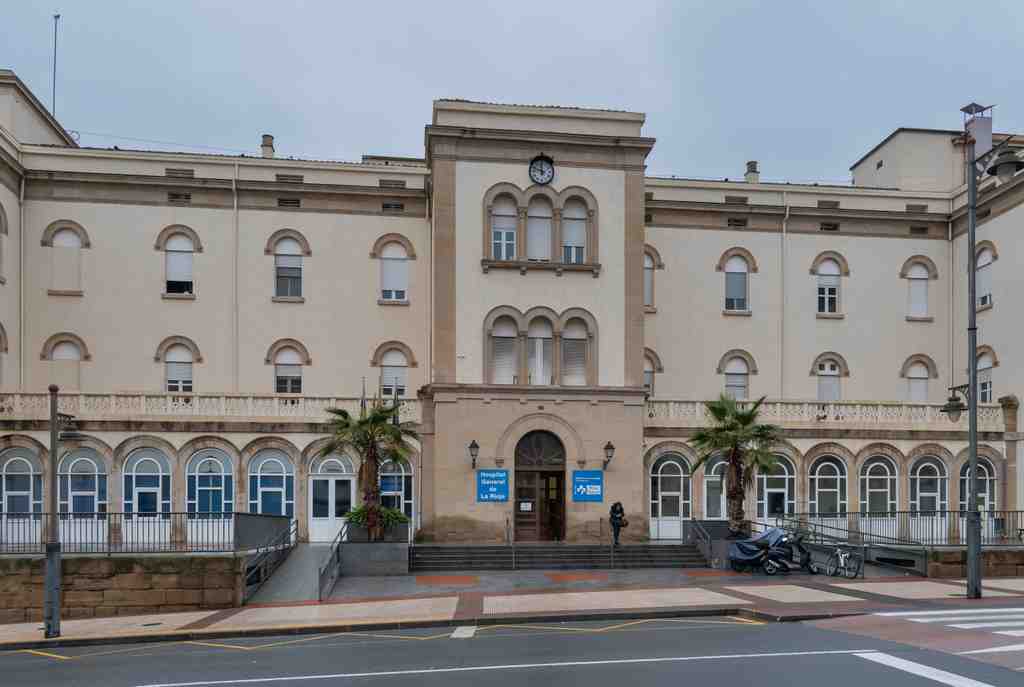
To spot the Hospital General de La Rioja, look straight ahead for a large, pale stone building with three floors, a central tower topped with a clock, and elegant arched windows all along the facade-it’s unmistakable against the cityscape and sits just behind the palm trees near the entrance.
Welcome to the oldest working hospital in all of La Rioja! Take a moment to gaze up at those stately arched windows and let your imagination whisk you back through more than 800 years of history-this is where the pulse of care and compassion has been beating in Logroño for centuries.
Picture it: medieval city streets, cold winds sweeping in from the countryside, and people wrapped in shawls hurrying through muddy lanes. Back then, being treated in a hospital wasn’t a luxury-it was a last resort, a place for the poor, the desperate, or the outcasts. If you were wealthy, a doctor would make a house call, saving you from the chilly, echoing wards where the less fortunate were nursed back to health-or bid farewell. The story starts long before this H-shaped grand building ever grew into the skyline. As early as the 13th century, travelers and the sick found shelter in makeshift hospitals all over Logroño-some within the city walls, others, like the infamous San Lázaro, out beyond the town, where they dealt with infectious diseases that terrified the population. San Lázaro was eventually abandoned and torn down in the 18th century, but the city’s hunger for healing never faded.
There were others-Rocamador, San Juan, San Gil, San Blas-with shoestring budgets and a big dash of religious spirit. Unlike elsewhere in Spain, many of Logroño’s hospitals answered to the city, not the church. They became places of refuge not just for the sick but for the poor and the marginalized-an early social safety net with a bit of faith, hope, and maybe a stray miracle or two thrown in.
But if you think this place has always been peaceful, think again! In 1570, the hospital of Rocamador had the rather spooky honor of hosting the Holy Inquisition’s tribunal after it was shooed out of Calahorra. I like to imagine the poor patients whispering rumors from bed to bed-“Did you hear the Inquisition is downstairs?” Now that will put the chills in any fever!
Later, when epidemics struck-like the devastating plague of 1599 or cholera in 1834-the hospital earned its stripes as the city’s lifeline. By order of the Catholic Monarchs in the late 15th century (heaven forbid they miss a chance to reorganize something!), a new central hospital, eventually named Hospital de la Misericordia, replaced the patchwork of old shelters, bringing the city’s healing powers under one, more manageable roof.
Disaster struck in 1869, when fire tore through the old San Francisco convent, by then a makeshift barracks. Rising from the ashes on this very spot, the blueprint for the Hospital General took shape. The Provincial Council enlisted architect Jacinto Arregui, who came up with the elegant, spacious design you see before you, completed in 1866 and continually expanded. By 1871, King Amadeo I himself came to inaugurate the hospital-no pressure, right?
If you could jump back in time, the buzz inside would have been fascinating: a small army of workers-doctors, surgeons, the charity Sisters, laundry women, a gardener, a woodcutter, and even someone in charge of foundling children. Out back? A working farm! Cows were milked every morning-the original organic supply for patients-and pig-sticking days must have been messy but lively.
Crisis after crisis-from the Spanish flu pandemic to new hospital rivals in the 20th century-saw this place transform and refocus, sometimes almost vanishing from public consciousness as new hospitals opened and another era began. Still, whenever a population boom hit, like when Logroño doubled in size between 1900 and 1930, the hospital would flex its muscles, finding space, beds, and staff to meet the city’s needs.
Fast-forward to today: the hospital is a specialist center for chronic patients and those needing short stays. The walls that once echoed with the cries of the desperate are now equipped to gently care for those who need time to recover, while just next door there’s a Day Hospital for Mental Health and a brand new Center for Reproduction and Sexuality.
So, while it might seem quiet now, remember you stand where centuries of drama, resilience, and healing have played out-proof that the heart of Logroño beats just as strongly here as anywhere else. And hey, if you ever need a fun fact for a trivia night: tell them you’ve stood outside the longest-serving hospital in La Rioja, right where history is still being written one patient at a time!


