
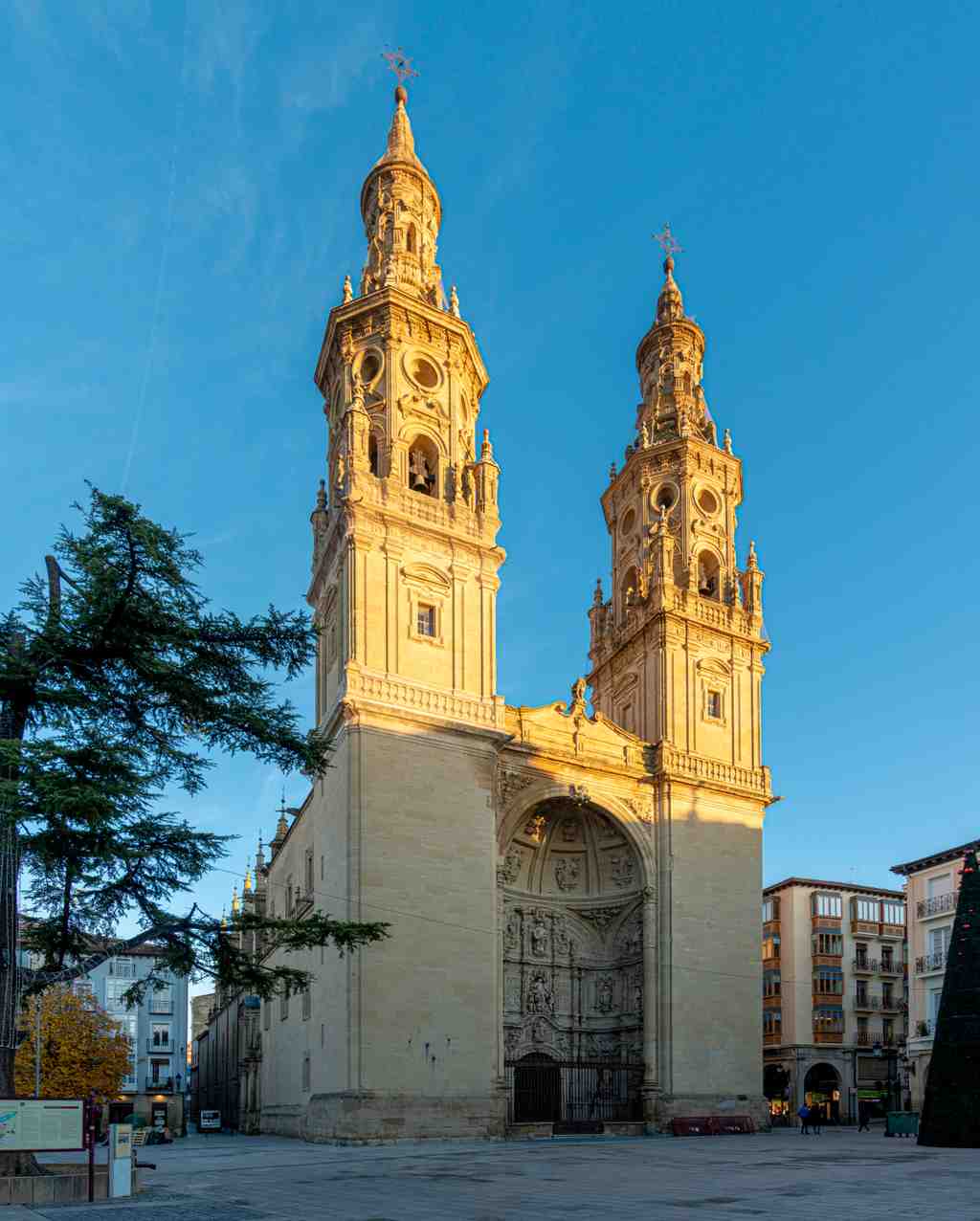
You’re standing in front of the magnificent Concatedral de Santa María de la Redonda: look for two tall, identical towers flanking a grand stone façade, like enormous candleholders rising proudly above the old town’s historic center.
Now, let’s dive into the drama, mystery, and magnificence of this remarkable place-but keep an eye out! In Logroño, history is hiding around every corner, perhaps even behind that pigeon.
Picture yourself back a thousand years ago: the air is fresh, there’s a hint of wood fire in the breeze, and pilgrims in dusty cloaks are crossing the ancient stone bridge over the Ebro, their laughter and footsteps echoing together. This very spot wasn’t always bustling-only after the famous Camino de Santiago passed through did Logroño grow from a handful of riverside huts into a real city. Pilgrims needed somewhere to rest and pray on their way to Santiago de Compostela, and what better place to build than right here? The first church on this site was different-it had a round or polygonal floor plan, which is where the name “La Redonda” comes from. Trust me, back then, church designs were quite the architectural fashion statements.
Over time, Logroño flourished, especially after King Alfonso VI of León gave it special rights to attract new residents in 1095. As the city blossomed, so did the buildings. Churches started popping up like mushrooms after the rain: Santiago el Real, Santa María de Palacio, San Bartolomé, and, of course, the original Santa María de la Redonda. By 1435, the church here was so important it was declared a collegiate church, and eventually, in 1959, it leveled up once more to “co-cathedral” status-meaning, yes, you’re looking at one of only three cathedrals sharing bishop duty in this entire diocese. They say sharing is caring, but sharing a bishop? Only in La Rioja!
Now, look up at the twin towers guarding the main entrance. Built in the 18th century by Martín de Beratúa, these are the definition of “twinning” goals. Their tall, slender silhouettes-modelled after the nearby church of Santo Tomás de Haro-tower above the city in true “Riojan baroque” style. Whenever someone tells you to look for Logroño’s icon, these towers are the answer. Between them, a striking stone altarpiece façade rises above the door, intricate as lacework carved from golden sandstone. It’s a sight fit for a storybook-but with less dragons and more saints.
Step just inside, and the ceiling lifts above you, like entering a forest of stone-columns soar up to vaults decorated with delicate stone branches, casting light and shadow patterns above. If only old stone could talk! But wait, perhaps the artwork whispers stories-behind the main altar, you’ll find a small painting that’s the cathedral’s own Mona Lisa. Legend says it might be by Michelangelo himself, brought here by Bishop Pedro González del Castillo, who, if you ask me, had a bit of an art-collecting obsession. The bishop, a true Renaissance man, even made sure to be buried close to his beloved chapel and artwork, perhaps hoping some of that genius would rub off for the afterlife. But don’t ask for the painter’s autograph-after centuries of debates, experts still aren’t quite sure if Michelangelo really left his mark here, or if it’s a case of mistaken identity. (Even in art, authorship is a mystery worthy of a detective story!)
As you explore, you’ll find treasures brought in from as far as Paris and as old as the 1400s. There are exquisite Flemish altarpieces showing scenes of the Annunciation and the Epiphany, painted almost lovingly-a curious bystander peeks through a hole in the wall, while Mary quietly reads, perhaps wishing she had brought earplugs. Don’t miss the statue of San Prudencio of Armentia-it’s a silver bust from 1461, complete with gothic inscription, and holds the remains of this patron saint. The main altarpiece, a grand display of stone and artistry, is both a fortress and a work of art, accentuated by ironwork and stained glass.
If you’re puzzled by the cathedral’s orientation, you have keen eyes-it’s aligned perfectly east to west, opening out onto the bustling Plaza del Mercado, where history still hums beneath the cobblestones. The street life outside is a tapestry of old and new: friends meet for coffee, children dart past, and weddings sometimes spill out in laughter and confetti.
So here you stand, where medieval pilgrims walked, bishops schemed to leave their artistic legacy, and every stone tells a secret. The Concatedral de la Redonda isn’t just a building-she’s the wise old grandmother of Logroño, keeper of treasures, mysteries, and more than a few architectural jokes. Just ask her twin towers-they’ve been hearing all the city’s best stories for centuries.
To delve deeper into the historical introduction, evolution of temple architecture or the art collections, simply drop your query in the chat section and I'll provide more information.


