
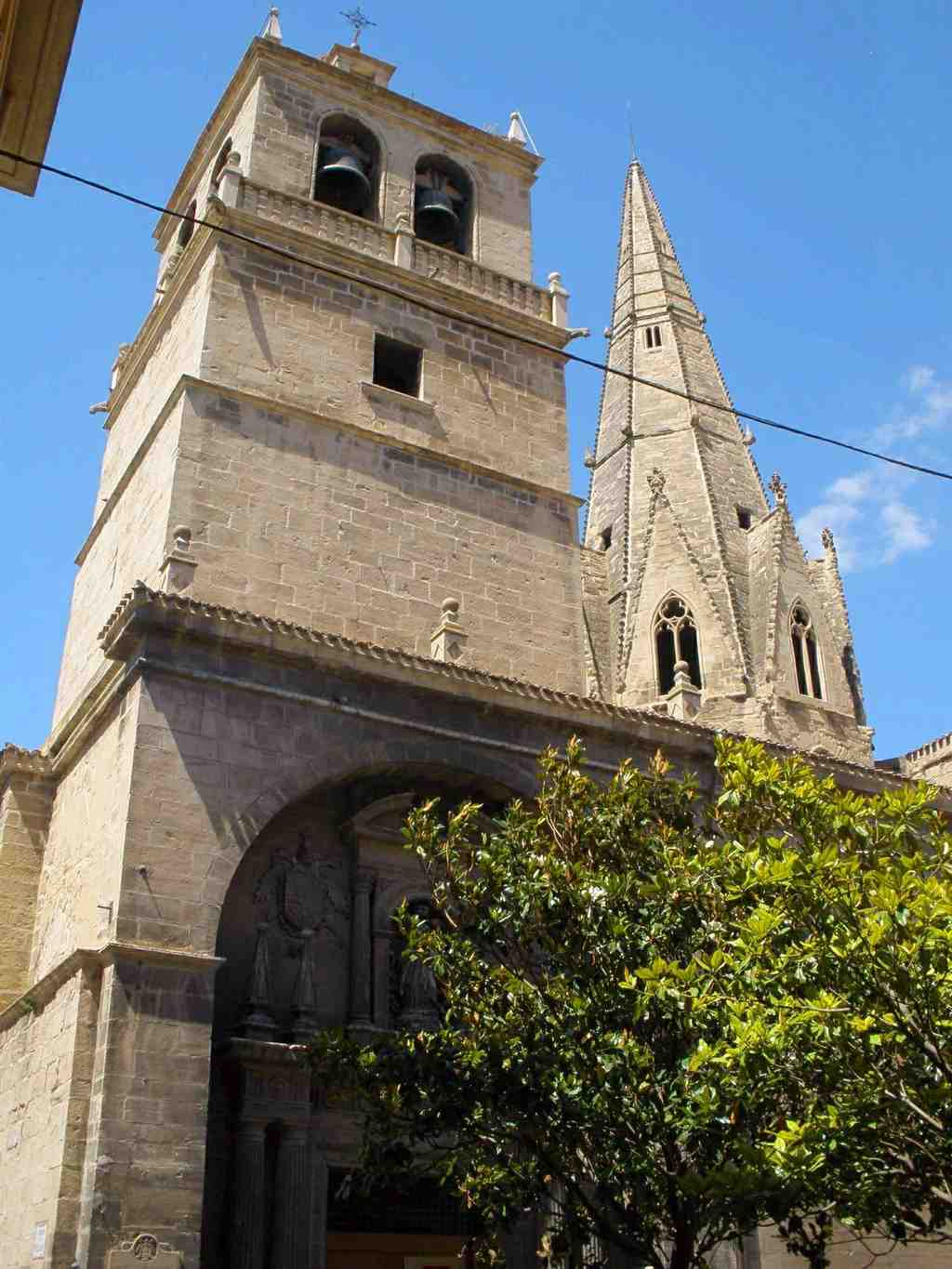
Look for a striking stone church with a tall, pointed octagonal spire shaped like a crown, and a solid square bell tower-just gaze upward and you can’t miss it!
Welcome to the magical world of the Imperial Church of Santa María de Palacio! Right now, as you stand here, imagine yourself whisked back in time-let’s say, to the year 1130. There’s a bit of royal drama brewing: King Alfonso VII decides to donate his grand palace, right on this very spot, to create the first foundation of the Order of the Holy Sepulchre in the entire Kingdom of Castile! How generous, right? Thanks to Alfonso, this church gained the extra-star title of “imperial,” and you, my friend, are standing at the core of centuries-old stories.
What sets the church apart is its unique silhouette on the city skyline-the octagonal spire overhead was built in the 1200s and looks like a crown fit for a fairy-tale emperor. If you close your eyes for a second, you can almost hear the swirling winds brushing over those stone pinnacles and crests. The church itself stretches back to the 12th and 13th centuries, but it’s like a patchwork quilt of history, with each era leaving its stubborn stitch. Some parts are Gothic-pointed arches, tall naves-while others are from the constant renovations that kept the church standing no matter what trouble came its way. In fact, the poor spire you see overhead was nearly taken down in 1671 when it tilted dangerously! They even banned carriages from clattering along the street because everyone was afraid the whole thing would come tumbling down. Fortunately, after years of repairs and no small amount of wringing hands, the spire survived, though much of the daylight that once flooded the altar was lost.
Step closer to the doors and you’ll spot two main entrances: the elegant Baroque portal with columns and the image of the Assumption on this side, added in 1627, and another entrance honoring Saint John over on Rúa Vieja-so the church is always ready for a dramatic entrance, no matter which direction you’re coming from!
Inside, there’s even more medieval mystery. The church has three naves, each stretching out to side chapels, and above, a great octagonal dome rises up, echoing that famous spire on the outside. But the real crowning glory is the main altarpiece, built by Arnao de Bruselas. Believe it or not, that grand triptych was originally made for the city’s cathedral-only to be rejected because Arnao sneakily included his own coat of arms! Instead, it landed here in Santa María de Palacio, where it became the church’s pride and joy. Say what you want about 16th-century artists, but at least they knew how to leave their mark, right?
Peer closer at the altar, and you’ll see stories upon stories: delicate stone prophets, tiny scenes from the life of Jesus, saints, the Last Supper, and one spectacular Tree of Jesse that branches up from a snoozing ancestor to Mary and Jesus after generations of twists and turns. Above it all, you’ll spot the Calvary scene, with the Virgin, Mary Magdalene, and Mary Salome grieving at the cross-emotional enough to send shivers down your spine.
Speaking of drama, take a look at the choir. Built in the late 1600s, it’s got nineteen seats with elegant Corinthian columns. You might notice statues of Saint Barnabas, the beloved patron of Logroño, and Saint Matthew, honored every year at the grape-harvest festival. Imagine this place echoing with their celebrations, filled with music and laughter.
Now, here’s a mystery even master detectives might puzzle over: the story of the church organ. No one really knows how old it is, but it’s been through a few... let’s say, “less than harmonious” renovations. The old mechanical magic was swapped out for electric gadgets, and much of the original sound disappeared forever. Still, every Sunday at noon-and at special weekday masses-the organ comes alive, played by a dedicated organist. Picture the echoes of the music soaring up, brushing against ancient stones.
If you explore a bit further, the cloister once belonged to the strict Cistercian order; only one simple, rugged wall survives from the Middle Ages, but the rest hints at that austere life of long-ago monks.
So, as you look up at Santa María de Palacio, with its sky-stabbing crown and mix of stories from every century, remember: kings, artists, monks, and townsfolk have all left a trace in this extraordinary place-almost as if the past itself is hiding in the cool stone shadows, just waiting for you to listen.
Interested in a deeper dive into the origin, temple architecture or the altarpiece? Join me in the chat section for an insightful conversation.


