
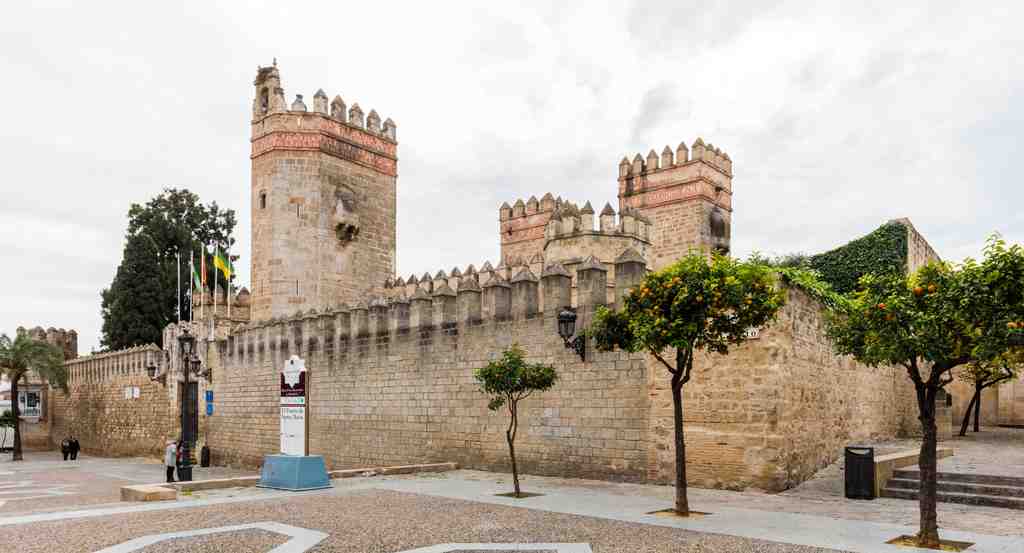
To spot the Castillo de San Marcos, look for high, solid stone walls topped with battlements and corner towers rising above the plaza-straight ahead where the trees part, you’ll see its impressive fortified facade and striking pinkish trim near the top.
Welcome to the Castillo de San Marcos, where history stands tall and refuses to be quiet. Imagine you’re in the 1200s, the scent of orange blossoms wafting through the air, but just beyond, the heavy thud of stones is ever-present as masons and soldiers build a mighty fortress. If these walls could talk, they’d have stories that stretch back even further than the dust between the stones.
Believe it or not, you’re standing at the crossroads of civilizations. The castle rises on the ancient foundations of a mosque, which itself stood atop Roman ruins-so if you ever feel like the ground is buzzing with secrets, you’re not imagining things! In the year 1264, King Alfonso X (known as Alfonso the Wise, and let’s be honest, with a beard like his, he had to be wise) ordered that the old mosque be transformed into a fortified Christian church. Picture craftsmen working by torchlight as four towers, two with hexagonal shapes and two with mighty square bases, slowly grew towards the Andalusian sun.
Inside, the lower rooms of the hexagonal towers became sacred spaces for the Virgin of the Miracles-a name that certainly fits for a place that’s survived so much. And if you press your ear close enough, you might even hear echoes of prayers that mix with the shouts of guards, wondering who left the drawbridge down again.
Some original features still survive today: look for the quibla wall, where the mihrab of the mosque once pointed people towards Mecca. The castle’s upper tower still boasts its distinctive Almohad style-flat, simple lines crowned by detailed battlements that stand out against the sky, almost like a row of teeth daring invaders to try their luck.
Speaking of invaders, this fortress wasn’t just for show. It stood ready to defend against raids from North Africa-imagine anxious soldiers watching the horizon from these very towers, the wind rattling their armor. Over time, Castillo de San Marcos switched hands between powerful nobles-genovese admirals, heroic knights, and even Alonso Pérez de Guzmán, who gifted it to his daughter as a wedding present (because who needs a toaster when you can have a castle?).
By the fifteenth century, new Gothic vaults and chapels sprouted from its ancient heart, while courtyards on the upper levels rang with the footsteps of sailors and explorers. Even Christopher Columbus and Juan de la Cosa, famous map-makers and explorers, walked right here. Look for a tiny corner near the castle where you’ll see a bust of Juan de la Cosa and a small fountain with a replica of his legendary map-that’s a little slice of world-changing history tucked beside these stone walls.
Today, after centuries of being loved, neglected, abandoned, and finally restored, the castle is alive again with music festivals and study halls. So, as you stand here, imagine the layers of time stacked beneath your feet-each one echoing with stories, laughter, and the clink of armor. Welcome to the Castillo de San Marcos, where history never rests!


