
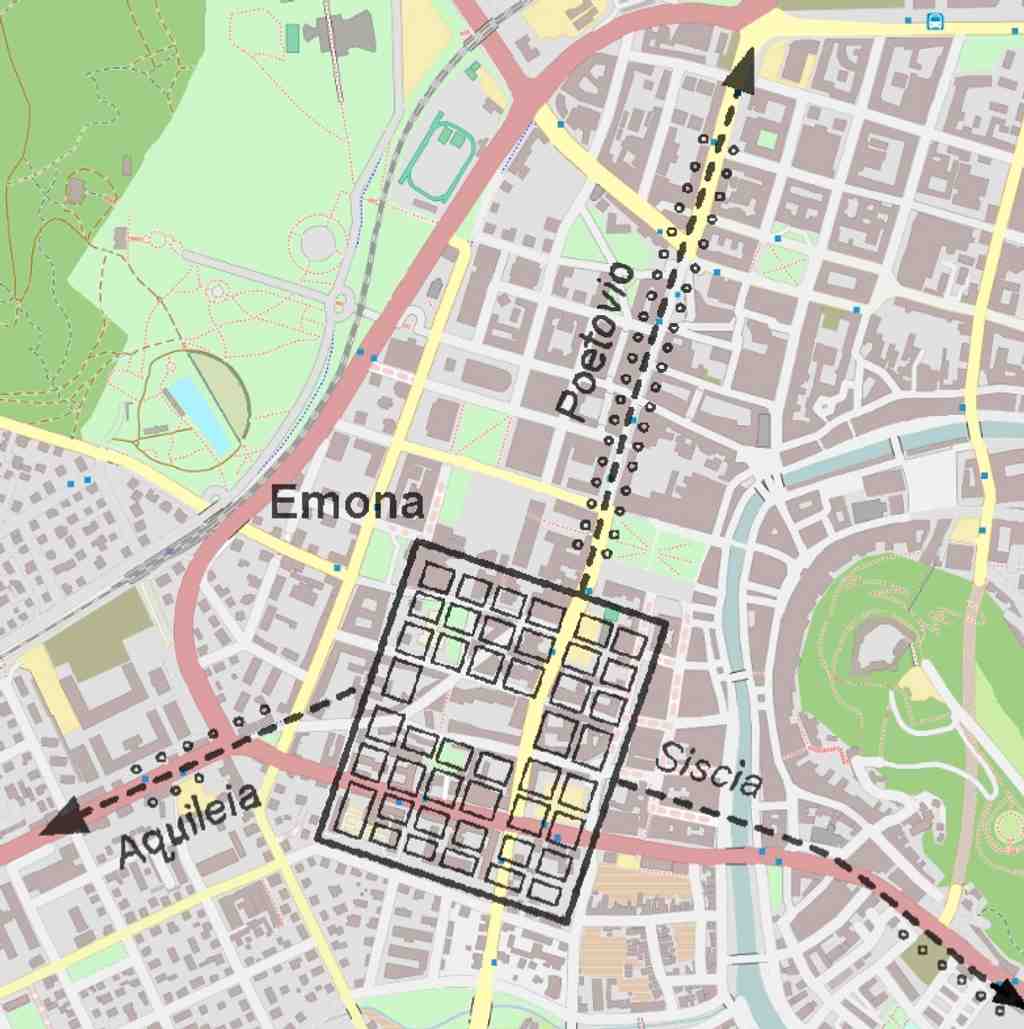
To spot Emona, glance at the ground and nearby signs-you're looking for a rectangular grid, outlined with old stone walls, right where the modern city overlaps with ancient Roman streets; the map shows Emona's boundary as an old city-within-a-city, just southwest of Ljubljana Castle Hill.
Welcome to Emona, where if you take a deep breath, you might just catch a whiff of ancient Roman bread-or, more realistically, the nostalgic scent of buried history beneath your feet. Imagine standing here nearly 2,000 years ago. Instead of buzzing scooters and café chatter, the air was filled with the clang of a blacksmith’s hammer, the calls of merchants hawking their wares, and the steady march of soldiers' sandals on stone streets. Emona, or Colonia Iulia Aemona, was a true Roman city-prepare to go back in time.
Let’s step into the shoes-maybe sandals-of a Roman citizen. It’s the 1st century AD, and you’ve just arrived at Emona, the farthest eastern outpost of Italy proper. The city was carefully planned in a neat rectangle, with streets crossing at right angles, and a central forum bustling with gossip and fresh fruit. Emona was protected by mighty stone walls, some of which still peek out from the modern city today, thanks to clever renovations by architect Jože Plečnik. Think of Plečnik as Ljubljana’s own “time-travel architect,” blending Roman ruins with twentieth-century parks and a pyramid covered in grass. Yes-a Roman pyramid, Slovenian-style!
Emona wasn’t built just anywhere. Its location, by the closely-flowing Nauportus River and underneath Castle Hill, made it perfect for Roman traders, connecting the north of Italy with the east of the empire. The citizens-mostly merchants and craftsmen-were surprisingly international, and could boast about luxurious mosaics and houses filled with statues. For a city its size, Emona was a happening place-5,000 to 6,000 strong, all worshipping their very own goddess, Equrna. Not every town gets its own goddess!
Life was not always peaceful here. Close your eyes and listen-imagine the whistle of bitter cold wind in the winter of 408. The Visigoths, fierce warriors with impressive beards, set up camp by the city walls. Just a few decades later, the Huns stormed through with clattering hooves, led by none other than Attila himself! After that came the Langobards, the Avars, and Slavs. It sounds like the guest list for the world’s wildest block party, except with a lot more swords. Miraculously, ancient cemeteries show that locals and the so-called invaders managed to coexist for a while-imagine sharing a loaf of bread and awkward small talk in Latin and Proto-Slavic.
Emona also shone as a beacon of early Christianity. By the late 4th century, this was the seat of a bishopric with deep ties to Milan. On Erjavec Street nearby, archaeologists uncovered a sprawling early Christian complex, where worshippers once prayed, whispered, and got baptized in solemn mystery. Eventually, the bishopric moved away, but the legend of Emona grew-sometimes even outgrowing reality. Over coffee in the 18th century, Ljubljana’s elite boasted that the city’s true founder was Jason, the fearless leader of the Argonauts, who supposedly named Emona for his old homeland while taking a travel detour from the Black Sea. Who needs Google Maps when you have Greek epic poems?
History also tells us of great drama. After the Legio XV Apollinaris departed, Augustus and Tiberius established Emona as a colony, and it even got caught up in conflicts between powerful Roman emperors like Licinius and Constantine-the ancient version of a presidential scandal. When Emperor Theodosius I swept into town after a major victory, Emona’s citizens greeted him with wild cheers-just imagine the roar echoing off these stone walls!
After the 6th century, life in Emona faded away, but its bones remain hidden under Ljubljana, whispering secrets to anyone who listens. Every new building project here stumbles across something-an old mosaic, a weathered tombstone, a forgotten wall. From the grid pattern in the streets to the mysterious boundary stones fished out of the Ljubljanica, this whole area is a living archaeological museum. Modern parks and playgrounds rest atop ancient ruins, blending today’s laughter with Rome’s echoes.
So, as you stand on this ancient ground, remember: under every cobblestone is a story-of goddesses and generals, invading armies and epic legends, waiting for a curious listener. And if you hear a faint jingle (or just the tour guide’s next corny joke), it might just be Emona trying to get your attention from beneath your feet!
Interested in knowing more about the historical descriptions, location and layout or the archaeological findings




