
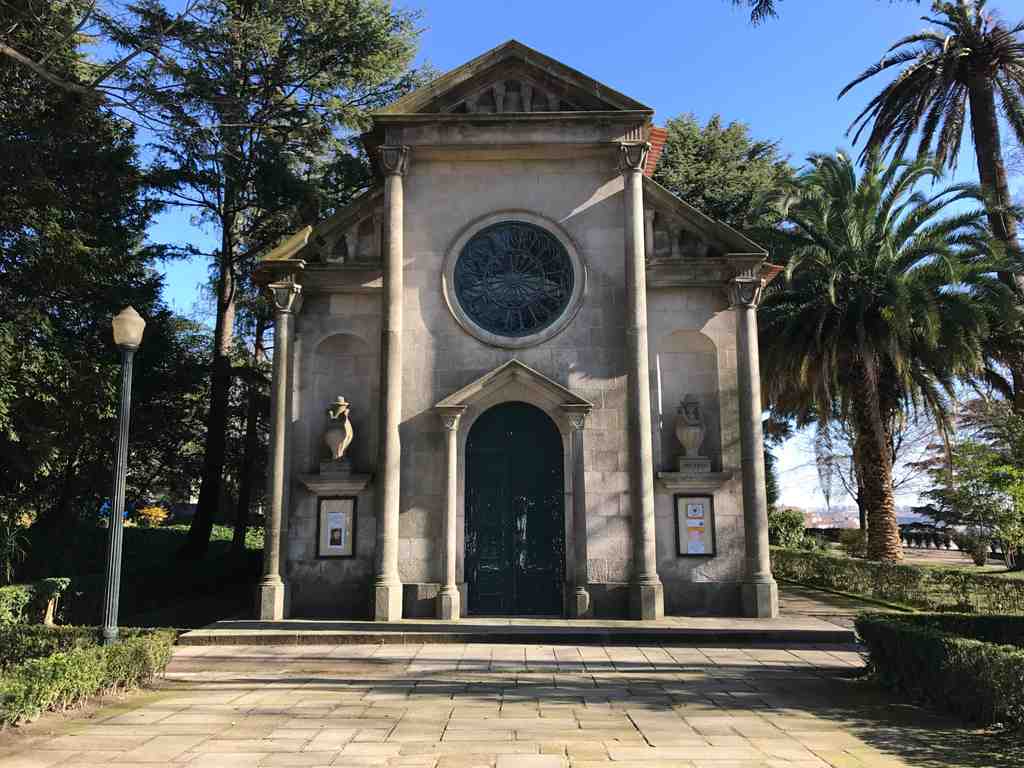
Ahead of you stands the Carlos Alberto Chapel. It’s not your average chapel-look for a small but stately stone building nestled among tall palm trees and evergreens. Its face almost resembles a secret tucked into nature, with a perfectly round window above the door, flanked by sturdy columns and two decorative urns on either side. The chapel’s light stone color really stands out in the shade of the gardens-if you’re approaching from the path, it’s framed by greenery and almost looks like it just popped up out of a storybook.
Now that you’re right in front, take a breath and imagine the year is 1849. Europe is buzzing with dreams and drama-kings falling, revolutions swirling, people everywhere talking about freedom and unity. This very chapel is all about those big ideas. It’s here because of a king named Carlos Alberto, who rather dramatically lost his throne after fighting for a united Italy and ended up exiled right here in Porto. Imagine him: heavy cloak, tired eyes, walking among these trees far from his homeland, plotting and hoping, but also missing family, his royal dinners, and probably Italian pasta.
His half-sister, Princess Augusta, wanted to honor him in a way no one could forget. So, she had this grand cenotaph built-basically, a kind of memorial that’s really a chapel. Some call it the biggest romantic cenotaph in all Portugal. This is a place that remembers dreams that never quite came true-Carlos Alberto died here, far from his kingdom, but his story didn’t end with him. After he passed away, he was taken back to Italy, but this spot stays as a tribute.
If you could peek inside, you’d see three statues brought from Paris and imagine the first Christmas mass here, the candles flickering in the winter chill of 1861. The chapel was later passed down to royalty, changed hands many times, and now serves the local Lutheran community. If walls could talk, these ones would whisper about exiled kings, royal heartbreak, and the distant sound of Italian marches.
So, as you stand here surrounded by gardens and sunlight, think of Carlos Alberto-fighting for a country that didn’t yet exist, remembered here among Porto’s trees. And don’t worry, there’s no history exam at the end of the tour-unless you count spotting your next stop as a victory. Ready to continue?


