
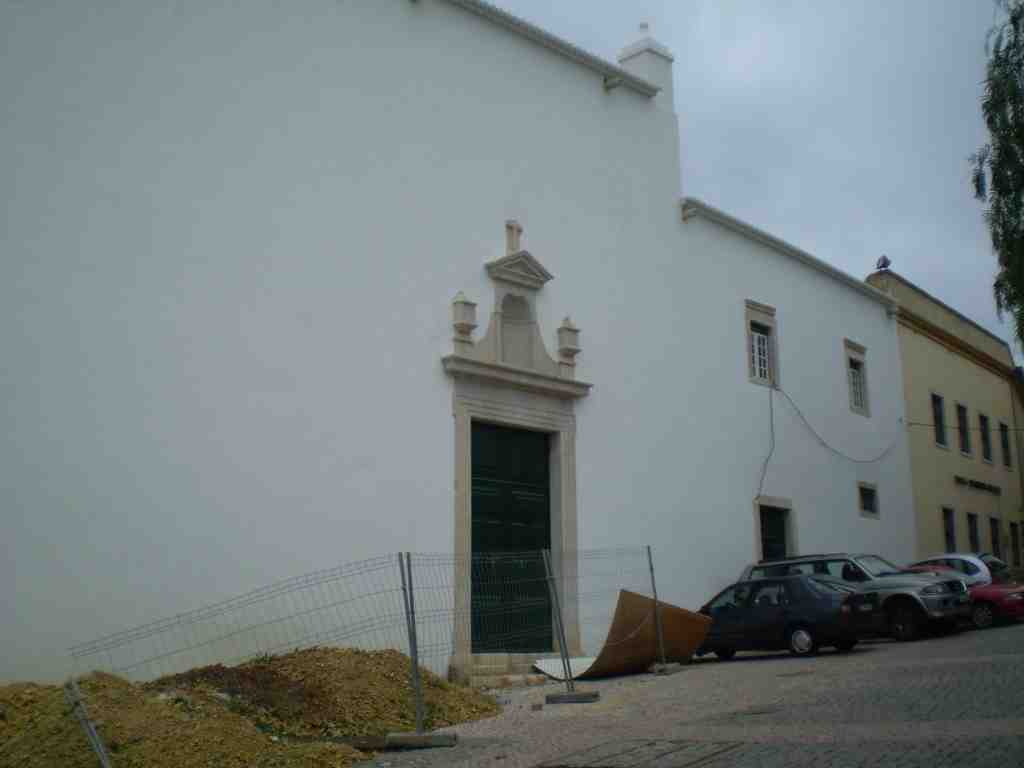
To spot the Church of Our Lady of Mount Carmel, look ahead for a large, plain whitewashed building on a small hill with a simple stone-framed doorway and hardly any exterior decoration-it stands quietly but impressively above the cobbles while the world bustles around it.
Now that you’re facing this unassuming but fascinating façade, let’s uncover its secrets and stories-because this spot has seen more plot twists than your favorite TV series! If you stood here in 1463, you’d find just a humble hermitage dedicated to Our Lady of the Conception, perched above the rooftops with the salty breeze from the coast below. Fast forward to the hustle and bustle of the 1500s, and this peaceful spot became home to the Carmelite nuns-the so-called “Carmelitas Calçadas.” Why Lagos, you ask? At the time, this city was the Algarve’s shining star, attracting these devout sisters to build their convent right here, finishing in 1554 under the ambitious eye of Father Cristóvão Dias.
Back then, the church was anything but showy. The Carmelite nuns weren’t into bling outside-a simple white box, no fancy statues or carvings. But Ah! Step inside, and you’d be surrounded by golden altars, sparkling glazed tiles, and a dome where nuns peered out to attend mass from their secret window! The outside whispers “humility,” but the inside sings “divine splendor.” I suppose you could call this building the nun-equivalent of business on the outside, party on the inside.
The convent and its church survived the great earthquake of 1755, shaken but not broken. Legend has it that in the 1700s, the nuns here whipped up the first ever Dom Rodrigo dessert-one of the Algarve’s sweetest secrets, all sticky eggs and sugar in honor of the local governor. Clearly, they took “divine inspiration” very literally in the kitchen!
But the plot thickens in the 1800s, when trouble brewed. The convent’s numbers dwindled-between nuns leaving, sick sisters, and new laws, soon only two stubborn souls remained. With so few left, the building was divided up-a school over here, a theatre back there (imagine students doing quadratic equations within whispering distance of amateur actors and carnival balls)! In fact, the Teatro Gil Vicente, created partly on the old convent’s ruins, staged its first play in 1862 to a packed house-maybe even out-audiencing the church next door.
Through wars and new governments, the building kept evolving. In the early 1900s, it hosted businesses, military hospitals, and more schools. By the mid-century, it grew into a center for technical and industrial education, its echoing halls filled with the clatter of tools and the dreams of students from across Lagos. The old convent garden even became a playground, sparking laughter where nuns had once tiptoed in prayer.
Come the 1970s, the artist João Cutileiro set up shop here. Imagine sculpting a king (D. Sebastião himself) in a studio filled with the ghosts of centuries past-stone dust mingling with centuries-old prayers. Over the years, restoration plans tried to pry the church from ruin’s grip. In 2004, city leaders and the diocese finally teamed up to save this heritage. Builders and archaeologists dug deep, restoring tiles and golden altars, strengthening the dome, and giving the church a new lease on life.
After more dust, sweat, and paperwork than you’d find in most soap operas, the church opened its doors in July 2023, ringing its newly restored bell for the first time in decades. Today, the sanctuary hums with music, students, concerts, and the youthful energy of Lagos’s next generation.
So as you stand here, breathe it all in-the silent white walls, the secrets of lost convents, echoes of theater and classrooms, and the faintest memory of sugar, gold, and devotion. The Church of Our Lady of Mount Carmel is living proof: never judge a church by its cover!


