
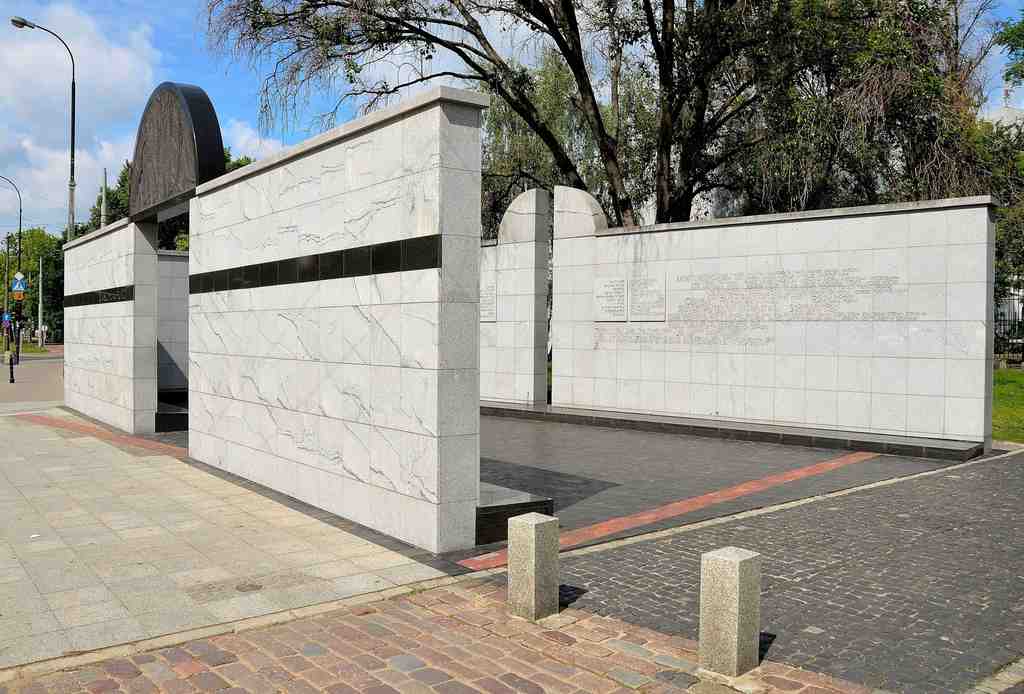
To spot the Umschlagplatz Memorial, look to your right for a white marble wall with a wide black stripe and an arched top-this is your sign you have arrived at the final and very important stop on our tour.
Welcome to the Umschlagplatz. Take a deep breath-the air here is thick with stories, and echoes of footsteps long past. What you see in front of you looks like an open freight car made of white marble, with a black stripe resembling the tallit, the traditional Jewish prayer shawl. If the design seems somber and stark, that’s no accident. You’re standing at the very spot where the fate of so many was sealed during some of the darkest days in Warsaw’s history.
If you listen carefully, you might almost hear the heavy shuffle of thousands of shoes, the murmur of voices, the heartbeats of women, men, and children pressed together in fear and confusion. Back in 1942, this was the place where the Nazis assembled Jews from the Warsaw Ghetto, holding them in this yard next to the railway station. Sometimes people waited here overnight out in the open, clutching the hands of their families, surrounded by a wooden fence that was later replaced by cold concrete walls. On some mornings, freight trains would arrive, and with chilling efficiency, entire blocks of the ghetto would be emptied into these cars, their destination: Treblinka, a death camp where most would never return.
You’d think the word "Umschlagplatz" would be innocent-it means "reloading point" in German, usually a spot where goods are transferred for shipping. But here, on Stawki Street, it became twisted, a cruel euphemism, for loading human lives onto trains. The word itself became a mask-a way for the Nazis to cover up what was really happening, just like they used bland words for their worst crimes. This wasn’t just unique to Warsaw; there was another Umschlagplatz at Radogoszcz near the Łódź Ghetto, a dreadful pit stop on the way to Chełmno and Auschwitz.
During the so-called Grossaktion Warsaw, which started in July 1942, as many as 10,000 Jews a day were expelled from the ghetto. They walked, marched, or stumbled toward this square, often herded straight from their homes-sometimes even through tenement courtyards or along Zamenhof Street. Imagine the thunder of boots, the calls and orders in foreign voices, the desperate tears and whispering of prayers. Not even the most important or skilled could escape easily; even famous musicians like Władysław Szpilman, known today from the movie "The Pianist," stood among the crowds here, just another face in a sea of thousands.
The site was divided into two parts back then. The southern part, fenced inside the ghetto, was where people gathered and waited. The northern section, next to the rails, is where people were packed into the freight cars, the doors slammed shut behind them. The rails themselves were laid down way back in 1876, but between 1942 and 1943, over 300,000 people took a one-way journey on them.
But let’s not stop at tragedy! In 1988, to mark the 45th anniversary of the Warsaw Ghetto Uprising, this monument was built-a silent sentinel for the memories and names of those who passed through here. Take a look at the marble. The inscribed names on the wall are in Polish, Yiddish, Hebrew, and English-over 400 of the most popular Jewish names, each one standing for a thousand victims. The gate above, with its syenite stone from Sweden, is carved with a shattered forest-the symbol of a nation cruelly cut down.
It’s not just a piece of history. The colors themselves mean something: white, with a bold black stripe, a visual reference to ritual clothing worn on prayers and special occasions, reminding us of the dignity and culture stripped away. There were once warehouses here, and even a homeless shelter before the war-now all gone, replaced with stories and reminders.
So as you stand here, let your mind wander back to the thousands who walked this path and the quiet strength of those who survived. The Umschlagplatz may not have the grand architecture of palaces or the shine of a museum, but it has a silence that speaks volumes. And hey, if you hear footsteps by your side, just remember-it’s probably me, your tour guide, ghosting along, making sure you don’t miss a single detail!
Want to explore the usage, warsaw ghetto or the deportations to treblinka in more depth? Join me in the chat section for a detailed discussion.




