
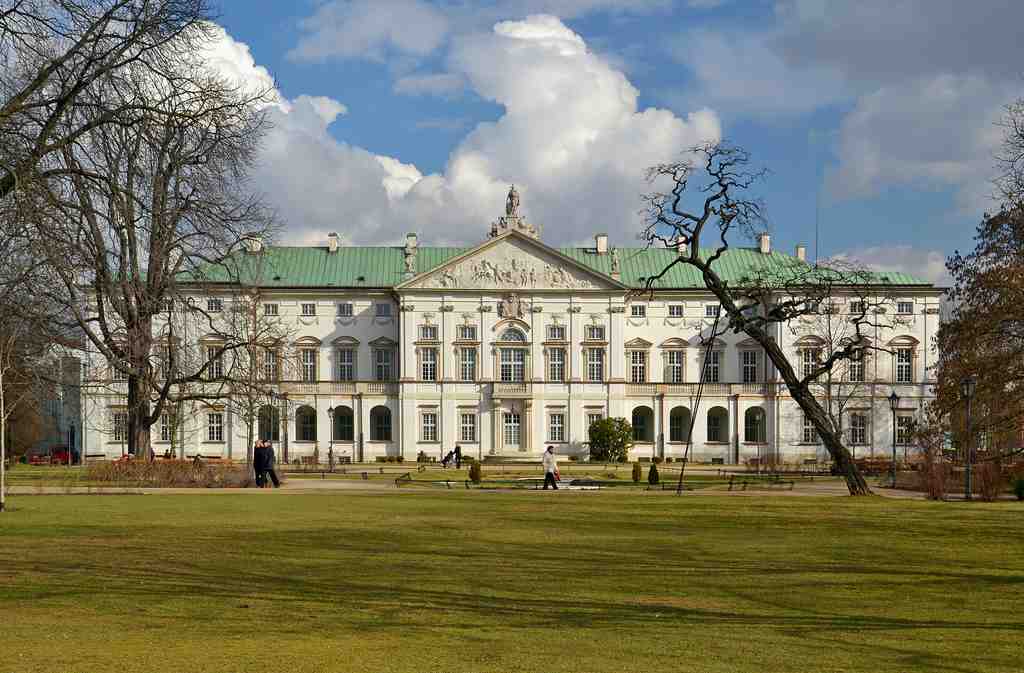
To spot the Krasiński Palace, just look for the grand, white Baroque facade with a pale green roof and a dramatic pediment adorned by detailed statues and sculpted reliefs, set behind a wide open lawn right ahead of you.
Now, time to step into the shoes of a 17th-century noble! Imagine yourself standing on Krasiński Square, surrounded by the smell of fresh grass and the gentle whisper of leaves as a breeze sweeps across this very garden. Back in the late 1600s, Jan Dobrogost Krasiński-a man who never settled for small dreams-decided Warsaw needed a place as grand as his family tales. He called on Tylman van Gameren, a Dutch architect with an Italian education and a knack for Baroque drama, to design a palace meant to shout, “Look at me!” to all of Poland. And yes, if the Palace could talk, it would probably brag, too.
Krasiński, eager to outshine his rivals (and maybe impress the king), kept an eagle eye on the construction. He even hired top French and Italian craftsmen, but the real artistic fireworks came from Andreas Schlüter, a German sculptor who brought the palace’s facade to life. Take a look above the central entrance-the intricate reliefs on the pediment depict a legendary Roman ancestor of Krasiński, Manius Valerius Maximus Corvinus Messalla. Now that’s family pride! There are also French-style doors on the first floor, once crowned with a cartouche held by two fluttering angels showing off Krasiński’s initials, “JK.” Who needs Instagram when you have your own palace-monogram?
As you stand in front of these tall windows, picture lavish frescoes inside, painted by Michelangelo Palloni, court painter to King John III Sobieski. The palace was a hub of art and luxury, bursting with stucco moulding, marble, and murals-alas, many lost during World War II. The gardens behind you? They were once even larger, with fancy symmetrical parterres and long, sun-dappled alleys leading off in three directions. Sadly, for all his ambition, Krasiński never quite finished the garden the way he dreamed. Even a nobleman’s to-do list gets a little too long sometimes!
Fast forward to 1765, and the palace changed hands, becoming the home of Poland’s Treasury Commission. A fire in 1783 brought another chapter: Italian architect Domenico Merlini helped give the palace a fresh look. By the interwar period, the Supreme Court of Poland met under this ornate roof. Then came the chaos of World War II-flames, rubble, loss. Yet the palace’s outer shell stood proud, a silent witness.
Today, after careful restoration, Krasiński Palace isn’t just a pretty face. Since May 2024, it welcomes visitors for the first time, showing priceless treasures from the National Library, including rare manuscripts, Medieval psalters, and even works by Chopin. Admission is free six days a week, so you can soak up centuries of history without spending a zloty!
So, next time you pass by, give a little nod to Jan Krasiński. He built a palace that has truly seen it all-glory, ruin, and an epic comeback. And if you listen closely, you might just hear the echoes of old courtly footsteps wandering through the halls.




