
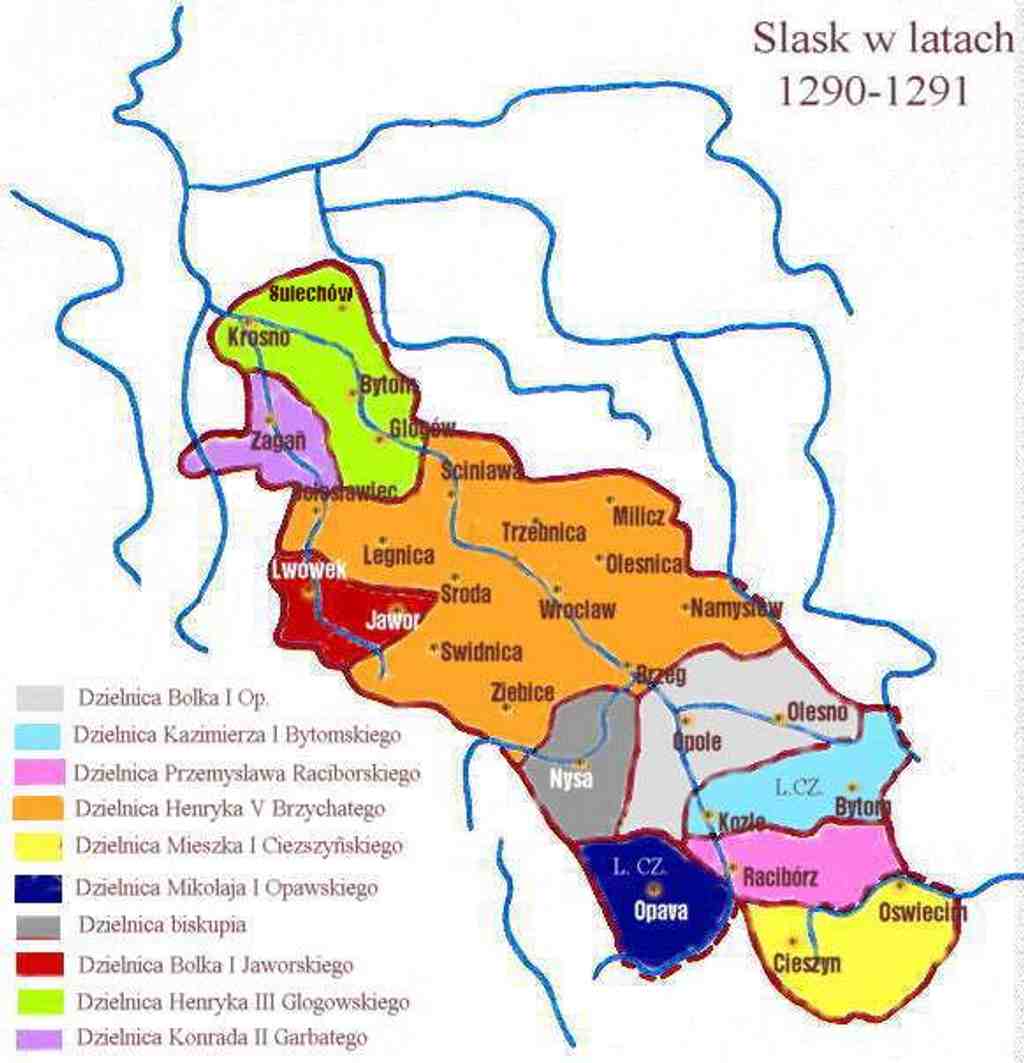
To spot the Duchy of Legnica, look for a large swath of land on this historical map stretching across the center left, marked as “Legnica,” often highlighted in a rich orange color surrounded by other duchies-if you look just south of the bright green “Krosno” and slightly west from “Wrocław,” you’ll find its borders boldly claimed.
Now imagine yourself standing on the lively ground where once, nearly 800 years ago, the fate of empires and dynasties was shaped. The air almost buzzes with old secrets, as if you can hear distant hoofbeats and the clang of armor. This is the heart of the old Duchy of Legnica-a spot that saw almost as many plot twists as your favorite TV show, but with even more crowns and less Wi-Fi.
The story begins in the year 1248, when Poland, much like a cake at a birthday party, was being split into smaller pieces. The Duchy of Legnica came out of this great division, ruled by the Piast family, a dynasty that seemed to specialize in two things: having sons with unforgettable nicknames (like Bolesław the Bald), and fighting over territory. They ruled here until 1675, which, even if you aren’t a history buff, you’ll agree is a pretty solid run!
Step back further, and you’ll find Legnica Castle, which had already been a comfy seat for dukes since 1163-talk about a family with a long commute to work. But the real drama unfolds in 1241 during the legendary Battle of Legnica. Imagine this very landscape filled with the colors and chaos of a vast army-the Christian knights, Polish nobles, grizzled Bavarian miners, and even crusader orders-all united under Henry II the Pious. Their mission? Stop the Mongol horde. The clash was fierce! Henry was killed, his side defeated, but the Mongols soon turned back-rumor has it they had to go home for a very important meeting (the death of their Grand Khan). If that isn’t the medieval version of “I have to take this call,” I don’t know what is. If you’re here in April, you might catch the small celebrations the locals host to remember this wild moment in European history.
Curious about how rulers managed all this chaos? After Henry’s untimely exit, his son Bolesław II the Bald took over, but family drama quickly followed. Brothers squabbled, duchies were carved up, and at one point Legnica even scored some extra towns like Środa Śląska and Strzegom. If anyone’s ever argued over the TV remote in your house, you’ll appreciate this level of royal sibling rivalry.
Later, when Henry V the Fat (yes, that was his real nickname-clearly, salad wasn’t invented yet) took the reins, he actually managed to expand the duchy, briefly reuniting it with Wrocław. But, as with all good things, unity didn’t last! The duchy split again, with Bolesław III the Generous (whose money management skills left much to be desired) in the hot seat, with his brothers waiting in the wings. Legnica, by now an important city with 16,000 folks dreaming of fame or just a bit of gold, grew quickly, and even became a center for mining during a local gold rush.
Next chapter: Legnica’s fortunes got tangled with big European powers. The Piast line here became a vassal to mighty Bohemia, and the city was frequently a pawn in the grand chess game of European politics. Along came the Protestant Reformation early in the 1500s, which turned Legnica into a Lutheran stronghold, causing more than a few heated sermons over dinner. The Habsburg monarchy, however, was determined to keep things Catholic, and the resulting tug-of-war saw more legal squabbles than a modern soap opera.
When the ruling Piast line fizzled out in 1675 with Duke George William, Legnica landed under the rule of the Habsburgs, sparking even more inheritance disputes. Prussia, watching from the sidelines, finally used one of these age-old arguments as their excuse to march in and take over (because, after all, who doesn’t love a good old-fashioned family feud?).
So as you stand here, let your mind wander: armies clashing, dukes scheming, and the march of centuries echoing beneath your feet. Who knew that the quiet ground under your shoes once carried the weight of empires? Rumor has it, if you listen closely, you can still hear the distant laughter of Bolesław the Bald... or maybe that’s just the wind!


