
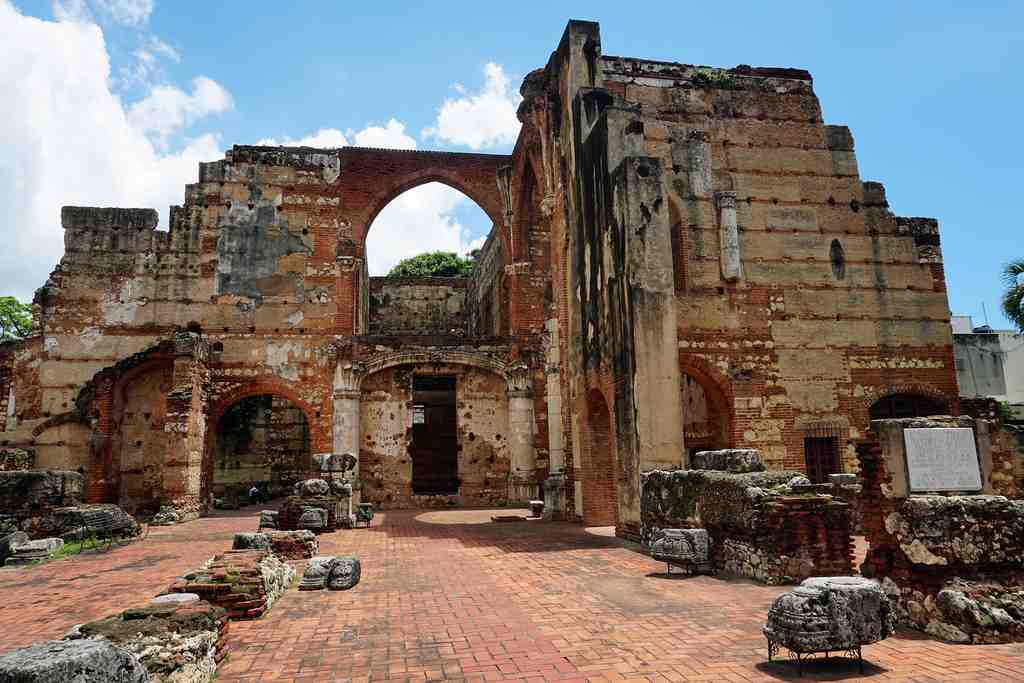
To spot the Hospital San Nicolás de Bari, look straight ahead for crumbling ochre and red stone walls with a large, open archway in the center, surrounded by scattered stone blocks on a brick courtyard.
Now, let’s step back in time-way back! Imagine you’ve just arrived at this block more than 500 years ago, and instead of ruins and sunlit silence, you’d hear the echo of footsteps, maybe a few moans, and church bells ringing out. You stand at the entrance of the very first hospital ever built in the entire Americas, started in 1503 thanks to Governor Nicolás de Ovando. Ovando wanted to show off a bit, just like those fancy European princes-so he borrowed ideas from Italy’s grand Renaissance hospitals, making this place a true medical marvel of its day.
By 1522, this spot was buzzing with activity! Picture priests moving from the central nave straight to a patient’s bedside, doctors whispering about the latest herbal cure, and rays of sunlight pouring in from the open courtyards at each corner. This wasn’t a small clinic; it was a complex two stories tall, built in a cross shape, able to care for up to seventy patients-pretty impressive, since that matched the mighty hospitals of Rome. The design was so modern, it inspired big-name copycats across Spanish America, like the hospital Hernando Cortés started in Mexico.
Inside, you would have found three naves: the main one for worship, and two side naves just for the sick. Imagine, you’re ill but only a few steps away from a chapel, hoping a little prayer would help with the medicine. Even the architecture here was a wild mash-up: Gothic arches, Renaissance styles, and the distinctly Spanish Mudéjar mix. Look up and you’d see pointed arches on the upper floor and barrel-shaped arches below-almost like the building itself couldn’t quite make up its mind.
For centuries, this place was a lifeline for the city, until the mid-1700s when its bustling halls went quiet. By 1908, time and weather had taken their toll, and part of the grand façade collapsed with a dramatic crumble. What’s left now is like a giant open-air history book, but every stone tells a tale of hope, pain, faith, and the determination to heal.
And don’t think its story ended with those ruins! In 2021, a fresh chapter began with the dream of turning these remains into a vibrant museum-a place where the history of medicine across the Americas could come alive again. Teams from universities, the mayor’s office, even language and culture experts, are hard at work organizing exhibitions and cultural exchanges in these magnificent old walls. With every brick and battered column you see, you’re standing on the very ground where doctors of old changed lives, and where modern historians are building new bridges.
I’d say this hospital is the perfect prescription for anyone hungry for history! Which, luckily, can be cured without a trip to the pharmacy.


