
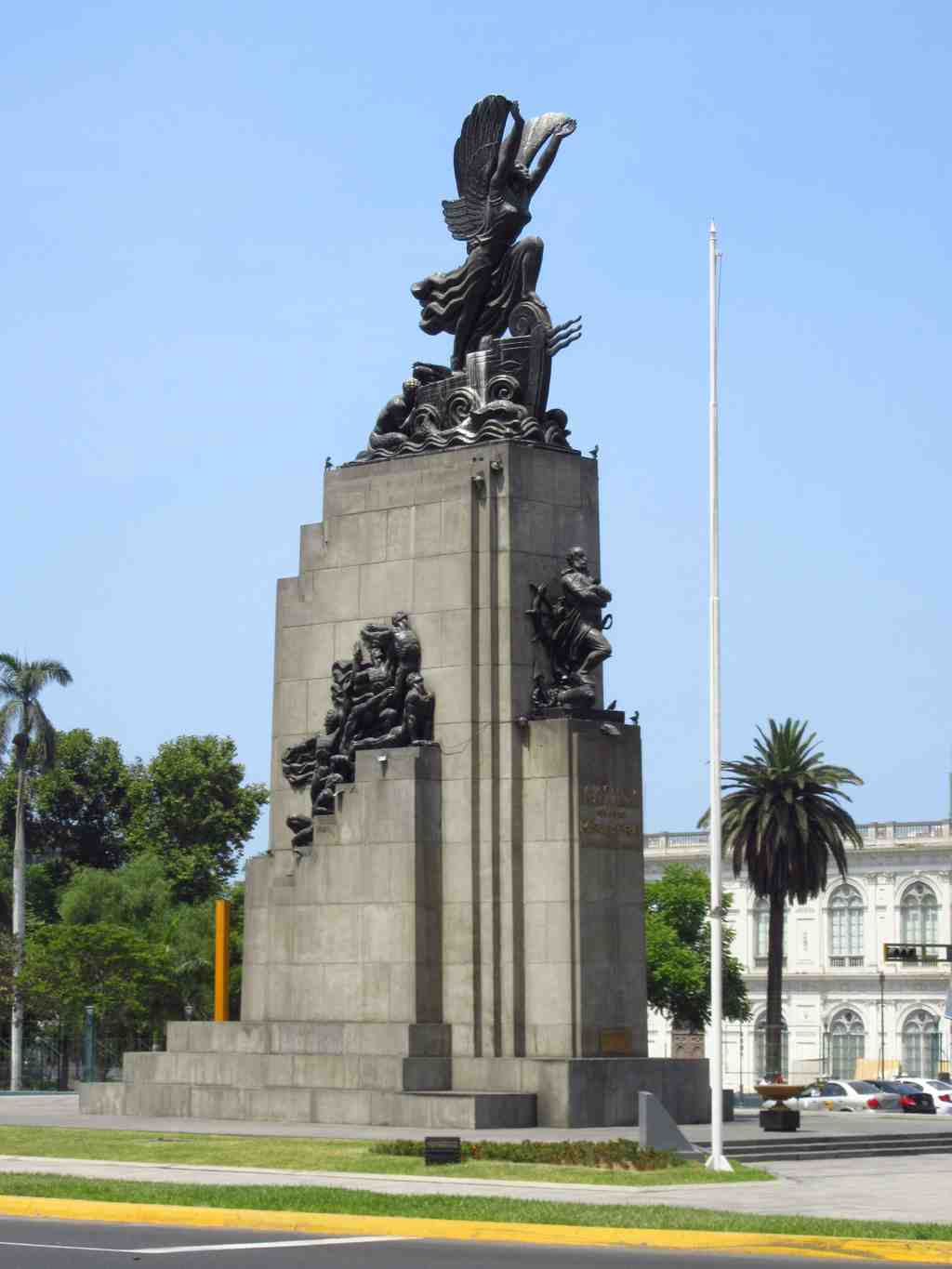
The monument was designed by the talented Spanish sculptor Victorio Macho and was inaugurated on October 28, 1946, during the government of President José Luis Bustamante y Rivero. It is even considered a movable property part of Peru's Cultural Heritage.
The monument itself is truly impressive. It consists of a four-sided granitic monolith, symbolizing the land of Peru, with vertical stretch marks and ascending stands that represent the sea. At the center of the monument stands a sculpture of Admiral Miguel Grau Seminario, adorned in his sailor uniform, with his arms crossed and surrounded by a helm and ship anchors.
On the pedestal beneath the sculpture, you will find a dedication that reads: "To the glory of the great admiral of Peru Miguel Grau, the Millennium Peruvian." The side faces of the monument feature symbolic sculptures depicting men struggling to reach great heights.
At the back of the monument, there is a commemorative plaque honoring the Battle of Angamos, the naval engagement in which Admiral Grau lost his life. And to top it all off, the monument is crowned with an allegorical sculpture of fame, raising its arms towards the sky in a clamor for immortality. This sculpture is driven in a mythical ship by tritons and sirens.
The Monument to Miguel Grau Seminario holds great significance for the people of Lima and the nation as a whole. It serves as a constant reminder of Admiral Grau's bravery and sacrifice during the War of the Pacific. And across from the square where the monument stands, you'll find the starting point of the Paseo de los Héroes Navales, a beautiful promenade honoring Peru's naval heroes.
Shall we continue our fascinating journey through Lima?


