
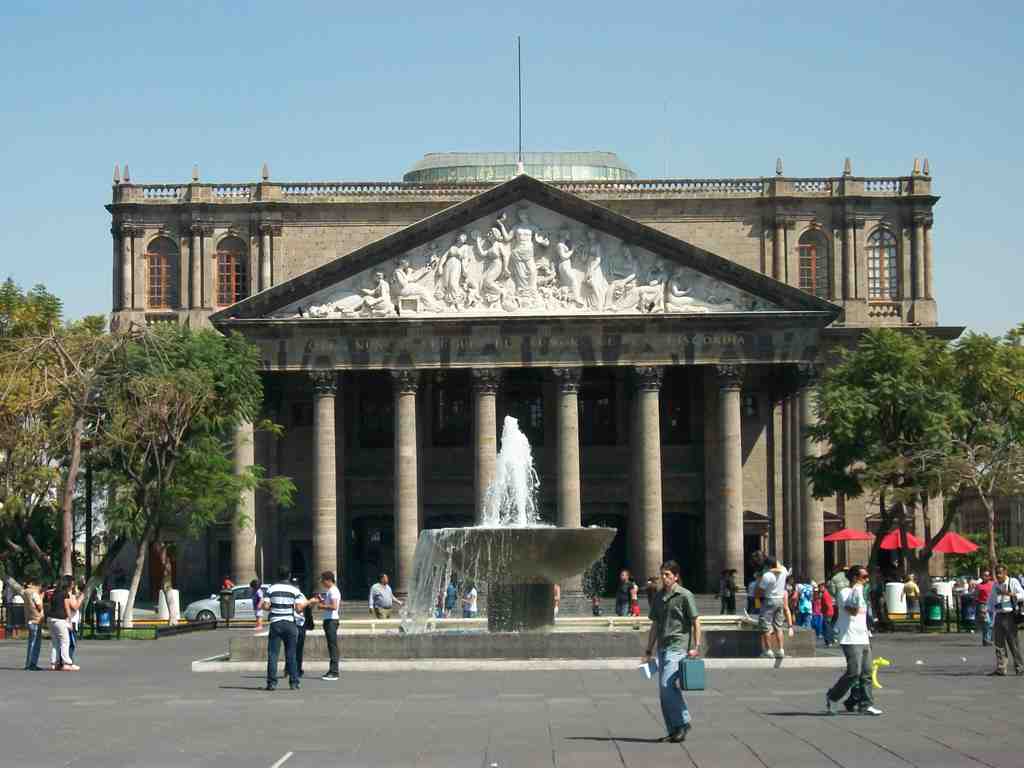
Right ahead, you’ll spot the grand Degollado Theater by looking for a wide stone building with tall columns and a white sculpted triangle at the top, right beyond the splashing fountain in Plaza de la Liberación.
Welcome to Guadalajara’s crown jewel of the arts-Degollado Theater! Let’s imagine the mid-1800s for a second: bustling city streets, gentlemen in top hats, ladies in elegant dresses, and all of Guadalajara buzzing with one big question: “When will we get a theater worthy of our dreams?” The story begins in 1855, when the visionary Antonio Pérez Verdía pitched the idea to Governor Santos Degollado. The city was yearning for a grand stage-a place where culture, music, and the passion of the people could shine. Without missing a beat, Governor Degollado signed the approval faster than you can say “Bravo!” and, come March 1856, he laid the very first stone of this now-iconic building.
But, as in every great drama, there was a twist. Construction slowed to a crawl-wars, politics, and money woes couldn’t resist making a special guest appearance. Still, in November 1861, with progress finally resuming, the city’s new governor decided to change the name to Degollado Theater to honor the late general, Santos Degollado, who’d bravely fallen in battle just months before. Oddly, no one paid much attention to the new name at the first inauguration-another plot twist! Only in December 1866 did the theater truly take on its now-famous name, as the city returned to Liberal hands after much political back-and-forth.
Picture the night of September 13, 1866. The air is thick with anticipation. A chorus of street vendors shout, horses clop on cobblestones, and hundreds squeeze close to catch a glimpse of the glamorous opening night. On stage? The legendary soprano Ángela Peralta, known as the “Mexican nightingale,” wowing the crowd with Gaetano Donizetti’s Lucia di Lammermoor. A grand debut-even though, just between us, the theater was only half-finished!
Finished or not, the show had to go on-literally. Over the decades, the Degollado Theater had FOUR more inaugurations after being remodeled, in 1880, 1910, 1941, and 1964. You might say it’s the only theater that loves a dramatic entrance as much as any of its performers.
Step inside, and you’d find a spectacle of red and gold. Imagine the soft glow of chandeliers, gilded balconies, and paintings so lush you’d think you’d entered a dream. The theater’s artist friends left their mark, too: Jacobo Gálvez, Gerardo Suárez, and Carlos Villaseñor painted a jaw-dropping mural inspired by Dante’s Divine Comedy. Years later, a golden eagle with a Mexican flag in its talons soared above center stage, while the walls slowly donned their iconic golden glow. In 1909, Roberto Montenegro added a crystal chandelier that could make even the clumsiest a dancer want to waltz under its light. Every inch of this place is the result of decades of artist teamwork, rivalry, and probably more ladders than you can count.
And outside-well, just look up! Sixteen Corinthian columns lift the entrance skyward, and the white artistic relief depicts Apollo with his nine muses. Montenegro designed this dramatic mosaic in the 1950s-no wonder the building looks ready to host gods and demigods for opening night. Along the frieze, squint and find the phrase: "Que nunca llegue el rumor de la discordia"-may the rumor of discord never arrive. Fun fact: that’s the closest thing a theater can have to a “no drama backstage” sign.
And yet, history lives on its walls. At the side facing Plaza Fundadores, don’t miss the monumental bronze relief showing the city’s founders-a tribute by Rafael Zamarripa, as tall as three people standing on each other’s shoulders!
As you stand outside, imagine the echoes of applause, the tap of dance shoes, and the murmurs of excitement from generations of performers-Juan Gabriel, Plácido Domingo, Anna Pavlova, Vicente Fernández, Ravi Shankar-even a magician or two!
Today, Degollado Theater pulses as the heart of Jalisco’s music, dance, and celebration-home to the city’s philharmonic, mariachi festivals, ballets, and unforgettable nights. So take a bow-you’ve made it to Guadalajara’s grandest stage, where every stone, every story, and every note still sings!


