
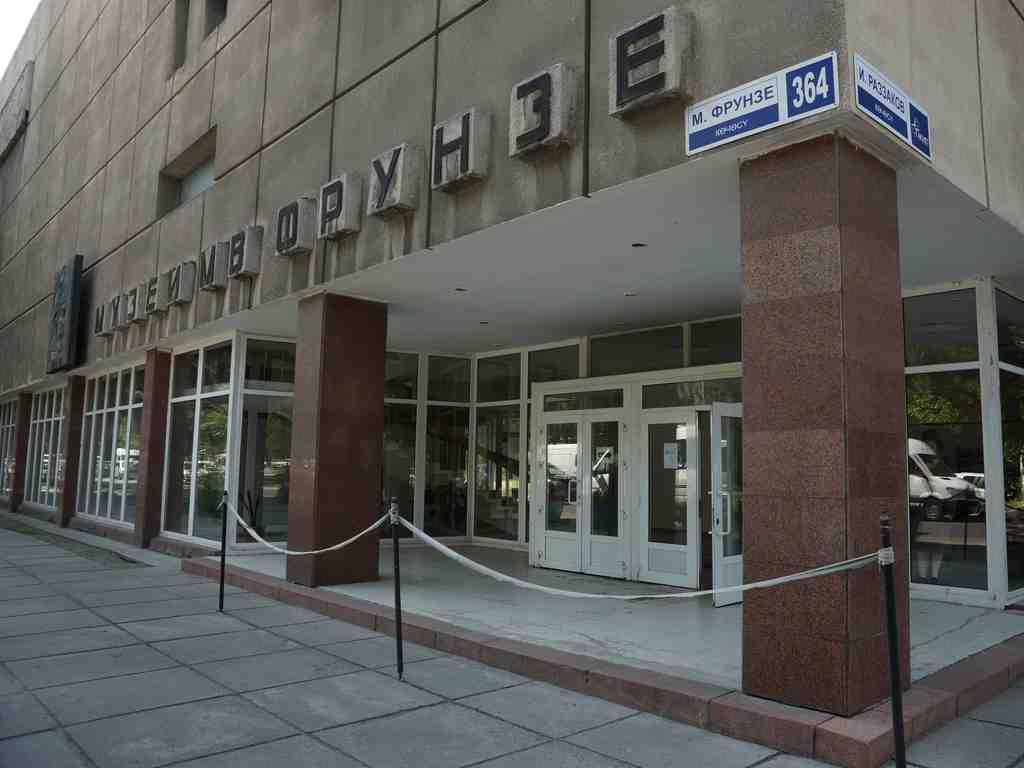
To spot the House-Museum of M. V. Frunze, just look for a bold concrete building with tall glass windows and big block letters above the entrance facing the street corner-if you see the address sign “M. Frunze 364” right at the intersection, you’ve found it!
Welcome to the House-Museum of M. V. Frunze! If these walls could talk, they’d surely trade stories from every decade of Bishkek’s colorful past-though they’d probably ask you to wipe your feet first. Right here, at this very spot, a great Kyrgyz tale began in 1885. In those days, it wasn't concrete and glass before you, but a humble house of adobe brick and a thatched reed roof, crafted by Vasily Frunze: a feldsher, or medical assistant, who set up both his family and his clinic in a cozy little wing that’s still preserved inside the museum today. Imagine the clinking of horse hooves on the dusty roads and the whisper of reeds on a summer evening.
This is the childhood home of Mikhail Vasilyevich Frunze-the boy who would grow up to become a revolutionary, general, and, not least, a bit of a local legend. His was a house full of busy hands: medical bags and white coats hung by the door, a kitchen full of the aroma of rye and tea, a samovar bubbling on the table, and a spinning wheel whirring beside sunlit windows decorated with potted plants. Even the children’s room was alive, with carpets on the walls, wooden cribs, a toy rocking horse, and Frunze’s own childhood desk cluttered with candles, inkwells, and glass jars. It was a window into the world of Pispek’s first settlers at the turn of the 20th century-a frontier town with little more than ambition, dust, and dreams.
But time, like a nosy neighbor, kept peeking in. This place changed hands many times: after the Frunze family moved away, doctors, tailors, notaries, and even military officers lived here, spinning their own stories into the walls. Then, in 1925, the new Soviet government decided this spot deserved to be more than just a footnote. They founded a museum in honor of the famous Mikhail Frunze, preserving its old wing and filling it with family treasures, handwritten notes, medals, and extraordinary weapons-like a richly decorated saber that once belonged to the Emir of Bukhara and was later given to Frunze by revolutionaries in gratitude. Imagine unwrapping that gift; it certainly beats a pair of socks!
Now, here's the twist: in the 1950s, the city needed more space for this growing collection, so the original family house was mostly demolished-except for the wing you can still spy through the modern glass facade. The whole museum was re-imagined by architects inspired by the spirit of modern Soviet monumentalism. Today, what you see is an imposing building with light gray concrete, mighty pillars, and solemn Soviet-era bas-reliefs showing scenes of revolution and war-along with Frunze’s own copper profile, keeping an eternal watch above the door. There's even a forest of Tien-Shan fir trees outside, planted to give the entry a stately air. Inside, the first floor lets you peek into the very rooms where the Frunze family once lived and worked.
Step up and you’ll find yourself walking through time: the second and third floors house ever-changing exhibits and an airy hall, big enough to hold 570 square meters of history, talks, and even the occasional film screening. There are over 13,000 items hidden away in its collection-each, perhaps, with its own secret to tell. From Frunze’s famous papakha hat to his Nagan revolver, and even the original baptism record from a remote village church, every object helps peel back another layer of mystery about the man and the city that shaped him.
Of course, not every museum can boast an Order of Friendship of Peoples from the Soviet Union as this one can-a medal for teaching generations of visitors about patriotism, history, and the bond between cultures. Even now, the House-Museum trains its gaze on both the distant past and the ever-changing present, reminding us that every great story starts in an ordinary room. And hey, if you listen closely, you just might catch an echo of life from a century ago, when a mischief-making boy named Mikhail once played right where you stand.


