
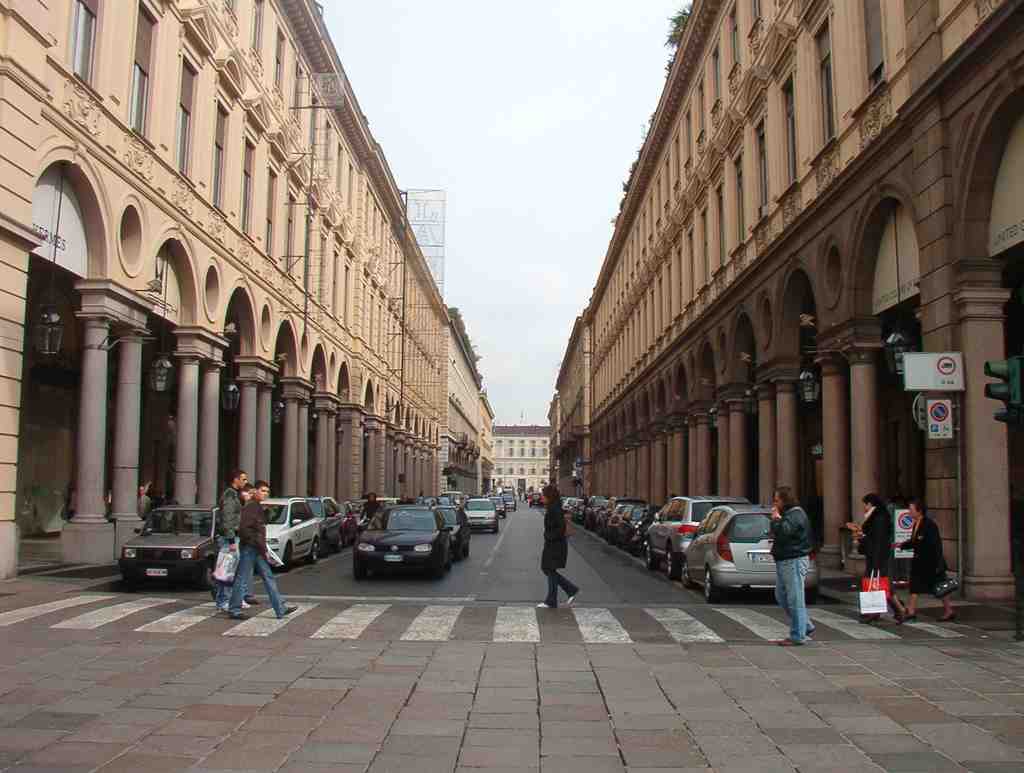
To spot Via Roma, just look straight ahead for a grand avenue stretching between rows of tall, elegant arcades-those impressive archways make the street look almost endless and frame a lively view full of shoppers and city verve.
Now, take a breath and let’s stroll back through time. Picture Turin at the end of the 16th century: a city on the brink of transformation, with the duke himself, Carlo Emanuele I of Savoy, dreaming up what would soon be known as the “Via Nuova.” This street, designed by the clever architect Ascanio Vittozzi, wasn’t even 10 meters wide at first-hard to imagine given how broad and powerful it feels today! It quickly shot to fame, one of Turin’s most important arteries, and even caught the eye of city officials. At one point, they had to decree, very seriously: “No building taller than the cornice!” (I imagine that caused a lot of tall hats to go out of fashion.)
For decades, Via Roma marked the very pulse of city life, though up until the 19th century, it didn’t stretch as far as it does now. It was only thanks to Carlo Felice of Savoy that Turin pressed onward, extending the street further to meet the needs of an ever-bustling capital. But don’t get too comfortable yet-the real shakeup came in the early 20th century. The street might have looked beautifully baroque from a distance, but it was a wild parade up close: rattling trams, wandering vendors, cinemas aglow, and so many food stalls that even the most disciplined shopper couldn’t resist a taste.
The city soon realized chaos needed some order. Enter a new architectural vision! In the early 1930s, Via Roma underwent a transformation more dramatic than my haircut in the 80s. New buildings in an eclectic style appeared, with harmonious porticoes paved with dazzling, colorful marbles sourced from all over Italy. The street was so fancy, at one point the road itself was covered with wooden blocks-not just for the look, but for the gentle, almost springy step they offered. Sadly, the wood had to go after World War II, when bombings left their mark, replaced by today’s handsome stone.
Oh, but the drama isn’t over! In the 1930s, an even bolder makeover swept the rest of the street. The architect Marcello Piacentini orchestrated the southern half, clearing old blocks to make way for something truly modern: imposing rationalist buildings, like the famous Hotel Principi di Piemonte, and rows of porticoes lined with mighty twin columns. Overhead, new lamps glowed-some modeled on antique gas lanterns, others with a trendy 'novecento' flair, depending on which section of Via Roma you strolled.
You might notice that nearly all the doorways and car entrances are missing here. That’s on purpose-maximum space has always gone to the shops. Ever since its rebirth, Via Roma has been the heart of Turin’s shopping scene. Under these high, bright porticoes, the city’s best-dressed citizens still parade between elegant cafes, famous boutiques (don’t forget those historic pastry shops), and the irresistible shoe and clothing shops that lure you in with every window.
If you’re wondering why you don’t hear the rumble of a subway beneath your feet, here’s a twist: there are vast underground spaces running the length of this street! The original plan was to build the city’s very first metro line here in the 1960s, but it never materialized. Instead, these spaces, after a few adventures, became Turin’s grandest underground parking garages.
Today, most of Via Roma is pedestrian-only-a stage for all of Turin to see and be seen. Plans are underway to complete the pedestrian dream, bringing even more laughter, footsteps, and stories to these historic stones. So, as you stand here, take in the echo of centuries. Imagine the lively market stalls, the elegant barons keeping an eye on their hat heights, the melodies of trams and chatter, and the promise that Via Roma, no matter how times change, will always be the beating heart at the center of it all. And don’t worry, you don’t need a tall hat to fit in-just a sense of wonder!


