
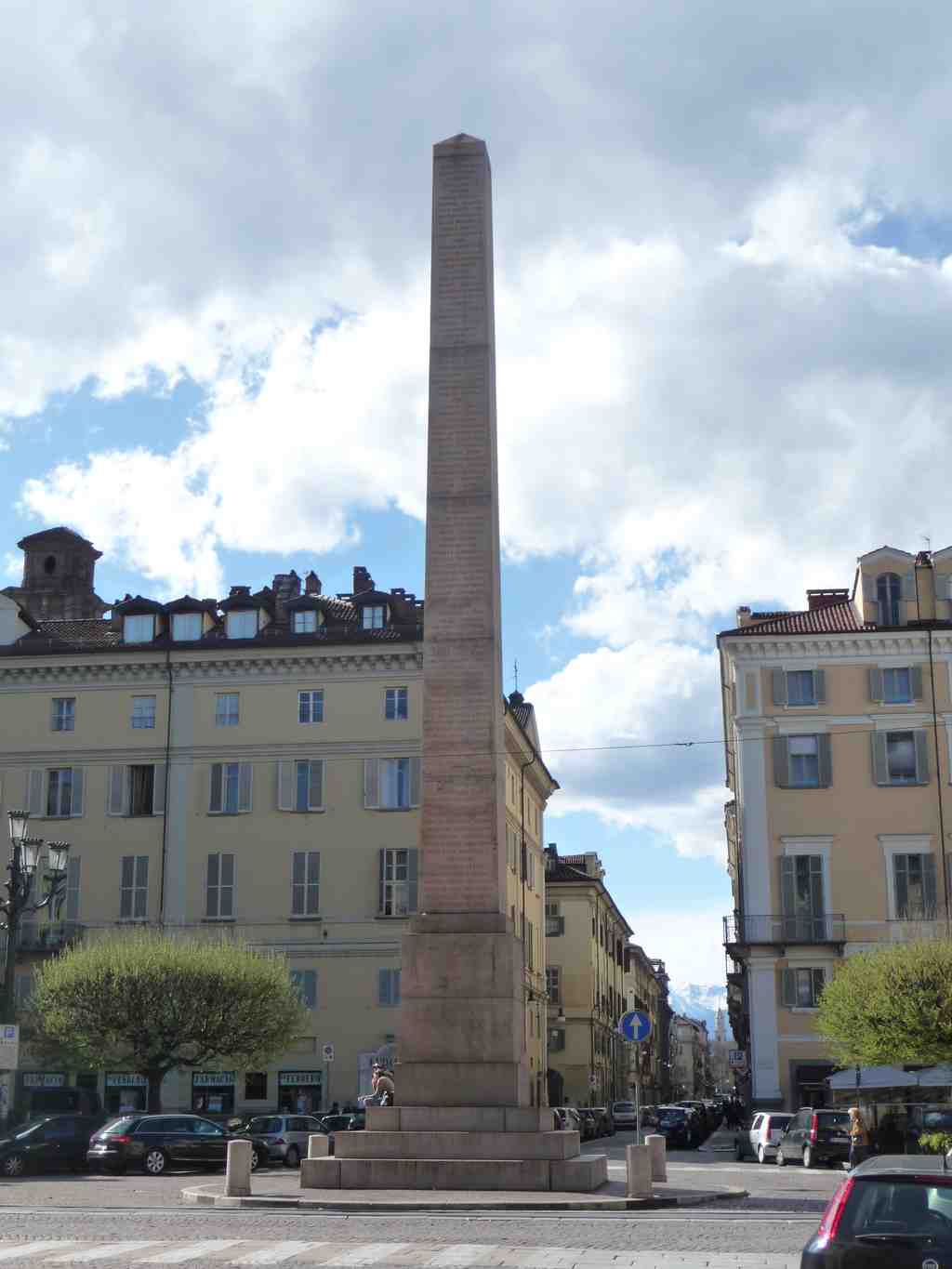
To spot Piazza Savoia, look straight ahead for a tall, pale granite obelisk rising proudly at the center of an open square, surrounded by elegant yellow buildings and trees-a sight that truly stands out as you approach.
Let’s jump right into the curious, unpredictable, and sometimes dramatic history of Piazza Savoia-though, if we’re being honest, the locals often call this “Piazza Obelisco” for a reason! Right now, the 21-meter-tall granite obelisk is impossible to ignore, but centuries ago, you’d have found the busy western gateway to ancient Turin-and maybe, if you’d lingered too long, an impatient Roman urging you to get out of their way. This was once the end of the mighty decumano maximus, the original Roman road cutting straight through the city, which led travelers directly out to the Via delle Gallie and west towards France.
As time wound through the centuries, the old Roman gate transformed and took on new names. In the 6th century, it became known as Porta Segusina, because here began the journey to Susa in the mountains. By the 10th century, even the noble Arduinici family felt this spot required a little medieval bling, so they set up a castle-fortress right where you’re standing-try to imagine armored counts and the famous Countess Adelaide of Susa glancing down from their windows! Of course, castles and city walls don’t last forever, and by 1250, Count Pietro II of Savoy decided he needed a new castle, so down came the old one. The area stayed bustling; for centuries, it was a critical turn-off on the pilgrimage route called via Francigena, leading devout Christians southward across Europe.
Fast forward to the 18th century, and the square started getting its current, elegant look. Michelangelo Garove drew up the first plans for this cozy and sophisticated piazza, intended to be adorned by palaces for the city’s “who’s who.” To the north, you'll notice the stately Palazzo Martini di Cigala, crafted by the celebrated Juvarra, while on the south side stands the Palazzo Baldassarre Saluzzo di Paesana, whose underground tunnels sparked their fair share of whispered rumors about secret passageways.
Yet nothing in Turin ever stays quietly dignified for long: when French troops arrived in 1798, out went the old names and in came “Place de France.” Then, after the monarchy returned, it became Piazza Paesana, and for a while, it even turned into a lively flea market known as mercà dij busiard-imagine stalls piled with treasures and trinkets, and plenty of haggling in Piedmontese dialect!
Now, let's talk about the main attraction-the obelisk. Erected in 1853 and towering above your head, it celebrates the Siccardi Laws, major reforms in 1850 that lessened the church’s legal privileges and stirred up more than a few heated arguments in Turin. Support for the monument came from all over, with 800 communities' names carved on its sides. There’s even a time capsule in the base-containing newspapers, laws, coins, rice, breadsticks, and a bottle of Barbera wine. That’s right, even the obelisk was prepared for a party! And during WWII, when bullets flew and mortars threatened to topple the monument, it shook but stood strong-restored after the war and again in 1993. Today, it’s a symbol of the city’s spirit: a little bit rebellious, a little bit grand, and always ready for the next chapter.
So, standing here in Piazza Savoia, the air filled with the echo of centuries of change, you are at the crossroads of pilgrims, palaces, protests, and pastries-Turin’s past and present all in one lively, sunlit place.


