
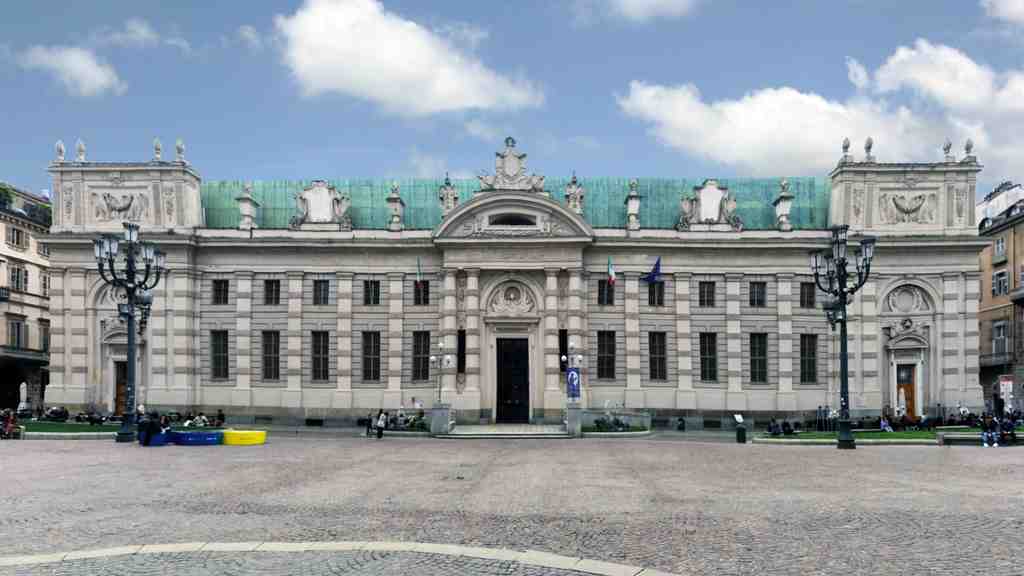
Straight ahead, you’ll spot a grand, symmetrical building with a row of tall windows and a striking green copper roof, its elaborate stone façade framed by two ornate towers and elegant street lamps nearby-this is the National University Library of Turin.
Picture yourself here in the early 18th century: dusty volumes stacked high, the echoes of learned professors bouncing through newly built halls, and the city crackling with the excitement of a growing hub for knowledge. In 1720, Duke Vittorio Amedeo II decided Turin needed a true treasure house, merging the Savoy family’s 14,000 precious volumes with the university’s growing book collection. Thus, Turin’s first public library-actually the very first in the Kingdom of Italy-came to life here. Over the centuries, it’s swallowed up donations, collections, acquisitions, and a mountain of academic work, growing ever more labyrinthine. Can you imagine: over 1.3 million printed volumes and thousands of manuscripts, some of which are older than Turin itself!
Now, this library’s story isn’t just dusty tomes and quiet reading rooms-it’s more dramatic than some people’s love lives. Picture the year 1904: on a cold January night, five of the library’s grand rooms are engulfed by fire. Rare manuscripts-some illuminated, dripping with golden ink-curl into ash among the falling timbers. About one-third of the library’s manuscript collection, and tens of thousands of books, vanish in a single, smoky disaster. But you know scholars: nothing stops them, not even when their workplace smells like burnt parchment. Rescue teams moved fast to save damp, scorched remains, and set up the nation’s very first book restoration lab. Imagine experts hunched over battered books, blackened pages, and crumbling spines, somehow transforming them back into readable history. There’s even a reconstruction of that original lab inside, complete with century-old tools and photo displays-sort of the “ER” of books.
Rising from smoke and ruin, the library also became a magnet for generosity. Manuscripts and books poured in from across Europe and the world, universities and collectors eager to refill Turin’s bookshelves. It was a comeback worthy of a movie montage: by 1911, the library’s collection had leapt back to 400,000 volumes, with stacks of works still awaiting their turn for restoration.
The library moved through endless growing pains. It wasn’t always in this splendid building; for years, books were packed into anywhere with decent humidity and not too many pigeons. Plans for new, fireproof halls-using the stables of Palazzo Carignano right across the square-were put on pause by wars and bureaucratic delays. By the late 1950s, this epic saga ended in success: a team of Italian architects finally created the building you see before you, preserving the original stable façade but hiding a modern, fire-resistant book lover’s paradise within. By 1976, the National University Library of Turin opened here, gleaming with new hope (and, crucially, improved fire safety).
But let’s talk treasures! There’s the legendary collection of Vivaldi manuscripts-450 pieces, the notewise signature of the maestro himself, donated in a grand act of remembrance and civic generosity. There’s also the Corpus Juvarrianum, over a thousand drawings by the brilliant architect Filippo Juvarra, spanning not just buildings, but theatrical scenes and baroque decorations. And don’t forget the collection of Queen Margherita herself: 13,000 elegantly bound volumes that cover everything from poetry to pasta-making-okay, maybe not the pasta making, but you get the idea.
Even today, if you step inside, you might encounter exhibitions of rare books or end up in the Auditorium Vivaldi-a spot where the music of history literally sits beside you. Not bad for a place that once weathered fire, war, and the occasional melodramatic librarian.
Go on, look up at its statues and carvings and just imagine the stories each book inside could tell-hopefully without bursting into flames this time!
If you're keen on discovering more about the patrimony, restoration workshop or the exhibition rooms and auditorium, head down to the chat section and engage with me.


