
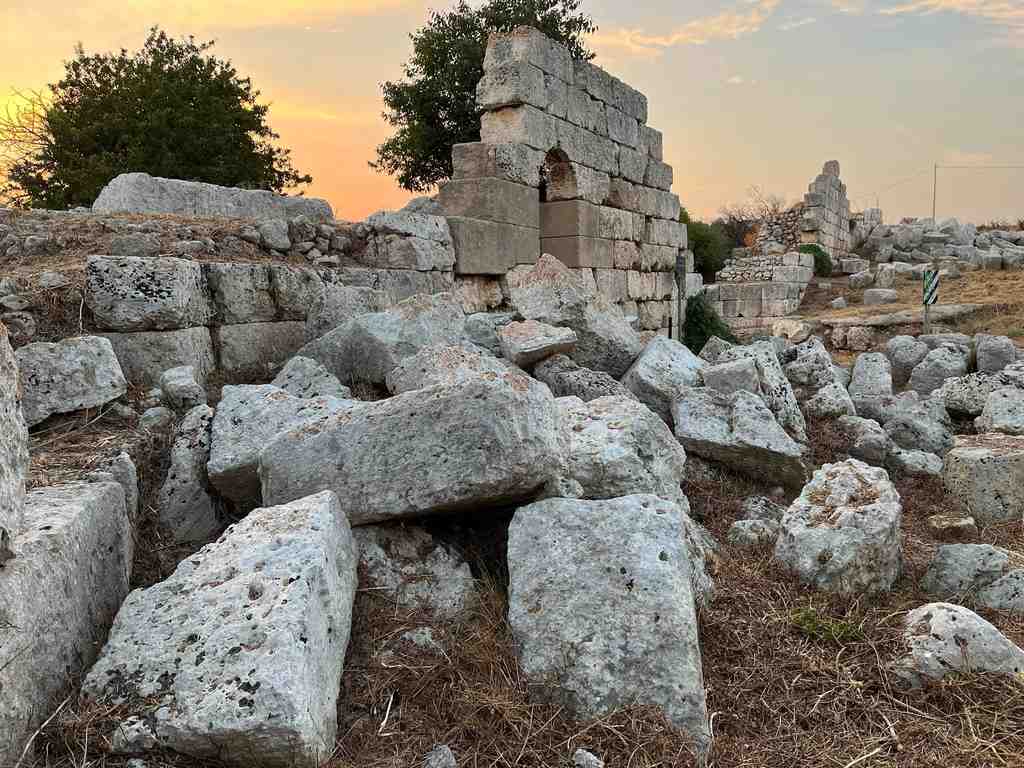
Look ahead! You’ll spot huge, weathered limestone blocks, some tumbled and some still stacked to form a crumbling, ancient wall snaking across the rugged landscape-these are the Dionysian Walls.
As you stand here gazing at these silent giants, just imagine: it’s the year 400 BC, and instead of today’s quiet breezes, the air is bustling with shouts, hammering, and the thud of immense stone blocks being stacked up, one after another. These mighty walls were ordered by Dionysius I, the cunning tyrant of Syracuse, who thought, “If you want to keep your city safe, make your walls so big that even the Romans will have to stop and scratch their heads!” He wanted a fortress so strong it could take on all comers, and he really pulled out all the stops-literally. More than 70,000 slaves and 6,000 oxen worked in tandem, moving 300 tons of stone every day to encircle the entire plateau of Epipoli.
It wasn’t just heavy lifting, though-Dionysius used the landscape itself. These walls snake along the natural slopes, giving guards a sweeping view for miles. “See those hills?” a sentry might have said, “If any invaders show up, we’ll spot them before they even put on their sandals!” In fact, from the tip of the northern shore all the way to Ortigia Island, and down south to the great port, the walls hugged the city tight-a massive 21 kilometers long! If you count the ones weaving around Ortigia too, that’s 27 kilometers. Rome’s famous Aurelian Walls? These gave them a run for their money!
And there were gates, too-like hidden trapdoors in a magician's hat. Up north near what’s now the Eurialo Castle stood the Trypilon gate, another to the south where Viale Epipoli stretches today. The Scala Greca quarter still whispers about Porta Scea, and the not-quite-lost Exapilon would’ve led you straight to the main roads heading north. Imagine travelers centuries ago, stopping before these immense guarded portals, their hearts pounding, eyes wide with awe!
But these weren’t just walls-they were legends. When Carthage came knocking in 397 BC, the whole city huddled inside, silent but unbroken, as the walls stood firm. Later, the Romans found their advances thwarted. Enter Archimedes, Syracuse’s answer to modern science fairs! With his famous burning mirrors, he supposedly set Roman ships aflame right from these heights. Who needs dragons when you have Greek math?
Eventually, though, even the strongest wall meets its match. The Romans managed to conquer Syracuse centuries later, but they respected these stones so much they strengthened them even more-it was serious business to own a city this tough! But as time passed-Byzantines, Arabs, Normans, you name it-the walls were chipped away, their stones taken for new buildings. The earthquake of 1693 finished the job, tumbling what was left.
Yet here you are, on the ruins rediscovered by archaeologist Paolo Orsi. UNESCO calls these ruins masterworks, and who can argue? Even 18th-century travelers were spellbound-measuring these stones, claiming they could rival the walls of Paris! Plans are in the works to build a grand park so folks like you can stroll through history. For now, close your eyes and let the echoes of those ancient builders, the clash of swords, and the wild inventions of Archimedes bring these broken stones back to life. And whatever you do, don’t try to move a block-unless you brought your own team of 200 oxen!
For further insights on the the city gates, numbers of the walls or the travellers' descriptions, feel free to navigate to the chat section below and inquire.


