
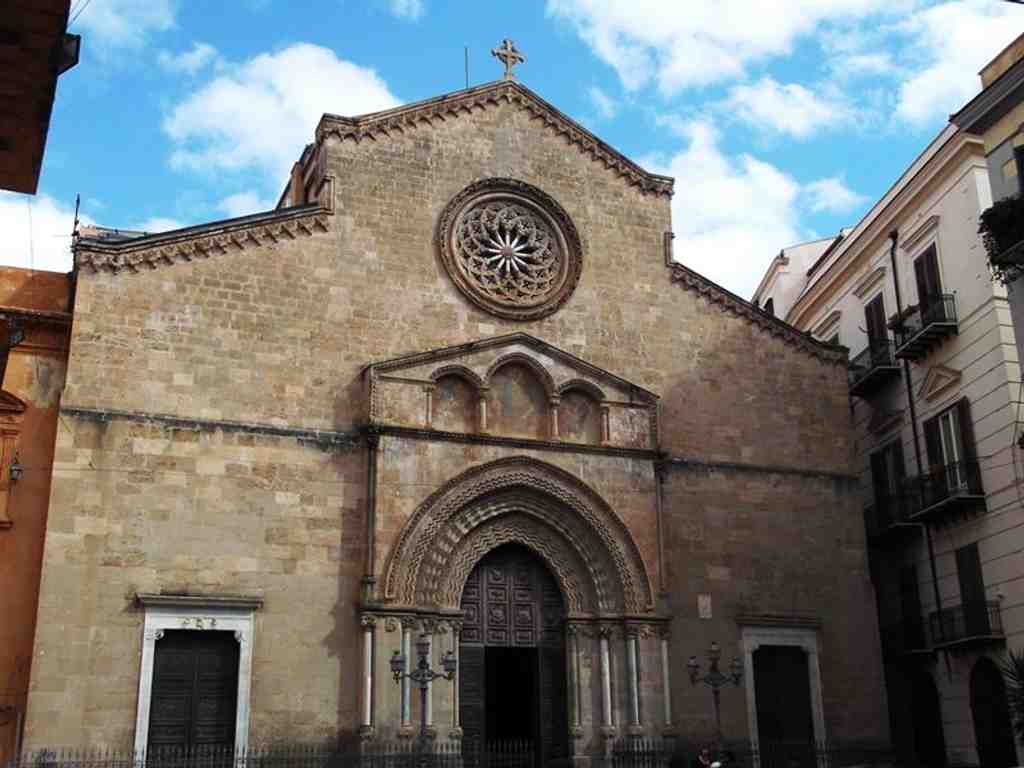
To spot the Church of San Francesco d’Assisi, look straight ahead for a grand, honey-colored stone facade with a striking circular rose window above a tall, pointed arch entrance richly decorated with medieval patterns.
Welcome to the Church of San Francesco d’Assisi, where the stories echo through every stone and archway! Imagine yourself here nearly 800 years ago, when this spot wasn’t filled with quiet anticipation but with the loud clang of hammers, mingled voices in many languages, and the ever-so-dramatic hustle of medieval Palermo. The story starts all the way back in 1224, when local troublemakers-yes, the clergy and even some Saracens-actually chased the early Franciscan friars right out of the city! The friars, still barefoot and full of hope, hurried off to the mainland, where they pleaded their case to none other than Pope Gregory IX. The result? A papal order demanding their return and the rebuilding of their church. A little lesson for all of us: never underestimate determined monks with connections!
Of course, fate in Palermo is rarely straightforward. As soon as the Franciscans started rebuilding, along came Emperor Frederick II who, mid-drama with the Pope, decided to destroy their new project. Only after Frederick passed away could the friars return, rolling up their sleeves once again in 1255 to finally lay the first stones of the church you see ahead. There was even a battered old defensive tower nearby, repurposed as the original bell tower! The air must have constantly rung with the tap-tap-tap of masons and builders-if only these rocks could talk…
By the 14th century, a new era began. The Chiaramonte family, Palermo’s own medieval heavyweights, stepped in to sponsor the grand new Gothic portal-go ahead, admire those zigzag carvings and imagine wealthy lords arriving in their finest silks! A few centuries later, the church didn’t just serve prayerful locals, but became a bustling center for city life. Major Sicilian families, Genoese and Pisan merchants, and even the Parliament of Sicily all took their turns here. The chapels inside-sixteen in all!-became family monuments, filled with marble statues, golden altars, and intricate paintings.
Step closer and notice that beautiful rose window. That’s a modern reconstruction, but it harks back to the original design, which was shattered by an earthquake in 1823. In fact, the church has played a part in nearly every era of Palermitan drama-earthquakes, Renaissance renovations, debates, processions, baroque upgrades, and unfortunately, the bombing raids of World War II. In 1943, explosions tore through the left nave and shattered centuries of artwork, leaving the church mournfully exposed to the weather and to history’s sometimes rougher hands. But like any true Palermitan, the Church of San Francesco refused to be beaten down for long. Long restoration projects returned it to its medieval glory, pulling away later opulent decorations to let the ancient stone and soaring arches shine again.
Don’t let its calm face today fool you-inside, there are treasures from some of Italy’s greatest artists. You’ll find chapels filled with marble works by the Gagini family, vibrant baroque stucco by Giacomo Serpotta (the guy who could turn plaster into pure poetry), and frescoes by Pietro Novelli. Lucky you, standing here, where famous artists wrestled inspiration onto stone and where, at one time, the city’s elite vied for their slice of sacred immortality.
The convent next door wasn’t just for quiet prayer, either. It was an intellectual powerhouse, where friars studied everything from grammar and philosophy to Greek and even Arabic. For a long time, this was where the cleverest minds in Sicily swapped ideas-sort of like the medieval version of a university campus, but with better habits and, hopefully, less student debt.
So as you look up at that magnificent facade and ornate rose window, let yourself drift back and forth through time-from the anxious friars seeking sanctuary, to the buzz of medieval craftsmen, to the bombs of the modern era, and finally, to today’s sunlit calm. Palermo may have changed around it, but the Church of San Francesco d’Assisi remains-a survivor, a witness, and a living piece of Sicily’s unstoppable spirit. And remember: don’t try to outlast a Franciscan church in Palermo. They always come back stronger!
Intrigued by the description, the right aisle on the south side or the the left aisle on the north side? Explore further by joining me in the chat section below.


