
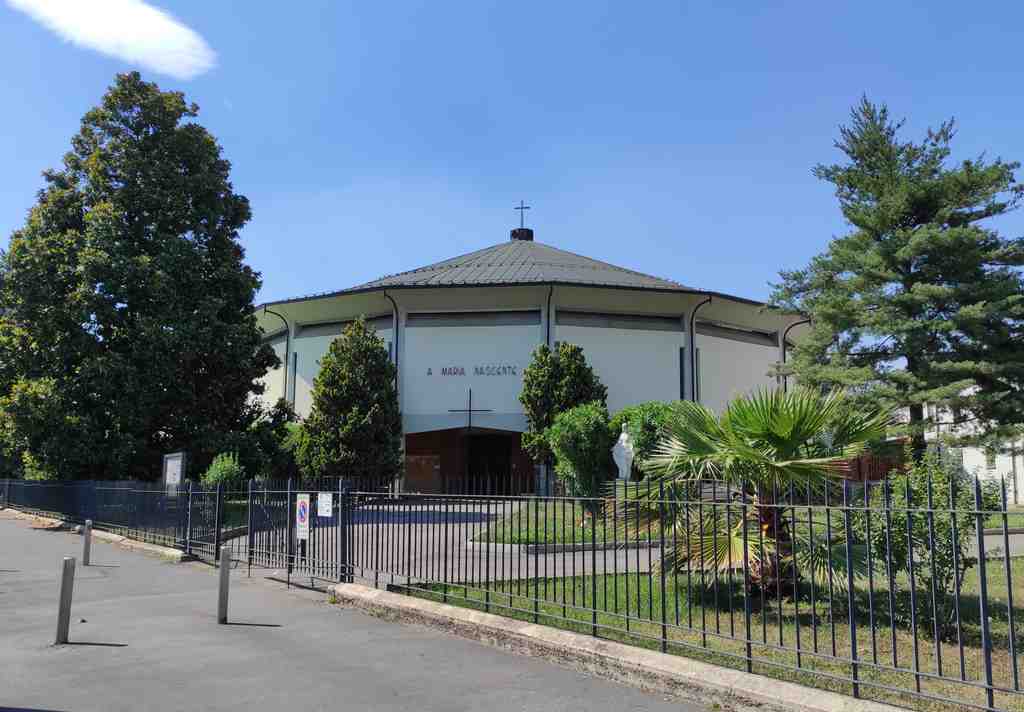
You’re looking for a round, modern church with a sloping roof, pale walls, and a cross perched on top, nestled behind a garden and almost peeking out from behind rows of green trees-you can spot it by its circular shape and the sign “A MARIA NASCENTE” above the entrance!
Welcome, traveler, to the Church of Santa Maria Nascente, the architectural heart of the QT8 district! Picture yourself standing here in the late 1940s-Milan is still licking its wounds from the Second World War, and the city’s greatest minds are imagining new ways to rebuild, to bring community and hope back to every corner. It’s 1947, and the buzz of the Triennale fills the air-imagine a flurry of excited voices as architects Vico Magistretti and Mario Tedeschi dream up something striking: not a traditional church, but a symbol of rebirth at the center of a brand-new neighborhood!
Step closer, and let the modern lines work their magic. This isn’t your classic, fortress-like cathedral. The church was drawn up for the QT8-a neighborhood literally built as a model for postwar living, created practically from scratch! Fun fact: the first church design competition actually wanted to place it somewhere else, but Magistretti and Tedeschi’s plan was so clever, it adapted gracefully to its final home, right here, where you’re standing now. In 1953, the blueprints became bustling construction, and only two years later-almost like a race against the clock-the church complex opened its doors to the public in 1955.
It might surprise you, but the church was almost like an unfinished symphony: open since 1955, it wasn’t actually consecrated until 1980, when Cardinal Carlo Maria Martini finally sealed its destiny. So if the building seems peaceful and timeless today, remember, it waited a quarter century for its final blessing-talk about being fashionably late to your own inauguration!
Look up at the bold shape-the circular base is actually made by shifting two big, offset circles: one for the church itself, and another for the porch that wraps around, as if the building is giving the world a big, concrete hug. The whole thing is held up by sixteen giant pillars of exposed, bare concrete, so no nonsense here-just modern strength on display! Up top, a band of windows lets the daylight peek in, creating a ring of gentle light under the big tiled roof.
Inside, there’s a cozy warmth from exposed bricks-no hiding behind paint! Curved walnut panels form the backdrop for the women’s gallery, while a handful of steps take you up to the circular altar at the very heart, crowned by a wooden crucifix all the way from Val Gardena. Glance left, and there’s a little surprise: a modern bronze altar tucked inside the circular baptistery, its copper roof glittering in the sun like a hidden gem.
Don’t miss the high-up balcony above the door: that’s where the mighty Tamburini organ lives, a 1950s marvel with pipes that could shake these walls, and keys ready for the next musical genius who walks through the door.
This church is Milan’s postwar optimism carved in brick, concrete, and hope-a round beacon of community that’s been waiting to greet visitors (fashionably late or not!) for nearly seventy years. Now, shall we keep moving and see what else this remarkable neighborhood has to share?


