
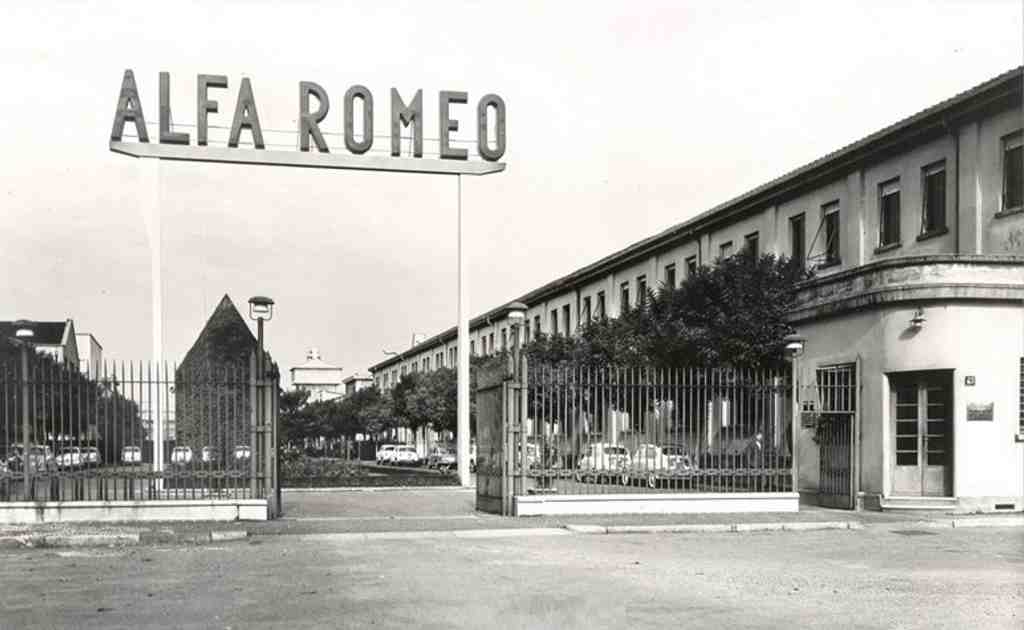
If you look just ahead, you’ll spot a large, bold “ALFA ROMEO” sign perched high at the entrance gates, with a long, rectangular, two-story factory building stretching out behind it-just follow the fence-lined driveway between the rows of trees and you can’t miss it!
Now, take a moment to soak up the scene-imagine yourself standing here over a hundred years ago, right at the beating heart of Italy’s automobile dreams. This is the legendary Portello Alfa Romeo plant, where Milan’s streets once echoed with the clatter of engines and the hopes of thousands of workers. Built way back in 1906, when this part of Milan was more open fields than concrete jungle, the very air would have smelled of hot oil, new steel, and, if you were lucky, the sharp thrill of innovation.
Picture a young engineer in a crisp shirt, perhaps Giuseppe Merosi himself, sketching out the very first “24 HP” model, while workers in flat caps and overalls push carts piled with crankshafts through these gates. In those days, the factory wasn’t just a workplace-it was a symbol of Italian ingenuity, and the site was chosen for its perfect placement: right alongside major trade routes to France, Switzerland, and the rest of northern Italy. No wonder the area quickly filled with other car companies-FIAT, Citroën, Isotta Fraschini… it was like the Silicon Valley of vintage engines!
But trouble never waits long. In 1909, just three years after it was founded, the original French backers pulled the plug. Instead of lights out, Milan’s bankers swept in and bought the place, transforming it into “A.L.F.A.”-the Anonima Lombarda Fabbrica Automobili. With a new name, 250 hopeful employees, and big dreams, they aimed to roll out 300 new chassis a year. That might sound modest, but in Italy, building cars was still an art, not yet the mass production machine roared to life over in America by Ford.
Just when they were hitting their stride, World War I slammed on the brakes. Suddenly, the plant wasn’t making cars for Milanese families anymore-it was producing trucks, air compressors, and, yes, even flamethrowers and airplane engines for the war effort. You wouldn’t have wanted to linger at the gates then, as the hot rhythms of assembly lines were joined by the thunder of heavy machinery and the scatter of marching boots. By 1919, after the dust of war had settled, over 2,000 people worked inside these walls.
The factory’s fortunes rose and fell with the wild tides of Italy’s twentieth century. After the horror of the Great War, the Portello plant tried to find its feet: tractors for a nation that badly needed to feed itself, beautiful new car models for an audience hungry for a hint of style after years of hardship. Alas, the tractor “Romeo” didn’t exactly sweep the market-perhaps it just wasn’t as good at cornering as Alfa’s sportier models!
Still, the 1920s and 30s brought a golden age. Race cars like the RL and the legendary 6C thundered out of these gates, engines tuned for both style and speed. If you listen hard enough, you might imagine the whine of an 8C engine or the cheers of crowds as Alfa cars whipped around the banking at Monza. At the same time, the plant boomed with heavy-duty production-buses, trucks, even aircraft engines, with thousands of workers bustling day and night beneath these roofs. By 1937, over 6,000 people were clocking in, and the plant stretched even further north, eventually divided by a tunnel running beneath the street-so you never had to dodge Milanese traffic to get from engine block to finished car.
The Second World War brought devastation. The plant’s importance made it a target, and in the bombings of 1943-44, much of the old Portello was destroyed. But like any good Milanese, the factory dusted itself off and started again. When the war ended, the site was rebuilt from the ground up, and the air filled once more with the clang of tools and the laughter of workers who finally hoped for peace.
The 1950s and 60s saw the rise of new legends: the Giulietta, the 1900, even a French import, the Renault Dauphine, assembled right here as factories around the city celebrated an age of prosperity. Conveyor belts rolled in, with sparkling new automation-out went the old days of handbuilt chassis; in came the era of crisp uniforms and teamwork, with assembly lines humming like mechanical orchestras. By then, Milan was growing rapidly, and before long, the city swallowed the countryside all around. Space got tight, and the decision was made: Alfa’s future would be at the bigger Arese plant outside town. Portello’s last cars, including the prized Alfa Romeo 2600, rolled out in the 1960s.
By the 1980s, only memories and a handful of loyal workers remained. Piece by piece, the plant was dismantled, and finally, in 2004, the last walls were brought down. Yet for all those years, this was not just a place where cars were made-it was a place where generations found hope, families built futures, and Milan wrote itself into the legends of the road. So, as you stand here, imagine the clang of steel, the whirr of engines, and the hum of dreams that once echoed from these very gates.


