
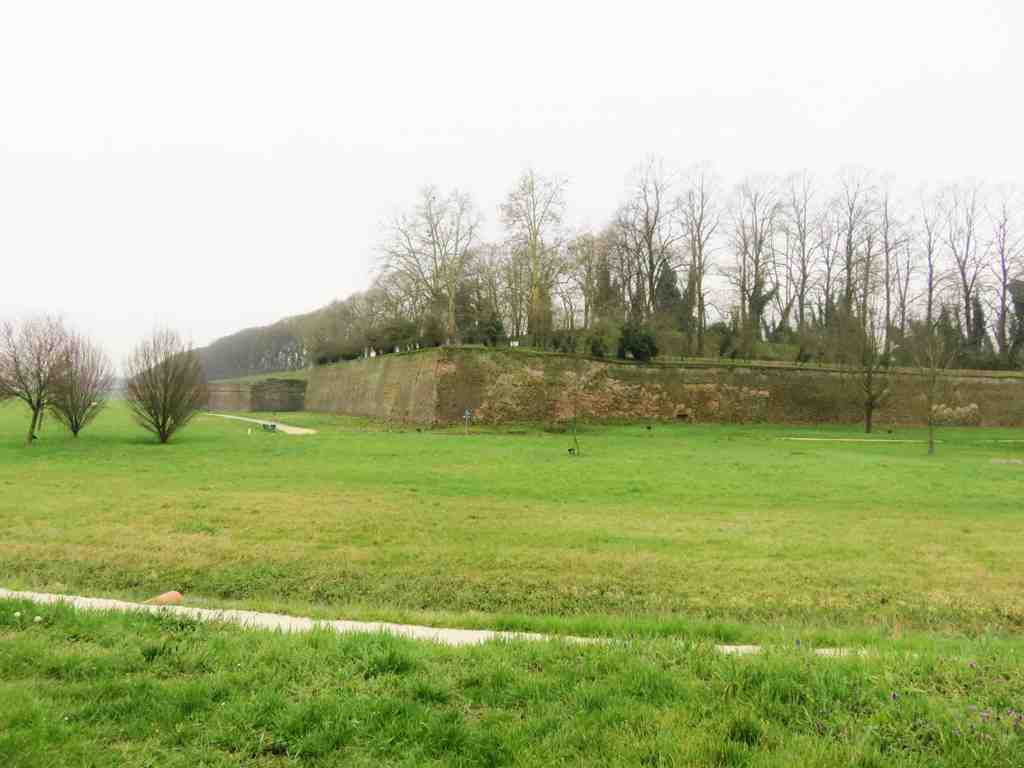
To spot the landmark, just look ahead at the wide, grassy parkland stretching up to a mighty brick wall topped by bare, wintry trees-those towering walls are the famous city fortifications that shape Ferrara’s unique urban landscape.
Now, let’s imagine ourselves strolling through the centuries while standing here… Ferrara didn’t just pop out of the ground as the enchanting “City of the Renaissances”-she grew, brick by brick, behind these endless walls that snake through the city. It all started with a tiny Byzantine fort on an island among winding river channels-picture a huddle of muddy soldiers, wary of invaders, peeking out from behind early ramparts. That humble fort became the embryo of Ferrara, thanks to floods, trade-and, of course, the constant fear of “who’s coming next?” The city’s fate took a twist when everyone packed up from a nearby town called Voghenza, which was being battered by barbarian attacks. After a memorable bishop was killed-let’s just say he didn’t get the world’s best Yelp review-everyone decided it was time to move somewhere a bit safer. In a stroke of brilliance, or maybe a roll of the dice, they chose Ferrariola on the riverbank, kicked off some marsh draining, and the great experiment of Ferrara began.
As Ferrara battled its way through the medieval ages, it was the walls you’re looking at that shaped everything. The people living inside them saw the city transform from a rough cluster of huts and new churches into a bustling hub of markets, palaces, and-of course-plenty of intrigue. There were times these walls were pressed by armies, threatened with collapse, and even lines of escape during rebellions and mysterious plots. In 1492-when most people were getting lost looking for America-the Duke Ercole I d’Este and his court architect Biagio Rossetti were busy doubling the city’s size. Their solution? A revolutionary town plan called the Addizione Erculea, which was so clever people started calling Ferrara the “first modern city in Europe.” The idea was to weave the roads in perfect harmony, inspired by ancient Roman thinking. You can thank them for Ferrara’s mathematical layout-a grid that really puts my sock drawer to shame.
On your right or left, depending on where you’re standing, Old Ferrara clings to its medieval roots, the kind of spots where you’d find secret alleyways, proud cathedrals, and the mighty Castello Estense. March north and you walk right into Renaissance Ferrara: palaces with diamond-shaped stones, sweeping avenues, and those grand intersections where nobles probably debated whether red velvet or gold slippers were the season’s must-have. The atmosphere must have been thick with horse hooves, church bells-and the odd crafty merchant hoping to avoid city taxes.
After the Este family packed their bags in 1598-honestly, no hard feelings, they just had bigger fish to fry-the city became part of the Papal States. Shifts in power brought big changes: ghetto walls rose, old neighborhoods fell, and swathes of the city were reimagined or lost forever. Ferrara’s walls might have seemed quieter, but inside the city, the shape kept shifting with each new ruler and idea.
The 20th century brought a fresh round of grand city projects-imagine the buzz and clang of construction. The “Addizione Novecentista” saw whole new districts pop up, rationalist-style buildings from Italy’s more modern ambitions rising beside medieval towers. Even today, Ferrara’s neighborhoods, from the old heart to the newer edges, each have their own flavor-eight districts and a string of rural outposts, each with their own quirks and stories. And still, those mighty walls rise up, wrapped in grass and quiet but carrying centuries of tense nights, grand dreams, and the odd argument about who gets the bigger room in the castle.
So, as you touch these ancient bricks or stroll along the green banks, let your imagination fill the wide space with rowdy merchants, dashing Renaissance dukes, nervous soldiers, and hopeful city planners-knowing Ferrara’s real genius has always been its ability to adapt, protect, and reinvent itself behind these weathered walls. And just think-with all its changes, Ferrara never lost the knack for surprising the world.
Want to explore the foundation of the city, medieval period or the renaissance in more depth? Join me in the chat section for a detailed discussion.


