
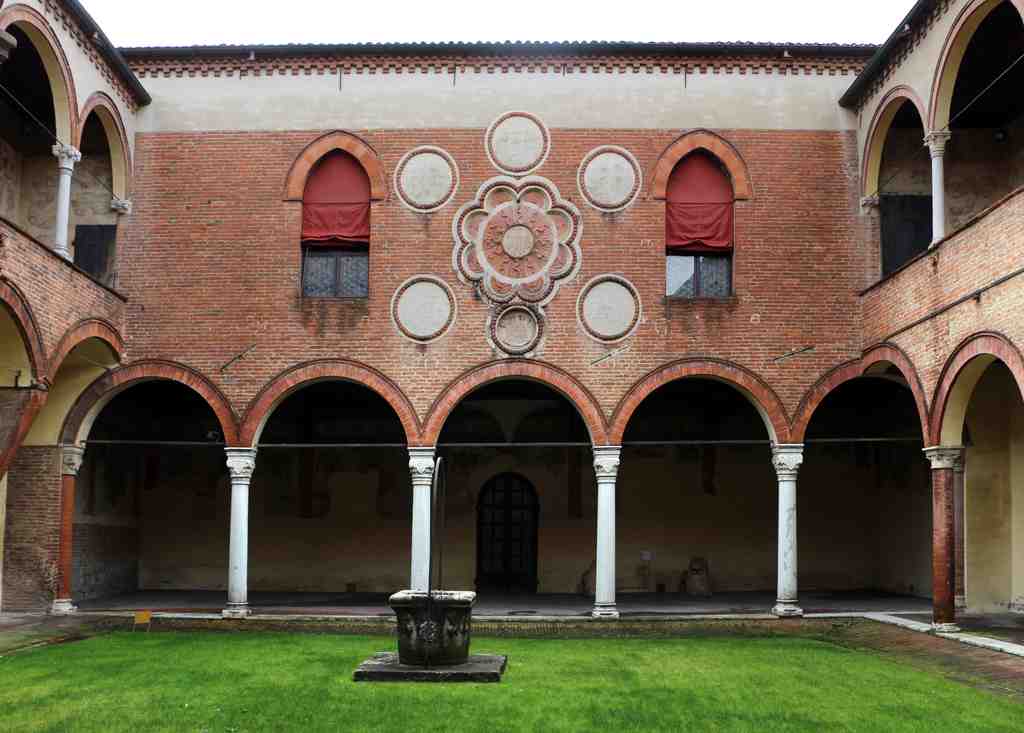
To spot the Romei House, just look ahead for a striking red-brick courtyard with elegant arches, white columns, and a large, decorative terracotta flower on the wall above - it’s impossible to miss if you’re facing the green lawn in front.
Let’s pause here in front of the Romei House - though trust me, this is no ordinary house, unless your house also looks like it sprang from a medieval fairy tale and is full of dramatic secrets from Ferrara’s past. Picture yourself in the middle of the 1400s: this grand building was crafted by Giovanni Romei, a wealthy merchant with an eye for style and maybe a bit of a flair for impressing his new bride, Polissena d’Este. The place got a stunning makeover just before their wedding in 1468, so think of it as the ultimate “happily ever after” renovation.
But this house wasn’t just about wedded bliss-it soon became tangled in the city’s twists of fate. After Giovanni’s death in 1483, he left the home to the nuns in the neighboring Corpus Domini monastery. Talk about unexpected roommates! For decades, the building blended into the cloistered world next door, but Ferrara never stays the same for long. In the 16th century, Cardinal Ippolito II d’Este, always a fan of grand gestures, ordered renovations that transformed many of the noble floors, decorating ceilings with jaw-dropping frescoes and even a few hidden grotesques-little artistic oddities peeking out if you know where to look!
Step into the courtyard, and you’ll see the late gothic style mingling with the new Renaissance mood of Ferrara. Right above you, that big terracotta monogram of Christ would have greeted every guest-a gentle reminder to behave. The interiors will wow you even more: the ground floor glows with gothic decorations and the "Room of the Sibyls," where painted prophetesses stare down from the walls, all clutching scrolls of their prophecies. If you feel judged, remember-every guest since the 1400s has had the same reaction.
Upstairs, the noble floor is a time capsule of ancient luxury. Imagine the grand hall, where Cardinal Ippolito’s symbol, a white eagle, pops up as often as your least favorite song on repeat. In what was probably Giovanni Romei’s own study, the wood-coffered ceiling holds intricate paper designs-yes, real paper from the 1400s, miraculously surviving the centuries. And scattered around the loggia, you’ll even find some old-school “graffiti”-everything from poetic quotes to doodles of medieval board games. Who knows, maybe Giovanni was Ferrara’s first game night champion?
This house doesn’t just look impressive; it’s a treasure chest. When it turned into a museum in 1952, it gathered rescued art from churches, lost convents, and demolished palaces. Here you’ll find sculptures by Donatello (yes, the real one-not the Ninja Turtle), paintings, and ancient marble busts. Don’t miss the fragments from Ferrara’s destroyed churches-the Madonna with Child sculpture, for example, has survived more property transfers than the average family sofa. There are even bits of a broken statue of Napoleon, once toppled by invading Austrians, which feels like Ferrara’s own epic “ultimate unfriending.”
Hidden within the museum’s walls is also an unexpected Roman-style mini-spa: an excavated, sunken bath heated by its own private fireplace. This unexpectedly luxurious feature is the oldest of its kind found in Ferrara. Honestly, finding a place to warm up on a chilly day is the sort of luxury anyone could appreciate-even if the nuns probably never used it for a dance party!
Today, Casa Romei is not just a museum but a lively cultural spot. Its main hall hosts concerts and lectures, echoing with modern music atop centuries-old floors. Maybe if you listen very hard, you’ll hear a medieval tune drift out, or perhaps just the whisper of monks, artists, and mysterious guests who’ve crossed this courtyard over six centuries. Talk about a house with stories- and not a bad place for a wedding present, either!


