
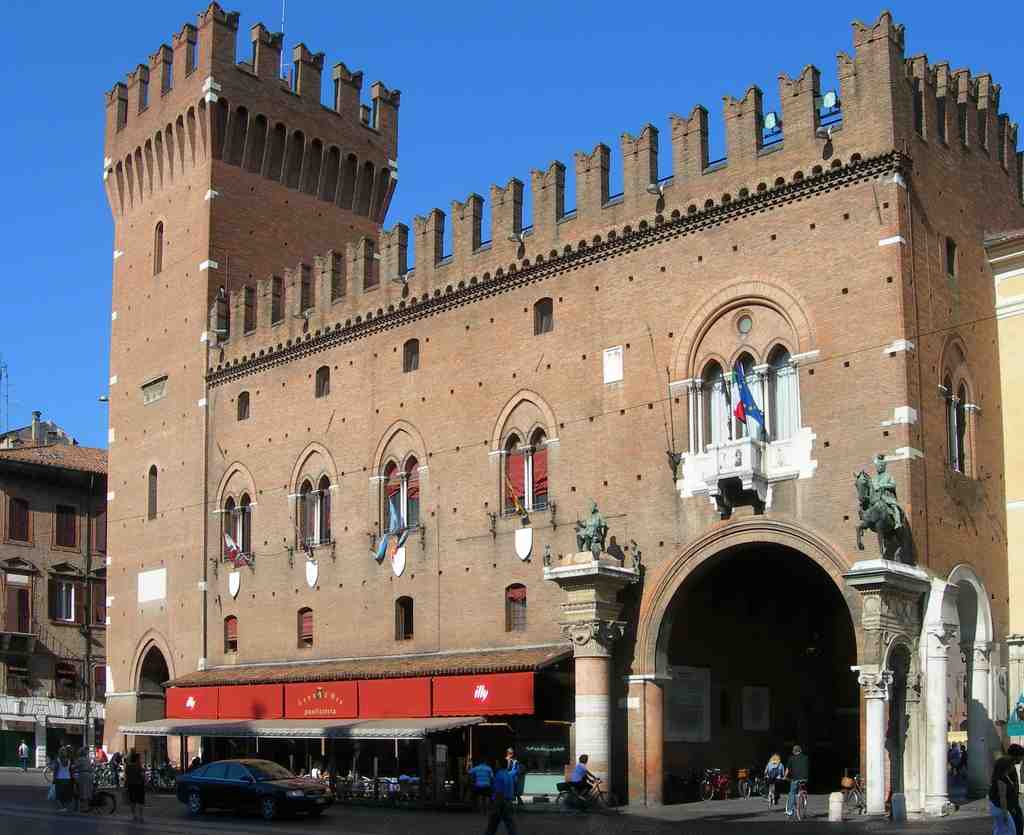
To spot the Municipal Palace, just look for the impressive medieval brick building with crenellated battlements and a tall tower, facing you across the square, with two grand bronze statues flanking an arched entrance known as the Volto del Cavallo.
Alright, you’re standing in front of the mighty Municipal Palace of Ferrara-don’t worry, those statues of Niccolò III and Borso d’Este on either side of the entrance won’t judge your sightseeing skills! Imagine the scene here centuries ago when this place was the bustling heart of power, home to the mighty Este family long before the Castello Estense stole the limelight.
The story of this palace begins all the way back in 1245, when its earliest walls rose along the little street called Cortevecchia. Over the next 200 years, city leaders and architects stretched it out, stitched on new bits, and by the late 1400s, it looked a lot like the grand residence you see before you. The palace’s main gate, the Volto del Cavallo, stands dramatically right across from the cathedral. Back in its ducal heyday, you’d have been dodging carriages and catching glimpses of lords and ladies riding through these arches.
Now, about those statues-there’s a story worthy of a medieval soap opera. The one on horseback is the Marquess Niccolò III d’Este, lifted high atop a pedestal that might’ve had Roman emperors nodding with approval. His neighbor, the dignified Borso d’Este, is reading out rulings and brandishing his scepter like a judge who really loves drama. These statues were crafted by master sculptors from Florence in the mid-1400s and took years-and plenty of heated debates-to finish. Both statues once vanished in a rather dramatic fashion in October 1796, melted down for bronze to feed the ever-hungry cannons of the French.
But Ferrara wasn’t about to let a little thing like war erase its icons. When the 1920s rolled around, the city buzzed with a new energy-much like your phone might when you get a sudden flood of notifications. The community, led by a determined mayor and some very persuasive letters in the local paper, demanded the statues’ return. Enter artist Giacomo Zilocchi, who sculpted the bold bronze copies you see today, based on old sketches, coins, and even bits of theatrical costumes. The city held its breath as the replicas were hoisted up beside the arch in 1927, a triumphant moment for local pride.
The façade itself is a tale of transformation. In the 1700s and again between 1924 and 1928, the entrance was refaced in a neo-medieval style to match everybody’s idea of what a ducal palace ought to look like. Each brick, arch, and decorative flourish has survived earthquakes, military occupations, and the kind of renovations that make homeowners everywhere break into a cold sweat. The ostentatious windows, the shield-like crests above, and the striking marble details all speak of a place where art and governance were inseparable.
Slip through the main arch and you’d find yourself in the old Ducal Courtyard, now the bustling Piazza del Municipio. Look for those marble windows where Este nobility might have peered out onto the square, and, if you squint, you can just about picture them gossiping about each other’s fashion choices. The grand staircase, built in 1481, sweeps you straight up to what used to be the court chapel, now a venue for conferences and shows.
Inside, every room whispers of intrigue and ceremony: there’s the Sala dell’Arengo, wrapped in murals of mythic Ferrara; the dazzling Gold Room, currently napping under a cloak of restoration dust; and the Marriage Hall, home to Flemish tapestries that once set artistic hearts aflutter. Even the Camerino delle Duchesse offers a hint of sibling rivalry, decorated for Eleonora and Lucrezia d’Este-it seems the Este women wanted a bit of luxury too.
And just when you think the palace couldn’t hide any more treasures, stroll to the north side and you’ll spot the covered walkway, the via Coperta, a secretive bridge that once let Este nobles scuttle straight to the Castello Estense without braving the public square-or rain showers!
So take a moment to breathe in the layers of history here, where powerful rulers once held court, artists battled for commissions, and the city of Ferrara refused to let its proud past slip away-even if they had to recreate it from scratch now and then!
Interested in knowing more about the description, ducal courtyard or the interiors


