
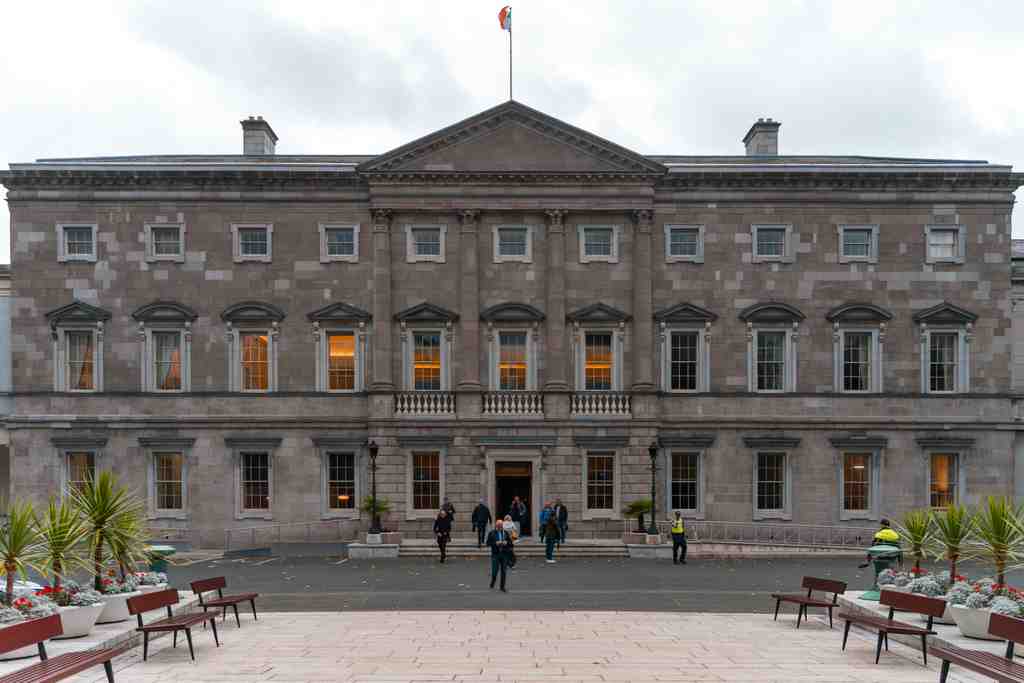
Look ahead for a grand grey stone building with many tall windows, columns, and a triangular pediment centered above its entrance-it’s standing proudly at the top of Kildare Street.
Now, as you stand before Leinster House, take in its stately silence and imagine the lives and secrets cradled within these elegant stone walls. Once upon a time, this wasn’t the bustling seat of Irish politics but the plush palace of the Dukes of Leinster-those were the days of sparkling chandeliers, ball gowns swishing along marble floors, and horse-drawn carriages rumbling across the forecourt. In fact, back in 1745, when James FitzGerald, the ambitious Earl of Kildare, had this house built, people thought he’d lost the plot-who’d want to build a palace out here on the “unfashionable” side of Dublin? But he had a vision, and sure enough, the city’s upper crust soon followed, filling Merrion Square and Fitzwilliam Square with their grand residences too.
Picture heavy velvet curtains, the smells of roasting game from the kitchens, and a long line of carriages arriving for lavish parties. The Earl became the first Duke of Leinster in 1766, and the house took on its legendary name. No other mansion in Dublin could match it for size or glamour. Some say its first and second floors inspired Irish-born architect James Hoban’s design for the White House in Washington, D.C-so, you’re looking at the “blueprints” of the White House right here! At one point, Lord Edward FitzGerald, the Duke’s rebellious son and unlikely hero of the 1798 Rebellion, even roamed these halls, harboring dreams of revolution.
But the grandeur didn’t last forever. After the Act of Union in 1800, Ireland’s parliament was dissolved, the lords and ladies drifted off to London, and houses like this began to gather dust-or in less lucky cases, turn into slums. By 1815, the 3rd Duke sold Leinster House to the Royal Dublin Society, whose famous Spring Show and Horse Show brought crowds spilling onto the lawn facing Merrion Square. The gentle thump of hooves and the cheers of the crowd, can you imagine it?
Leinster House has worn many hats. In 1853, it hosted the Great Industrial Exhibition, and the Natural History Museum rose next door a few years later. Elegant new wings sprouted up to house the National Library and National Museum-so the place just kept getting busier.
Fast-forward to 1922: the Irish Free State is born, and Michael Collins is in a dash to find a home for its brand-new parliament. Plans to settle into the grand Royal Hospital Kilmainham were scuppered-the British Army hadn’t yet packed their bags. So Leinster House, with its spacious former lecture theatre, was “temporarily” rented for the Oireachtas. And, as with so many good Irish arrangements, the temporary soon became permanent. Parliamentarians adapted the ballroom into a Senate chamber-a bit more dramatic than a typical office, but who could resist?
Over the years, the place grew in all directions, with extra wings, modern offices, committee rooms, and even a few handy bars for thirsty politicians. During the 1960s, new blocks were slapped on, and the 2000s saw further upgrades to keep up with the swelling ranks of TDs and senators. There’s even a variety of offices scattered around nearby streets, so if you think Irish politics is contained inside these walls, you’d be mistaken-it tends to spill onto the pavements as well.
Look closely at the gardens on the Merrion Square side, and you’ll spot a monument jam-packed with Irish history-a triangular tribute to Arthur Griffith, Michael Collins, and Kevin O’Higgins: three giants of Ireland’s fight for independence and early government, their legacy as weighty as the stone beneath your feet.
And if you feel a sense of déjà vu in front of those columns, it might be because, once upon a time, a huge statue of Queen Victoria glowered over the entrance-imagine the parliamentarians dodging her icy stare! It’s said her statue was shipped off to Australia in 1987, a sign of Ireland leaving its colonial days behind.
Leinster House has even hosted world leaders-from John F. Kennedy to French president François Mitterrand-a parade of history-makers all gathering beneath these timeless columns. Yet, this grand building has its own troubles. A 2008 report warned of creaky floors and dodgy wiring-a house with as much drama as any parliament! Thankfully, after a massive restoration wrapped up in 2019, it’s standing stronger than ever. Picture the entire building wrapped in scaffolding and plastic, like a birthday present waiting to be unwrapped, while the city watched anxiously for its rebirth.
So, next time you hear the words “Leinster House” in the news, remember: it’s more than a building-it’s a living, breathing stage for centuries of Irish ambition, high society, rebellion, and democracy, where today’s big decisions echo through the same halls that once held lavish balls and secret debates. Now, how’s that for a final act on our Dublin tour?
Yearning to grasp further insights on the extensions, structural concerns and restoration or the legacy and inspirations? Dive into the chat section below and ask away.




