
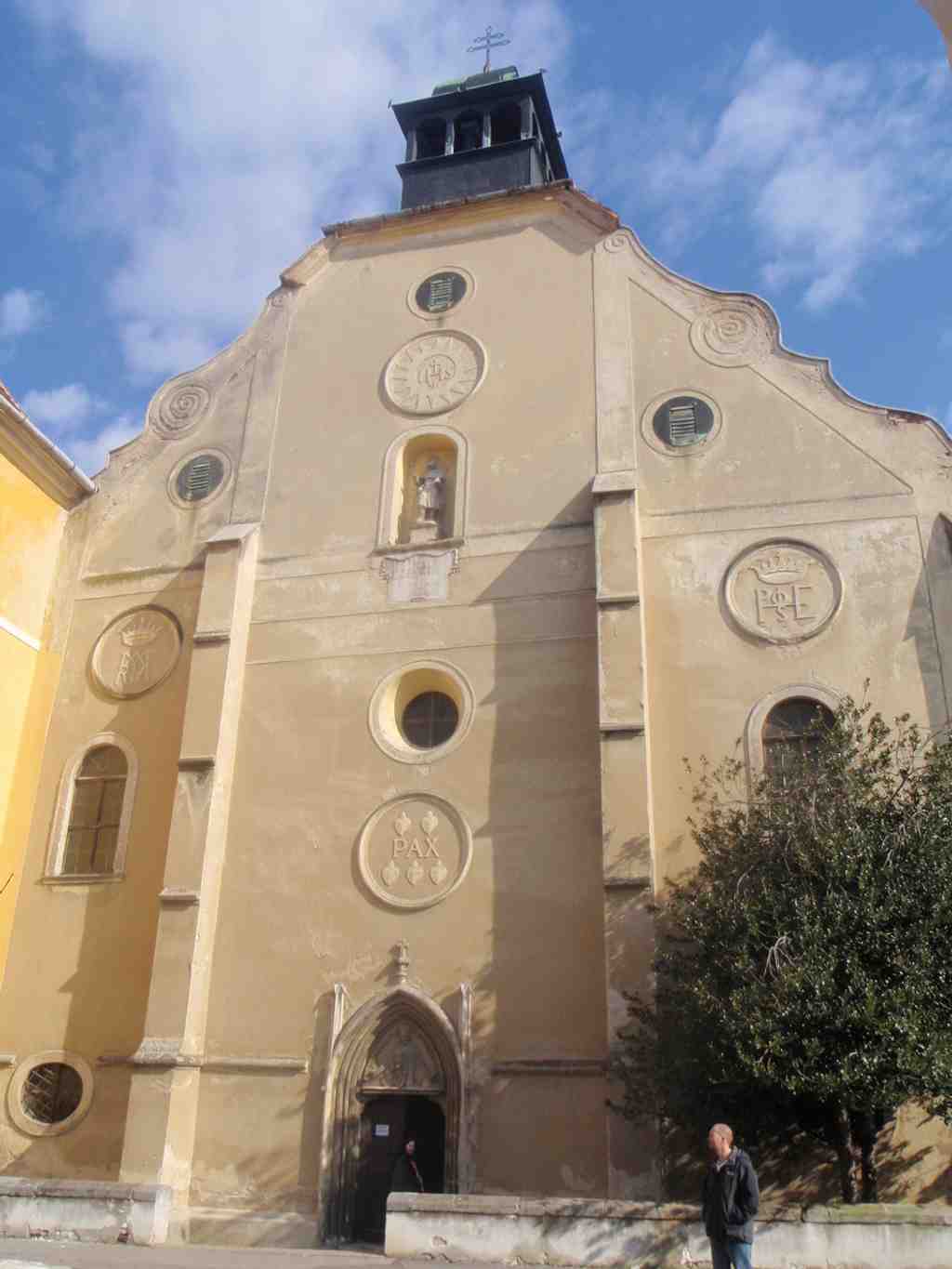
To spot St. Jacob’s Church, just look for the broad, pale yellow façade with swirled edges, round medallions, and a small dark bell tower at the top-the entrance sits right behind those slim pillars and leafy tree.
Step closer, my friend, because you’re right at the doorway to Kőszeg’s own time machine-St. Jacob’s Church! If these worn walls could talk, they’d have a gossip column longer than the Danube. Imagine a church built on layers of legend: back in 1289, this spot saw a minorite church destroyed in a siege, and from those ashes, a brand new life arose, courtesy of the hardworking Franciscans under King Louis, who rebuilt their monastery stone by stone. During the early 1400s, the mighty Garai family got involved, redecorating and leaving behind mysterious carvings of people, animals, and even a serpent-their family mascot. You’ll feel their watchful eyes as you walk in!
But all wasn’t calm within these walls. In 1551, the winds of the Reformation swept through, and suddenly the church was Protestant; a few brawls and a trashed medieval altar later, and it had become the town’s favorite tug-of-war toy. Then, just as things were quieting down, Bishop György Széchenyi pops in, talks the town council into returning the church-smooth talking, right? Over the centuries, Jesuits, Piarists, and Benedictines all took a turn calling this place home. The bell tower above you was built in the 15th century, while that cute little Sanctus turret joined the party in 1697.
During an 1807 renovation, the church got its stylish baroque outfit, but look inside and you’ll still find a gothic soul. There’s a real treat if you peek inside: frescos that hid for centuries! When they were revealed in 1937, the church finally showed off its Madonna in a Cloak, and St. Christopher looming large in stunning gothic style. And just think-restoration artists even snuck some local celebrities and church VIPs into the frescos. Even in the graveyard, there’s star power: nobles, mayors, even the “Venus of Murány,” all have their resting spots here.
So, while St. Jacob’s may look calm and sunny today, beneath its surface, it’s practically humming with the footsteps and secrets of centuries. Every little detail-those chipped stones and iron gates-has a tale to tell if you listen hard enough!


