
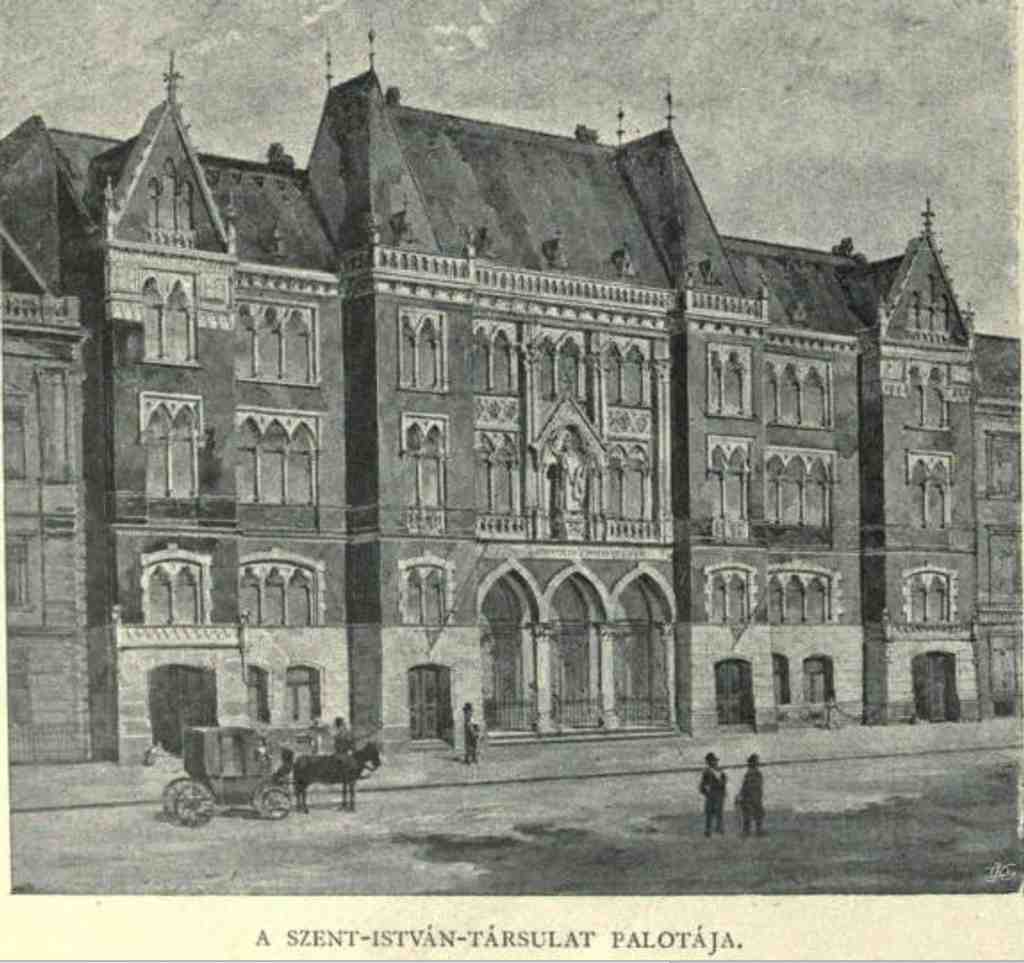
To spot the St. Stephen's Company, look up at the impressive, sprawling Gothic Revival building ahead of you, with its steep, peaked roofs, ornate stone arches, and rows of tall windows - it almost looks like something straight out of a storybook!
Imagine we’re standing here not just on a bustling Budapest street, but at the very heart of an incredible story that started nearly two centuries ago. Picture 1848: Budapest is crackling with new ideas, revolutions, and, let’s be honest, some questionable facial hair. Right in the midst of that chaos, a group of ambitious dreamers, with ink-stained fingers and hearts full of hope, decided Hungarians needed more than just paprikás and poetry-they needed access to books! Affordable, good books that even the humblest villager could read by candlelight.
So, under the guidance of Fogarasy Mihály and the patronage of the mighty Archbishop Kopácsy József, the Saint Stephen Society-Szent István Társulat in Hungarian-was born. If you listen carefully, maybe you can still hear the excited whispers of those first members discussing their mission: “Books should be cheap as bread and nourishing for the soul!” They started with just a thousand eager souls, promising every new member not just wisdom, but books-lots of them.
Their very first publication had a rather catchy name: “Christian Calendar for Hungarian Catholics.” Sure, it wasn’t exactly “Harry Potter,” but it filled a real need-guiding families through faith and the rhythms of the year. And soon, newspapers like the “Katholikus Néplap” followed, spreading news and cheer. Picture a Budapest where every cobbler, baker, and candlestick maker could finally afford to own a book.
But just as things were getting going, history barged in uninvited. The 1848-49 War of Independence turned lives upside down. Money lost its value faster than a snowman in July. Thousands of forints, carefully saved by the Society, melted away, and their precious publications scattered or seized-an organizational nightmare before spreadsheets even existed! Still, they didn’t quit. Like determined librarians on a mission, they dusted off whatever was left, gathered the best minds in the land-think of political heavyweights like Deák Ferenc-and got right back to work.
Now, fast-forward to 1852, and you’ll see the Society proudly adopting the name “Saint Stephen”-after Hungary’s first king, a man known for wisdom, faith, and the ability to wear a crown without it slipping. Picture years of struggle under official censorship, fighting to keep the Hungarian language-and people’s spirits-alive through books. Then, with reconciliation and peace in Hungary, suddenly their presses were humming like busy bees, churning out textbooks and teaching aids not just in Hungarian, but also in German, Slovak, Romanian, Croatian, and Rutén for the rainbow of cultures living in the country.
Meanwhile, they became the proud publishers of scholarly journals and fierce defenders of Catholic values, creating an ever-widening circle of writers, teachers, and thinkers. At one point, their annual general meetings must have looked like a who’s-who of Hungarian brilliance, with lively debates and no shortage of tea (or perhaps pálinka?).
By the turn of the century, the Society was so successful that they had this very building-yes, the grand, fairy-tale palace you’re looking at-constructed for themselves. It became not just their headquarters but the beating heart of Hungarian Catholic publishing. They even ran their own print shop, the Stephaneum, giving them the second-largest publishing operation in the land, just behind the legendary Franklin Company. And in 1923, their commitment was honored by none other than Pope Pius XI, granting them the coveted title of the Holy See’s Publisher, a badge of respect that probably made other publishers green with envy.
But, as every good story goes, more storms rolled in. After the Second World War, restrictions clamped down. Many of their journals vanished, their manuscripts were scrutinized by tight-fisted officials, and their grand printing presses lay quiet-except for the “Katholikus Szemle,” which survived, stubbornly, like an umbrella in a downpour. Only after 1989, with Hungary’s return to freedom, could the Society spring back to life, reviving its proud tradition of publishing for schools, congregations, and anyone hungry for knowledge.
Today, the Saint Stephen’s Company stands as a living bridge from Hungary’s stormy past to its creative present, having published close to 60 million copies of nearly 12,000 works-everything from encyclopedias and scientific treatises to schoolbooks, novels, and more than a few fascinating stories. So, as you look around, let your imagination wander: this was once the nerve center of bookish revolutionaries, determined to bring learning and faith to every corner of the nation, one page at a time. And remember-never underestimate the power of a good book... or a determined publisher!




