
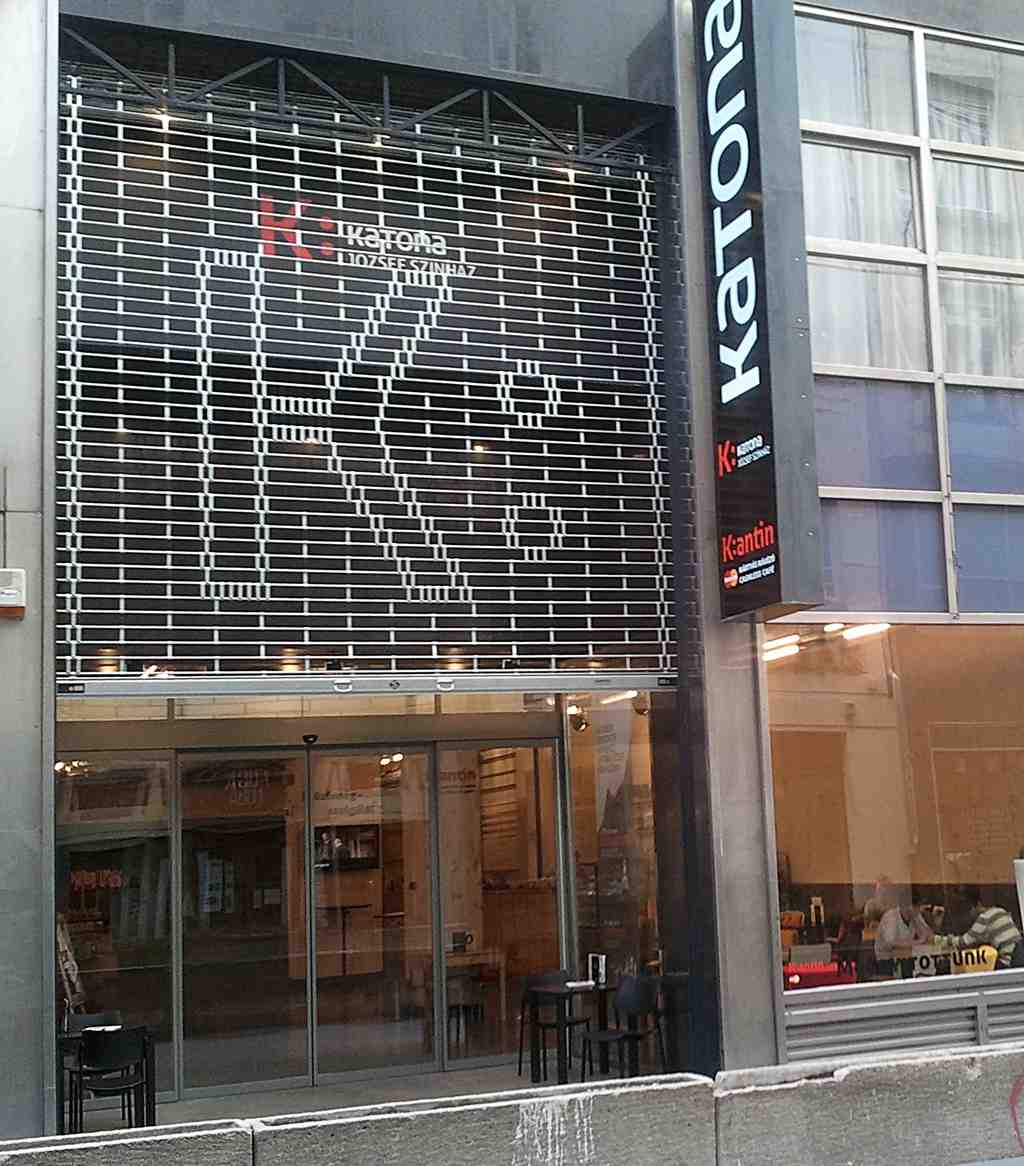
As you’re walking down Petőfi Sándor Street, look for a modern, glassy facade with a huge metallic gate featuring a giant stylized “K:” - that’s the Katona József Theatre, nestled quietly among the other buildings like a well-kept secret waiting for a dramatic entrance.
Welcome to the Katona József Theatre, one of Budapest’s most revered temples of drama! Imagine standing outside what looks like an unassuming modern stony theater jammed between residential buildings. Sometimes people walk right past it-until the theater leaps out at them with its bold design and the hum of anticipation from within. If buildings could whisper, you’d hear, “On your left, modern classics are being made.” Now, let’s slip into the past and let this story unfold!
Once upon a time, in the tail end of the Austro-Hungarian monarchy, this courtyard was home to a stylish Art Nouveau palace at Petőfi Sándor utca 6, built on the dreams of architects Falus Elek and Herquet Rezső. Can you believe this gem was originally meant to be a cinema? Bureaucracy had other ideas-no license, no films! Enter a stubborn hero: Artúr Bárdos. When life gave him lemons, he didn’t just open a lemonade stand, he opened a cabaret instead, which soon blossomed into a real, honest-to-goodness theater. Tucked away from the bustling main thoroughfares, it felt like a secret club for fans of laughter and drama.
Early audiences must have heard the creak of wooden benches, the laughter echoing off artful secessionist walls, and, for the first time in all of the Monarchy, the thrilling spin of a revolving stage in 1916. Through all its quirks, the theater’s intimate auditorium met every expectation, even with its tricky logistics.
Over the decades, the theater changed hands and names. Through the roaring twenties, it became the Belvárosi Színház, jazzing up the city night after night. By 1951, state policies rolled in, and the theater became a part-time chamber venue for the mighty National Theatre next door. But boy, did it punch above its weight! Iconic actors found their breakout roles here, like Ladomerszky Margit in Shaw’s Mrs. Warren’s Profession-she performed it nearly 600 times!
Directors found a creative playground within these walls, pushing boundaries. At one point, it even hosted Molière, Shakespeare, and Shaw alongside Hungarian playwrights like Csokonai and Mikszáth. Plays were sometimes judged not for their artistry, but for their “revolutionary” spirit-a bit like a talent show, but the judges are all aspiring politicians!
The 1970s and '80s were like a tense drama themselves. Behind the curtain, change was brewing-directors from the countryside were shaking up the city stage. Faced with resistance in the National Theatre, two visionaries, Székely Gábor and Zsámbéki Gábor, spotted an opportunity when bureaucracy finally let its guard down. The old regime couldn’t quite control the spark anymore. In the political games of 1982, this very building was offered up as the last chess move - the birth of a bold, independent troupe: the Katona József Theatre. The founding members were rebels of the old order, artists who believed theater should speak directly and powerfully to the audience. The very first play: Chekhov’s rare comedy “The Wood Demon”, which set the mood for decades of world-class performances.
From that day on, the theater became a heartbeat for the city’s cultural scene, a place for innovation and-let’s not forget-some truly spicy political statements veiled behind Shakespearean double-speak and farcical humor. Their productions didn’t just stay in Budapest; they’ve graced stages across forty countries, from Prague to Paris to Buenos Aires!
Inside, the theater has been constantly updated-from removing the ornate boxes to sneaking in high-tech lights and sound equipment. The space might leak from time to time (every historic theater needs some drama offstage too!), but it’s always felt modern, fresh, and a bit magical. You might like to know their show “Three Sisters” was performed over 230 times, and the production “Portugál” ran for over 20 years, loving every single applause.
Today, under director Gábor Máté, Katona József Theatre keeps surprising audiences and gathering fans. It ditched the old subscription model for a “patron’s circle”-think of it as the VIP section for drama lovers. And even if it’s standing room only, people are always eager to get in.
So, next time you see that big “K:” on the front, imagine the whispers of decades of Hungarian drama, political intrigue, and rebellious art echoing off the walls. Every creak of the revolving stage is another story told, another secret shared. Now, shall we see what’s playing tonight? Don’t worry, I promise not to pull you into a tragic monologue-or maybe I will!
To expand your understanding of the the building, previous independent companies or the chamber theatre of the "national" (1951-1982), feel free to engage with me in the chat section below.




