
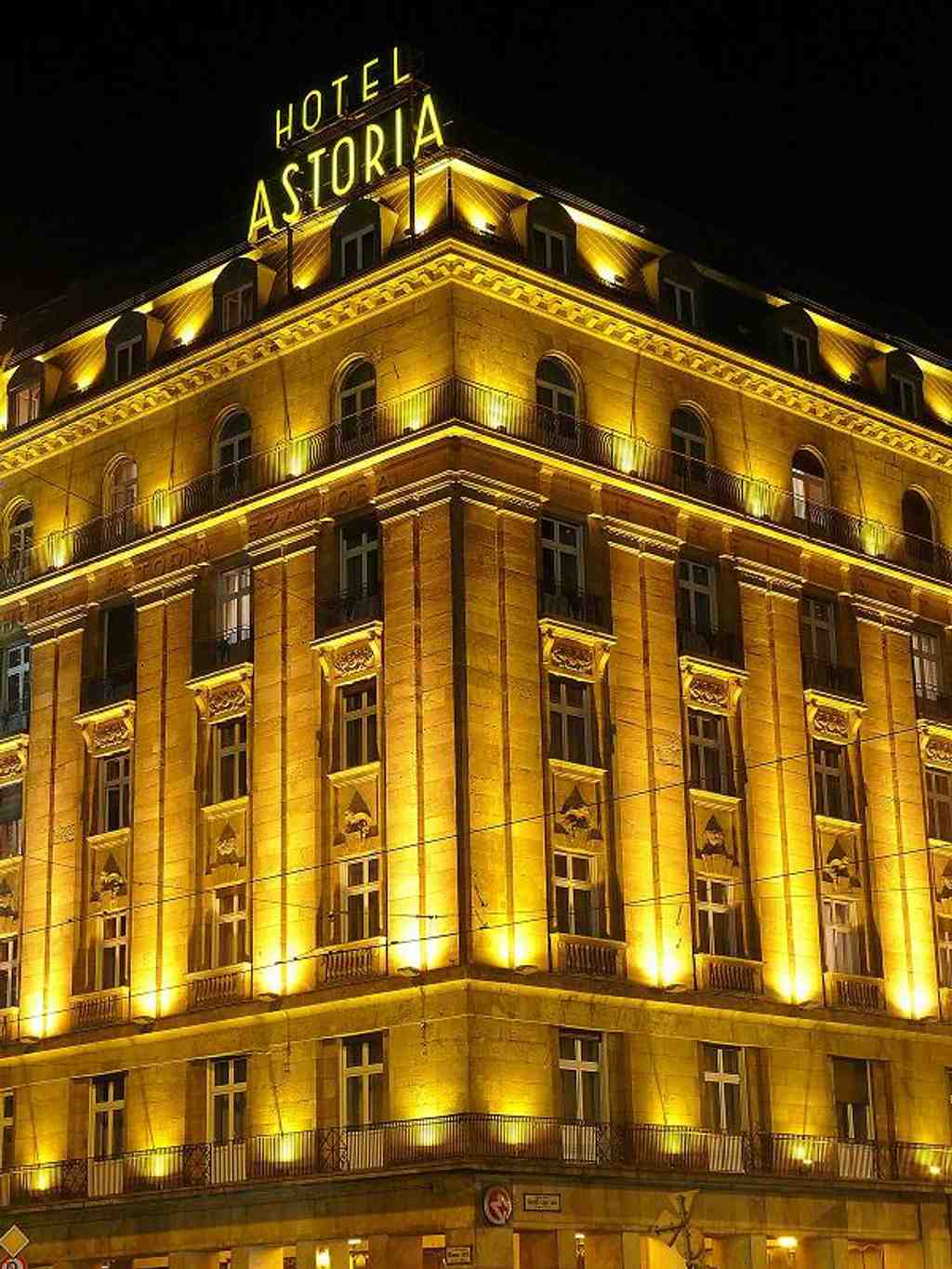
Take a look to your left-what you’re seeing is a grand, six-story corner building that almost glows gold at night, with large arched windows and a glowing “HOTEL ASTORIA” sign right up top, making it simply impossible to miss!
Now, let’s step in closer and imagine together: It’s 1914, and Budapest is ready to impress the world with its latest marvel-the Astoria Hotel, fresh and grand, its lights burning bright at the very heart of the city. For more than a century, this has been one of the city’s most elegant and storied destinations, a place where old-world charm still lingers like the scent of strong coffee in a velvet-draped café.
But the Astoria’s story actually begins long before the stylish guests and the marble floors. Travel back with me to the 1700s, and you’d find this very spot buzzing with the sound of a blacksmith's hammer, thanks to a determined craftsman named Benedek Unger. Over time, his workshop gave way to a lively café that soon became a magnet for Budapest’s brightest minds and boldest hearts-politicians, poets, and even the legendary Sándor Petőfi, who lived next door for a while and penned part of *János vitéz* here. You can almost hear the scratch of his pen in the silence, can’t you?
Fast forward to the 1800s, when the ancient city walls came tumbling down and the area exploded with possibility. Where there once was a city gate and an old fortification, now stood a flashy new lodging house and a café that buzzed with late-night debates and revolutionary dreams. Even today, Magyar Street next door is a silent nod to the Unger family's legacy.
By 1914, at the crossroads of Kossuth Lajos Street and Museum Boulevard, with Budapest booming and the world on the brink of change, the Astoria Hotel opened its doors. Talk about top-of-the-line! This place was state-of-the-art, boasting central heating, modern elevators, and even a vacuum-cleaning system-pretty rare back then. They’d even built a wine cellar that quickly became the toast of the town. The hotel’s design was an unexpected collaboration-two architects working separately but in perfect harmony, each side of the building reflecting a different vision, but together making magic.
And let’s talk about the name! The original manager, Mihály Gellér, thought back to his days in New York City at the Waldorf-Astoria, and brought a whiff of that transatlantic glamour right here. Astoria-it just rolls off the tongue, doesn’t it? No wonder locals started calling it, half in jest, “Ahsztória,” playfully noting how hard it was to snag a room among the city’s elite.
If these walls could talk, oh, the stories they’d spill! During the “Chrysanthemum Revolution” in 1918, Count Mihály Károlyi literally addressed a sea of hopeful faces from the first-floor balcony-think of it as a TED Talk with a little more drama and a lot more mustaches. Soon, the Astoria became the very headquarters of the National Council and even Károlyi’s own living quarters. Picture secret meetings in room 105, dramatic arguments, and maybe a few hasty plans scribbled on napkins.
The interwar years saw all sorts of colorful characters passing through under the glitter of chandeliers and the glint of sparkling mirrors. They say Gyula Krúdy, the famous writer, adored the hotel because the cleaning staff worked so quietly he could sleep in until noon-now that’s what I call a five-star perk! But all was not always champagne and jazz. In 1944, as history’s dark tide swept across Hungary, the Astoria became a Gestapo stronghold-its gilded halls echoed with boots and whispers, and by the end of that nightmare, the building was left battered and looted. Still, it bounced back with legendary resilience, hosting American army officers and, soon enough, ordinary guests eager for a little old-fashioned luxury in a city picking itself up, piece by piece.
Through revolution, war, and political storms, the Astoria has always come back brighter-literally, after every renovation, they seem to add a few extra bulbs to dazzle the nighttime streets. Today, it’s part of the Danubius Hotel Group and has all the bells and whistles of a top-class hotel-soundproof rooms, fine dining, and just enough secret history to make any stay here feel like you’ve snuck onto the set of a grand historical drama.
So, as you stand there now, imagine the sweep of long gowns and the sharp click of dress shoes on the tile, the whisper of revolution and the clink of glasses. The Astoria isn’t just a hotel-it’s one of Budapest’s great survivors, a glamorous witness to all the laughter, whispers, and midnight plots that have shaped the city you’re wandering through today.




