
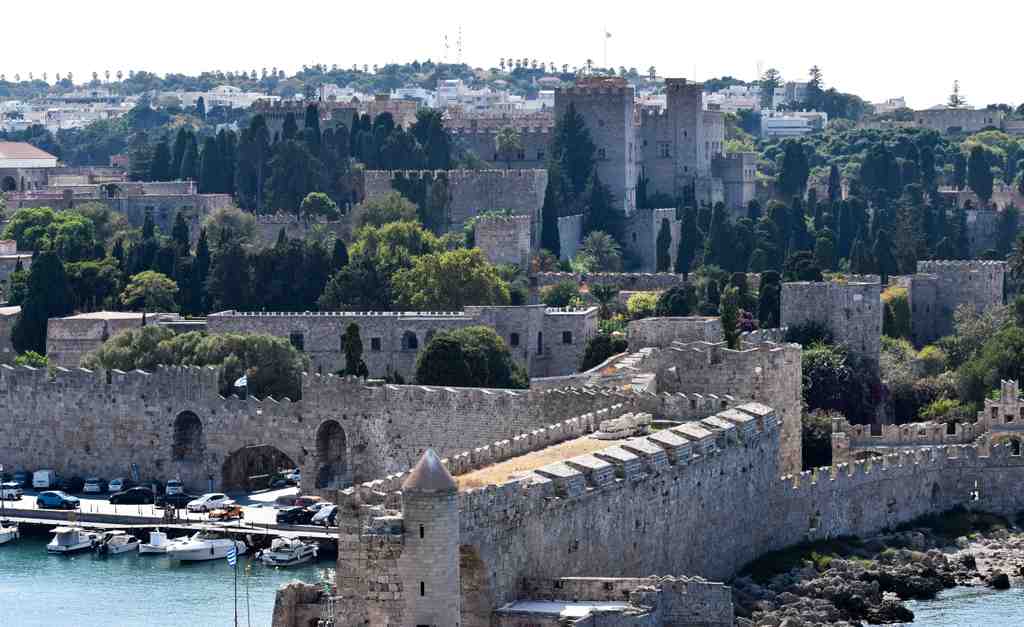
Right ahead of you, rising powerfully against the blue sky, you’ll spot the massive, honey-colored stone walls of the Fortifications of Rhodes, with their thick, uneven blocks and notched towers curling protectively around the medieval town-just look for the immense, ancient ramparts stretching out along your path, almost impossible to miss.
Ready for a trip back in time? Imagine yourself standing here centuries ago, heart pounding, as defenders peer out from these very ramparts, scanning the horizon for distant sails-a fortress straight out of a knight’s tale. These fortifications form a great defensive crescent around Rhodes. Built from layer upon layer of stone and earth, the walls aren’t just thick-they’re nearly impenetrable, with bastions and towering walls that once dazzled even the ancient engineers of Byzantium. The outer faces are so smooth you’d need a miracle (or at least a very fancy ladder) to climb them.
The Knights Hospitaller, those legendary crusaders in black cloaks emblazoned with white crosses, took over the island in 1309. And what did they do first? Well, they beefed up the old Byzantine walls to turn Rhodes into the medieval world’s toughest nut to crack. Picture the sounds: as knights and masons worked day and night, their armor glinting in the Mediterranean sun, all to create a fortress that could withstand anything-even gunshots from the dreaded new siege cannons.
Each stretch of wall had its own garrison, named after the “tongue,” or langue, of knights defending it; you’ll find the Bastion of Italy, the terreplein of Spain, and even mighty posts for France, Germany, and England. Inside these walls is the largest living medieval town in Europe-with over 6,000 people still calling it home!
But why all this fuss? Well, Rhodes sat perfectly on trade routes between east and west, making it a glittering prize for anyone who controlled the seas. Powerful armies came knocking-the Sultan of Egypt besieged for forty days in 1444, and in 1480, Mehmed II, conqueror of Constantinople, landed with a staggering 100,000 men and 170 ships. Now imagine the sound of distant war drums and shouts echoing along the battlements:. But the walls-and the brave knights-held firm, turning back the invaders against all odds.
Yet nature sometimes proved as fearsome as any enemy. In 1481, an earthquake hammered Rhodes, crumbling walls and taking thousands of lives. You can almost hear the low rumble and falling stones if you listen close. But the knights, never ones to let a little disaster stop them, quickly rallied their resources-calling in the best architects from Italy to rebuild and strengthen the defenses with the new technology of gunpowder warfare. Each Grand Master left his mark, transforming the old medieval walls into state-of-the-art fortifications for the age of cannons.
The Ottomans finally succeeded in 1522 after another epic siege. But oddly enough, they didn’t tear the walls down once they’d taken over; instead, they kept them in good repair for hundreds of years. These fortifications are remarkable because they were “frozen” in time in 1522, showing us a rare glimpse of both classic medieval defenses and the coming age of artillery-right here, side by side.
There are 11 gates piercing the walls, each with its own story-some grand, like the imposing Gate d’Amboise with its triple ring of defenses, and some much quieter, like the tiny Arnaldo Gate that now leads you toward the Archaeological Museum.
And let me tell you a little secret: thanks to its iconic, fairy-tale looks, Rhodes has even starred in films like “The Guns of Navarone.” But these walls hold tales much stranger than anything in the movies. Here, streets twist past churches, hammams, and mosques. Gothic arches stand beside Ottoman domes, and you can almost sense the ghosts of knights and sultans lingering in the cool shade of the ramparts.
So take a deep breath-smell the wild thyme from the moat below, feel the heat of the stones beneath your hand, and imagine just how many footsteps-marching, running, racing for cover-these ancient battlements have known. Welcome to the fortress of Rhodes: a place where history isn’t just written, it’s built right into the stone. And don’t worry: the only sieges happening these days are from eager tourists!
Intrigued by the the gates of the old town of rhodes, bastions and towers or the the medieval town of rhodes? Explore further by joining me in the chat section below.


