
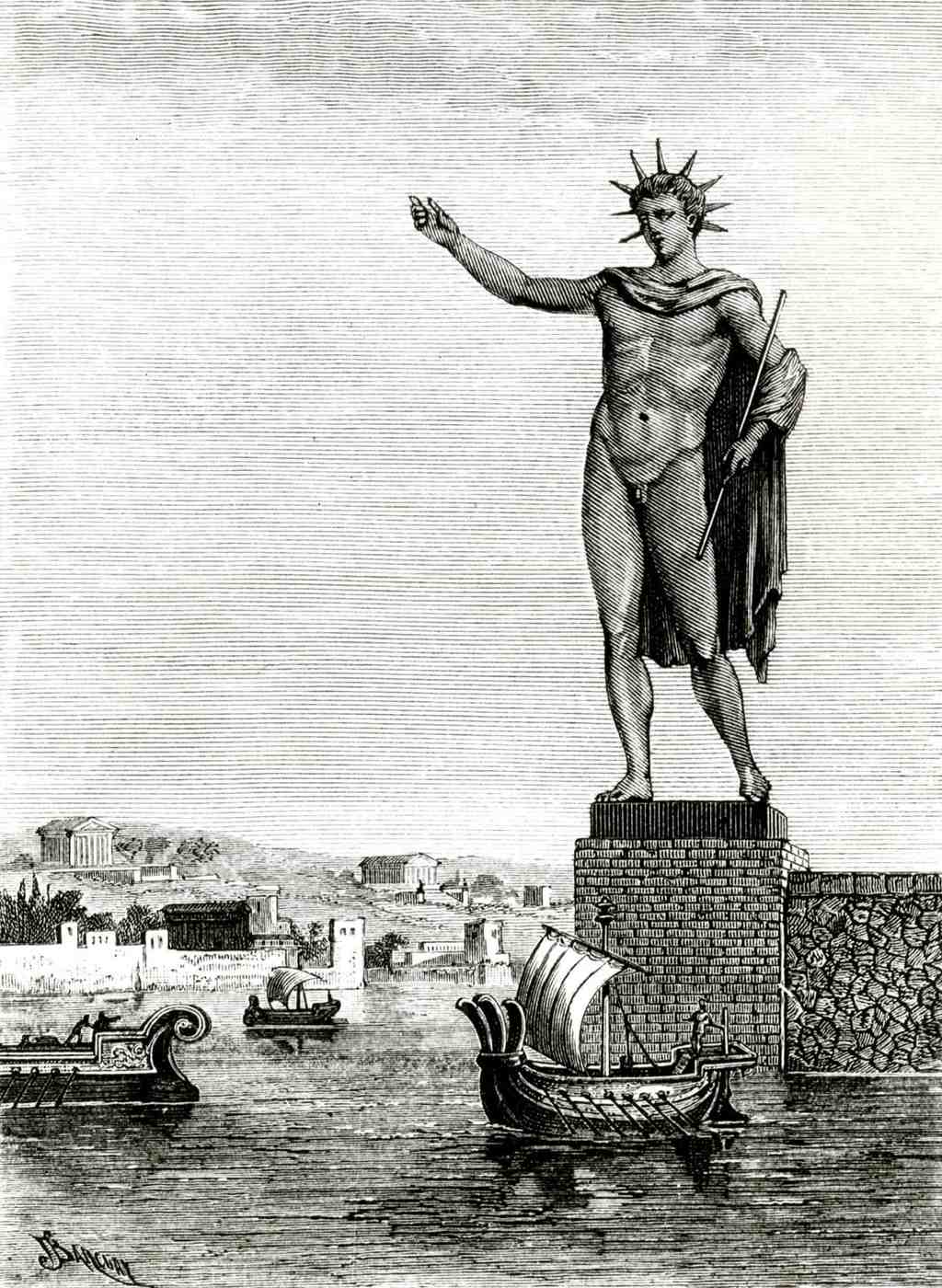
To spot the Colossus of Rhodes in front of you, just look above the harbor entrance for a giant bronze statue of a man with a radiant crown and outstretched arm, towering high over ancient Rhodes-with ships gathering below him and the city stretching into the distance.
Alright, traveler! Picture the harbor bustling with ships, seagulls calling overhead, the sun glinting off the sparkling water-and standing right before you, rising above it all, is the legendary Colossus of Rhodes, the bronze giant of the ancient world. Imagine it’s 280 BC; the city is alive with excitement as people gather to admire the newest wonder, a statue so tall-around 33 meters, or 108 feet-that you’d have to crane your neck so far back you might spot what Helios had for breakfast!
This enormous statue of Helios, the sun god, wasn’t just built for fun or to show off their metalworking skills. It was a triumphant thank-you to the gods after the people of Rhodes held off Demetrius I’s massive army and navy in a year-long siege. When the invaders finally retreated, they left behind heaps of weaponry and siege towers, which-never to waste a good bit of bronze-the Rhodians sold off or melted down to create this mammoth figure. So in a way, the Colossus was the ultimate recycling project!
Chares of Lindos took charge of making this giant, constructing it section by section, casting the bronze and building up with stone for over twelve years. To support its weight, especially around those mighty ankles, Chares and his workers used iron bars and rings, piecing huge bronze plates together like a gigantic metallic jigsaw puzzle. All this rested on a marble pedestal near the harbor-though, no, despite those wild medieval drawings, the Colossus didn’t actually straddle the entrance for boats to sail under its legs. If they’d tried, the only thing that would have "straddled" the harbor was a big pile of twisted metal! Still, people were awestruck-even in its fallen state, centuries later, visitors gaped at the statue’s broken hands: just the thumb could take two strong men to wrap their arms around it.
The Colossus stood proud as the ancient world’s tallest statue, glimmering in the sunlight, with his curly-headed face-think Helios meets a Rhodian coin-watching over sailors and citizens. They say he held his hand above his eyes, as if scanning for even more incoming enemies (or maybe just looking for the nearest lemonade stand on a hot day).
But the story has its shadows. Just fifty-six years after this achievement, disaster struck. In 226 BC, a massive earthquake rocked Rhodes. The statue, along with much of the city, toppled to the earth. It broke at the knees, and there it lay-its head in the dust, bronze shattered, looking like a sleeping giant in a metal suit. Even so, the remains were still so impressive that for the next 800 years, travelers came from afar just to marvel at the ruins, some barely able to grasp the colossal thumb with their arms.
The Rhodians never rebuilt their famous statue-not out of laziness, but because the Oracle of Delphi told them the gods had given a sign (and let’s be honest, you don’t want to anger the sun god, right?). Later tales claim the fallen bronze was eventually hauled off by invading armies, sold, and carried away on hundreds of camels. Quite the yard sale! But much of that is probably legend; by the time the Arab raiders came in 653, there may not have been much metal left to haul away anyway.
The real mystery? No one’s quite certain where the Colossus stood, though some believe it was here at the entrance to Mandraki Harbor, while others argue for a hilltop temple site. So every time you walk by those two proud pillars at the harbor, you might just be standing on the shattered toes of a titan that once inspired poets, travelers, and even Shakespeare himself.
So, as the breeze blows in from the sea and you stand here, let your imagination soar, because you’re in the shadow of one of the ancient world’s greatest wonders-even if the giant himself is now just a legend told in the sunlight of Rhodes.
Wondering about the siege of rhodes, construction or the collapse (226 bc)? Feel free to discuss it further in the chat section below.


