
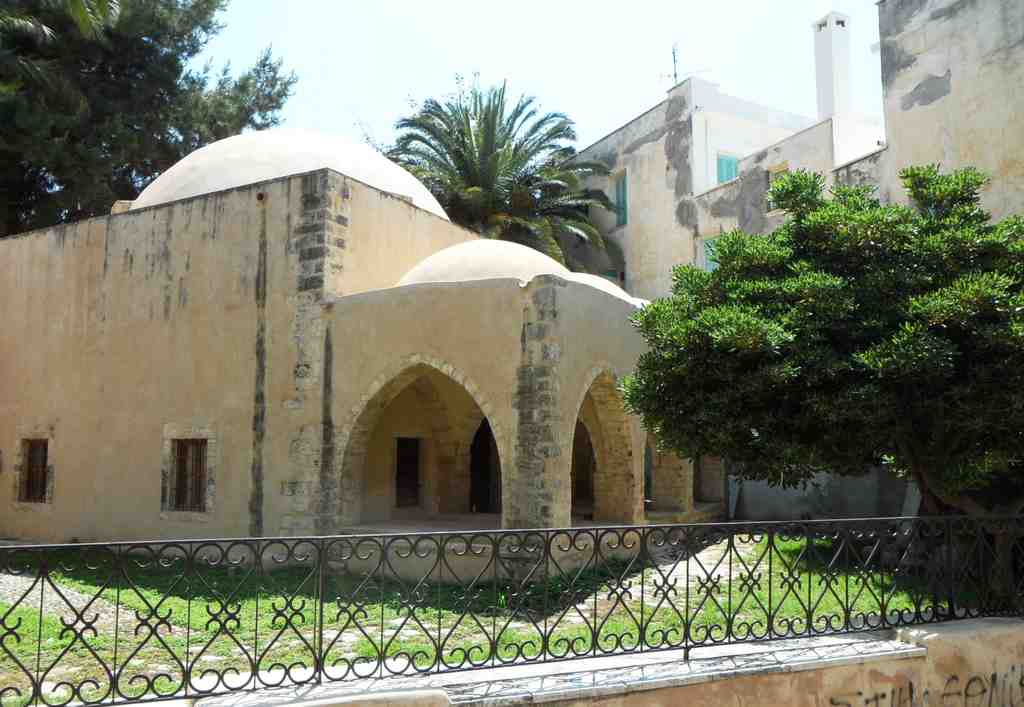
To your left is a smooth stone building defined by its two rounded domes and a portico of pointed arches set behind a dark iron fence. This is the Kara Musa Pasha Mosque. Like many historical buildings here, it has had a bit of an identity crisis over the centuries. It actually began life as a Venetian monastery dedicated to Saint Barbara. But after the Ottomans conquered the city in the seventeenth century, they gave the property a major makeover.
They added those prominent domes and a minaret, the tall slender tower used for the call to prayer. Today, only the base of the minaret survives. Glance at your screen to see a closer view of the entrance. You actually walk right under a domed fountain to get inside the building.
Somewhere in the precinct lies a turbes, a classic vaulted stone tomb, where the founder Kara Musa Pasha is likely buried. Abandoned in the 1890s, it is now safely preserved by the archaeological service. It stands as a fascinating monument to architectural adaptation. Take a moment to appreciate the details, and whenever you are ready, we can head toward our next stop.




