
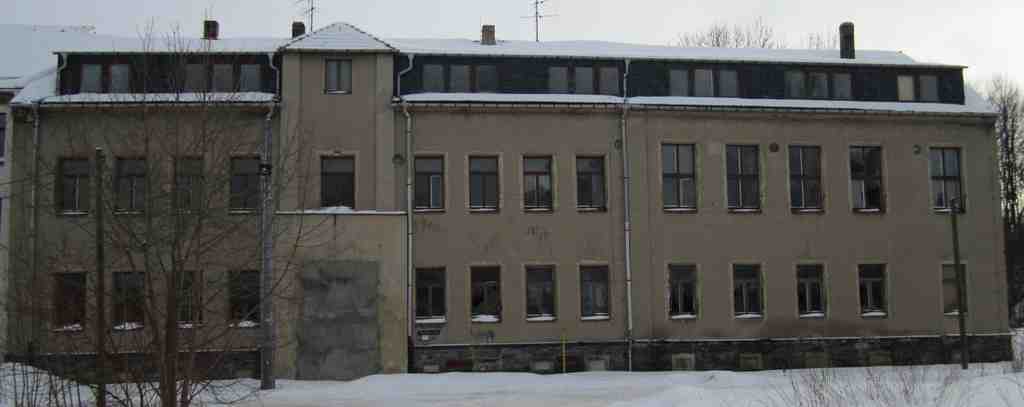
To spot the Zwickau Mountain School, look ahead for a large, weathered, rectangular building with plain tan walls, rows of equally spaced windows, and a slightly protruding center section-all capped by a snow-dusted roof.
Now, picture yourself standing outside this building on a wintry Zwickau morning, the crunch of snow under your boots, and a chill in the air, making every breath just a little crisper. You’re gazing at the historic Zwickau Mountain School, but don’t let its quiet appearance fool you-this place has been a hub of human drama, coal dust, ambition, and serious mustaches since 1862!
Let’s rewind to a time when the air was thick with coal smoke and Zwickau’s buzzing mines needed a new generation of clever, practical leaders. Back in the mid-1800s, the local mining boom was so intense that even the town’s official coal-watchers got worried they’d run out of experts! After a shaky start with an earlier school in Bockwa, determined mine officials wrote to the royal mining board in Freiberg in 1860, with a message that essentially said: “We need a school, and fast-before we all end up digging in circles!” Thanks to their neighborly persistence (and probably a few strong cups of coffee), by 1862, the first students were in class.
Classes here were never about stuffing your head with random facts; no, students were taught to understand the important things, and practice until they were as sharp as a new pickaxe. From Monday to Thursday, later shifting to Tuesday through Friday (hey, even miners liked a long weekend), students tackled everything from German and neat handwriting to the mysteries of mineralogy and the excitement of arithmetic. Bergschule students learned to draw, calculate, and-even more thrillingly-visit real mines during their holidays!
Of course, it wasn’t all sums and stones. In 1870, war swept through the land, and many students swapped their schoolbooks for military boots. The school, like a slow-burning furnace, never completely went out, though: by 1872, determined scholars could now officially postpone their draft to finish their mining studies-talk about dedication!
By the time the school turned 40 in 1902, a grand flag was commissioned, one side green with the Saxon crest, the other fiery red displaying the Bergschule’s own insignia. You can almost hear the flutter of banners and the clinking of celebratory mugs.
The school’s story didn’t get any duller. When the roaring twenties rolled around, it was reformed by a quirky club of mining associations from across Saxony-and even students from Bavaria joined the class, each paying a handsome 300 marks. Later, all the Bergschulen in Germany were brought under one big umbrella during the Reich, but the Zwickau Mountain School kept its own spirit-especially when, during World War II, it was considered so essential that most of its students were kept out of the army. Think of it: a school that quite literally kept people underground for their own safety!
But the real twist came in 1945, when the Americans arrived on Zwickau’s western doorsteps. For a while, the whole city was split in two-like a cake at a very tense birthday party-and no one knew quite what would happen next. Soon, the Soviets moved in, and suddenly the new rulers wanted the coal business running full speed. With coal so desperately needed, they reopened the Bergschule almost right away, and the classrooms buzzed again, now filled with new dreams and a few nervous glances.
After the war, the school bounced between private and public hands, shifted its name more times than a secret agent, and moved into this building in 1949. There were fresh starts, new dormitories, and a whole parade of subjects added to the curriculum-like legal rights for miners and even electrical engineering, so you wouldn’t get shocked by more than just your grades. Sometimes, students would even go abroad, making new friends while trying to remember what “Grubenrettungswesen” means in French.
Sadly, by 1965 it was time for one last change. The legendary Bergschule was merged into new institutes, but the tradition lives on through Zwickau’s university today. In the end, the story of the Bergschule is one of people determined to dig deep-not just for coal, but for knowledge, community, and maybe a good story to tell after class.
So if these walls could talk, they’d probably sigh, cough up a little coal dust, and tell you that every great achievement starts with a single step… and maybe a quick glance at your safety helmet!
Fascinated by the admission requirements and curriculum, school or the structure? Let's chat about it


