
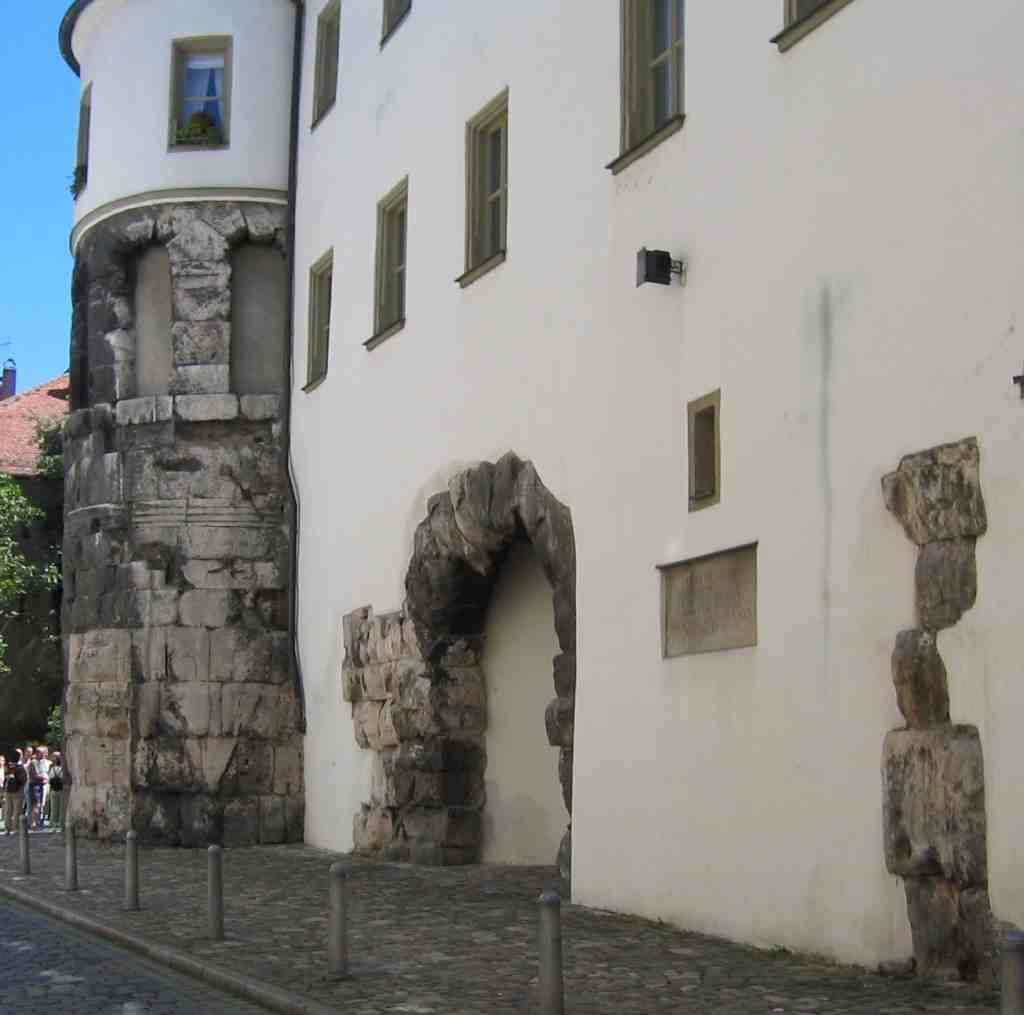
If you’re looking for the Porta Praetoria, just glance to your left-you’ll spot a weathered, ancient stone arch partially set into the wall of the modern building, with big Roman stones at the base and a round white tower rising above it; it’s like a time machine peeking through the streets of Regensburg!
Now, imagine this: you’re standing in the footsteps of Roman legionaries, right at the gateway of the mighty Castra Regina, nearly 2,000 years ago. The year is 179 AD, and Emperor Marcus Aurelius has just finished building this immense fortress on the windswept banks of the Danube-Regensburg was little more than a wild outpost then, and the Porta Praetoria was its proud northern entrance, facing the river and beyond that, the mysterious lands of the Germanic tribes. The gate you see before you was no ordinary door-it was the mighty “front door” of the legion camp, with thick stone arches and two towers that must’ve soared nearly 20 meters into the air, making today’s entrance look a bit like the doormat of a giant. I bet even the birds felt intimidated as they flew past!
Picture the clank of armor, the shuffle of sandaled feet, the torchlight at dusk as soldiers hurried through this very entrance. This gate was the gem in the fortress wall-a proud symbol of Rome’s power, meant to impress friend and foe alike. The Romans, ever poetic even when they were building military bases, once wrote that “like a jewel set in gold, the gate adorns the camp.” And Tacitus, the famous Roman historian, noted that a soldier’s greatest pride was his camp. So you’re not just looking at stones; you’re gazing at a badge of ancient honor!
For centuries, the Porta Praetoria was the way north, called the Wassertor or “Water Gate” by later locals since it led down to the river and the famous Stone Bridge. Even as medieval walls rose around Regensburg, at first the gate stubbornly kept its job as the city’s watery welcome mat. But time, weather, and more than a few invading armies left their marks. Legend has it that parts of the gate were hastily rebuilt after attacks, sometimes using whatever was handy-even shattered gravestones. Yes, nothing says Roman recycling quite like patching your fortress with someone’s memorial slab. Eventually, earthquakes, neglect, and the hustle of city life swallowed the gate-by the 17th century, it was literally built right into a brewery! I suppose that’s one way to preserve history: drown it in beer.
For a long time, the Porta Praetoria just disappeared from memory-hidden in walls, covered by new roads, forgotten by all except maybe a few wandering ghosts who wished they could still march out to the Danube. Then, in 1885, when the brewery next door decided to expand, workers began tearing down an old annex and-surprise!-the ancient arch and stone tower emerged from beneath the dust, like a Roman centurion returning from a centuries-long nap. The city was in a tizzy! Some people worried that disturbing the ruins would unleash ancient diseases. The city ignored the panic, coughed up some gold marks, and carefully revealed this bit of buried treasure.
Even after discovery, history kept playing its tricks. People got the gate’s floorplan all wrong, thinking it only had one archway instead of two. It took another hundred years and some modern archeological sleuthing to set the record straight with foundation scans and a bit of head scratching.
Today, the Porta Praetoria stands as one of only a handful of Roman military gates north of the Alps-its rough limestone blocks patched with newer stones, a mixture of history and survival. The big round tower leans ever so slightly, probably from holding up all those stories. The gate’s been a beer cellar, a potato store, and now part of a hotel, where lucky guests can sleep in the “Porta Praetoria Suite.” And thanks to recent renovations, you can finally see its ancient base again, right at the same level the Roman soldiers once marched through-so take a good look, and step back in time. If you listen closely, you might even hear the echo of Roman boots-or is that just the rumble of your stomach from all this history?




