
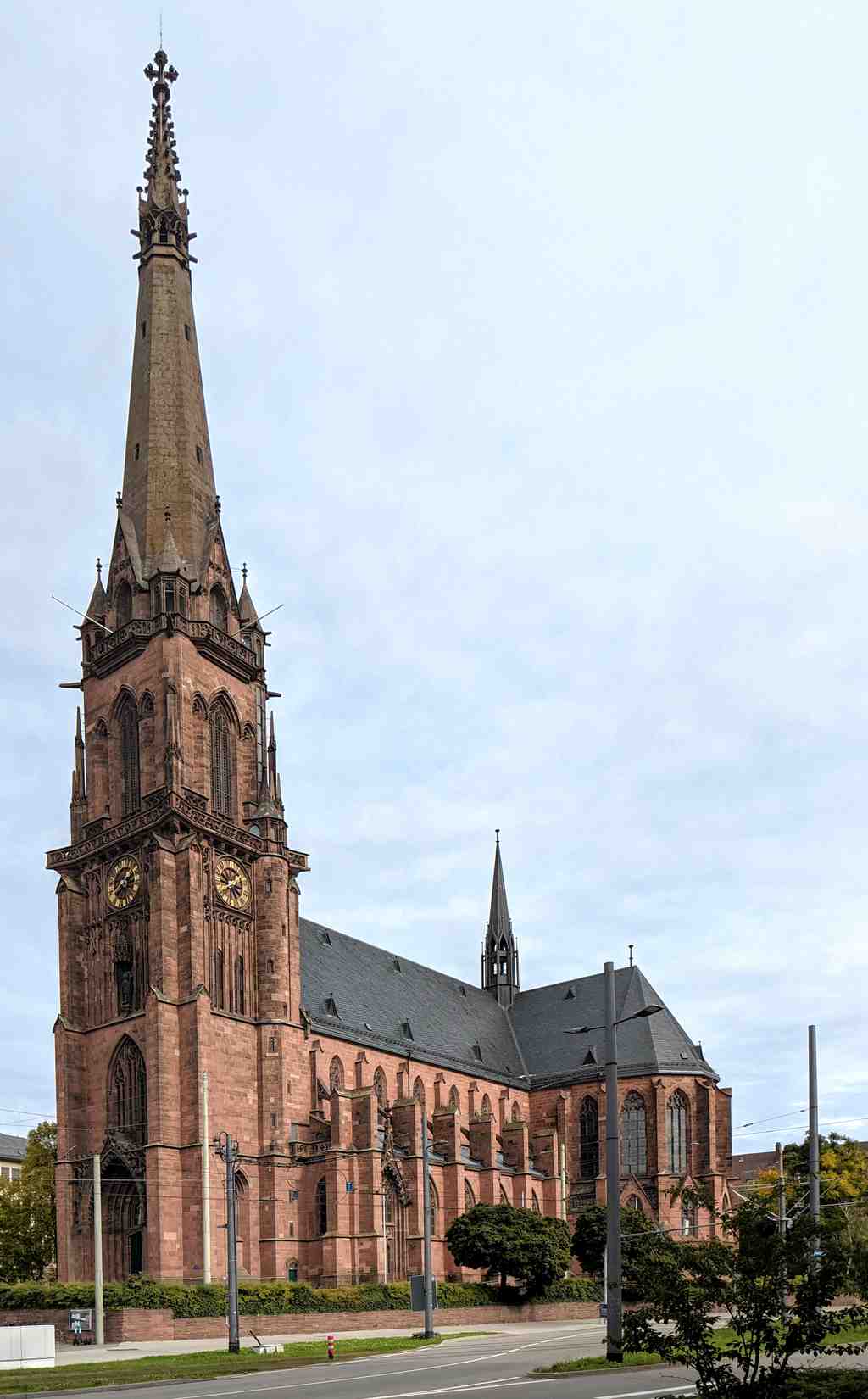
Before you stands a towering neo-Gothic basilica constructed entirely of striking red sandstone, culminating in an eighty-six-meter spire that features large golden clock dials near its base.
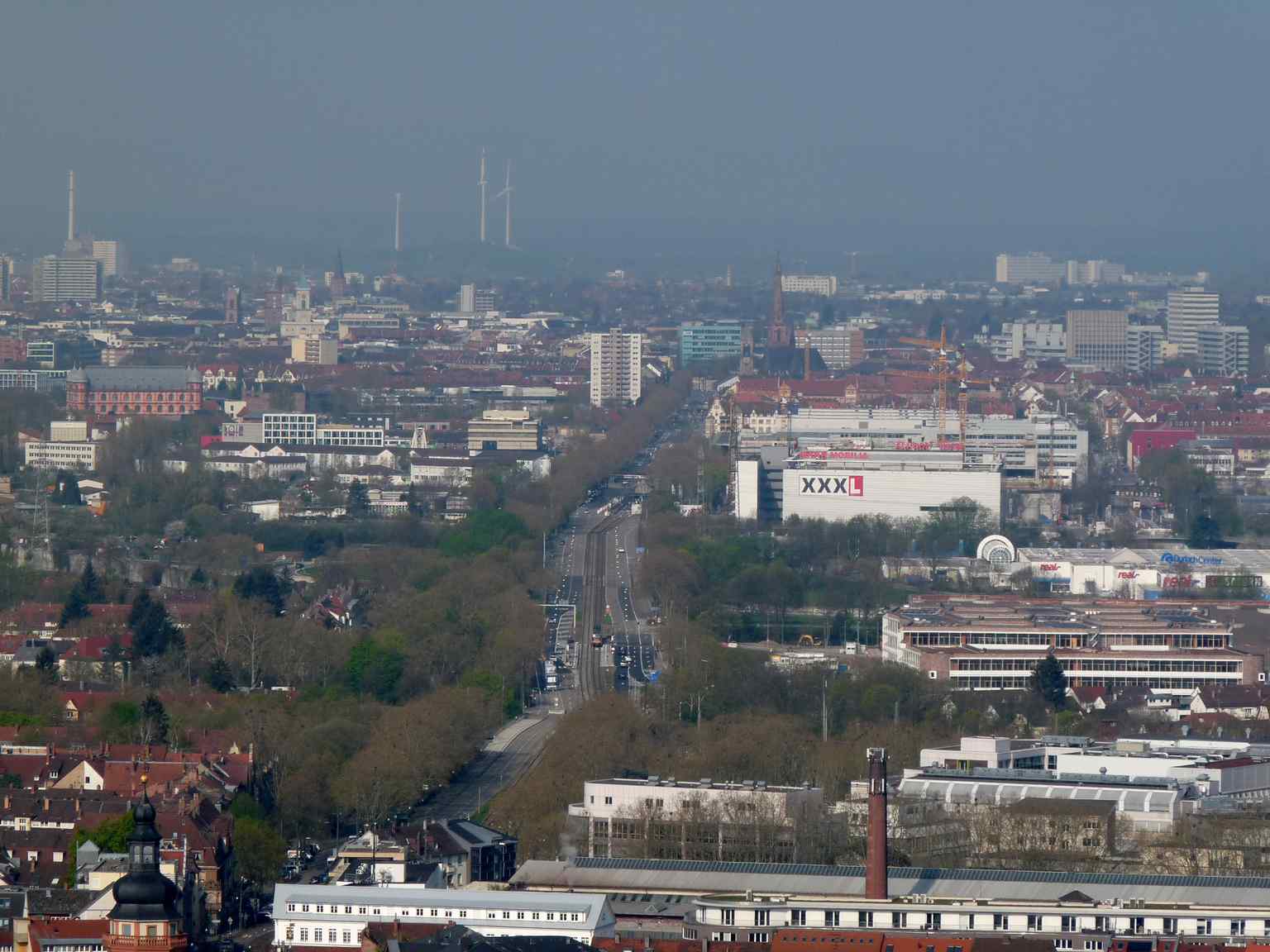
This is Saint Bernard, and its very existence is a masterclass in nineteenth-century power plays. Back in the late eighteen hundreds, Karlsruhe's Catholic population was booming. Grand Duke Friedrich the First, Protestant ruler of Baden, decided it was politically savvy to gift the Church a massive plot of land right here. But the Grand Duke did not just give them the dirt and walk away. He had a specific vision for the city's geometry. He insisted that the church feature an enormous tower, perfectly aligned to face the city center and cap off the eastern end of Kaiserstrasse. Take a look at your screen for an aerial view. You can see exactly how that colossal spire acts as a dead stop for the city's main axis.
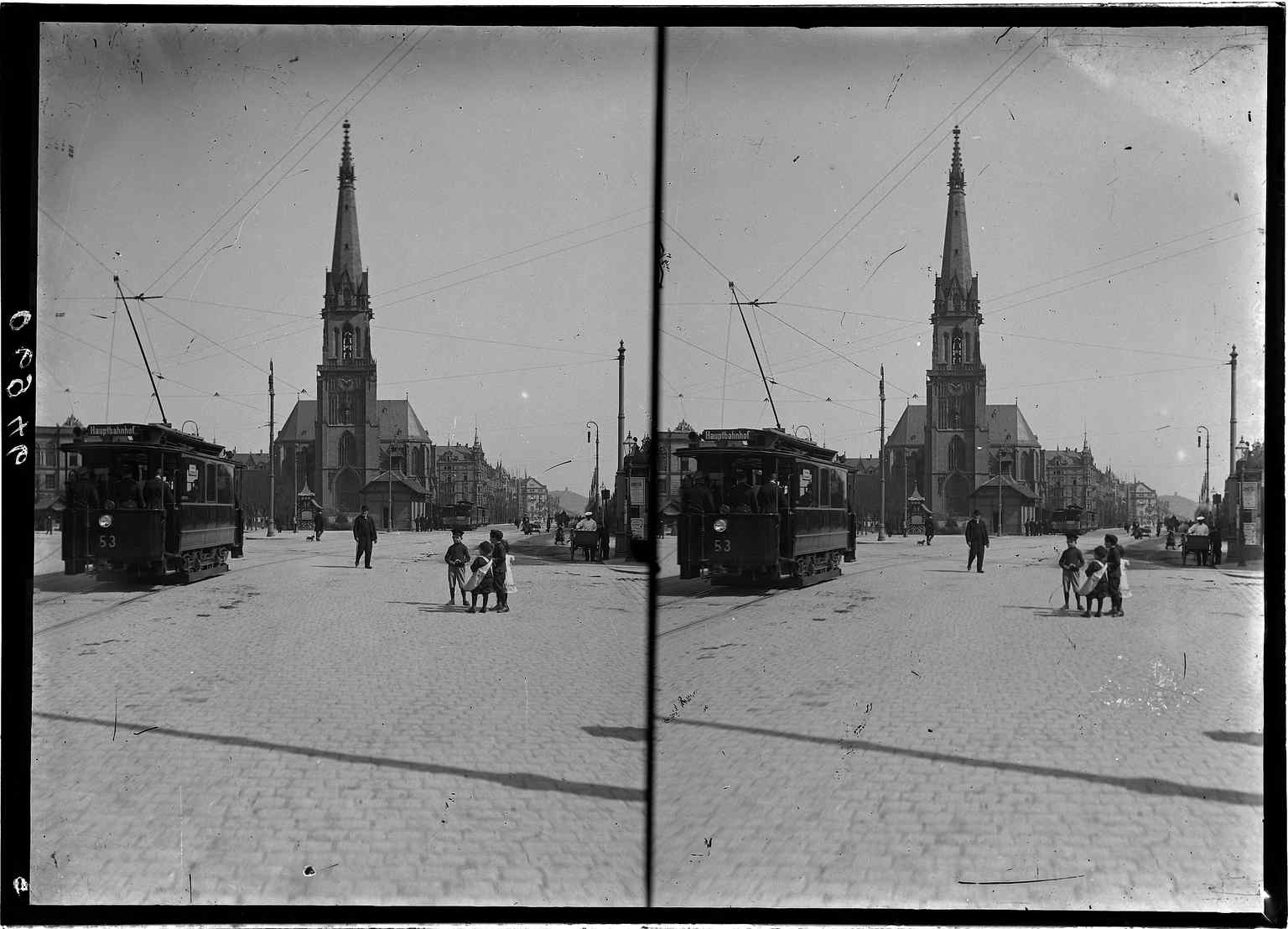
The church authorities initially hired an architect named Franz Jakob Schmitt. But by eighteen ninety-two, they fired him. His designs simply lacked the monumental scale they wanted. So, they brought in Max Meckel, the archdiocesan building inspector. Meckel drew up incredibly ambitious plans for a soaring nave, the central hall of the church where the congregation gathers. The Grand Duke loved it, but he had one major intervention. Meckel had planned to cover the exterior in plaster, which was standard and cheap. The Grand Duke vetoed this immediately. He demanded the building be constructed with exposed, massive red sandstone blocks. Look at the historical photo in your app from nineteen ten. That bare, bold stone facade is entirely thanks to royal meddling.
Now, Max Meckel was an architectural genius, but he was also spectacularly bad at office politics. He spent the entire construction period picking fights with church officials and building authorities. Unsurprisingly, his abrasive style caught up with him. In nineteen hundred, after years of constant bickering, he was unceremoniously fired from his post in Freiburg. He did not even get to see the official consecration of his own masterpiece a year later.
The building survived Meckel's drama, but it barely survived the nineteen forties. Allied bombing raids in nineteen forty-four obliterated the roof and the soaring vault. While the congregation managed to patch it up with temporary fixes, completely rebuilding the complex roof structure took nearly three decades, finally wrapping up in nineteen seventy-two.
Saint Bernard is a prime example of dogmatic authority in action. Between the Church demanding monumental scale and the Grand Duke dictating the sightlines and building materials, this skyline was engineered from the top down. It is a striking reminder of a time when rigid traditions and unyielding rulers quite literally shaped the horizon, long before the Oststadt became a playground for technological disruption.
If you want to admire the vaulting interior, the doors are open daily from eight in the morning until six in the evening. Otherwise, let us continue our walk. We are heading toward the modern administrative hub of the city, taking an eight-minute stroll over to BGV Badische Versicherungen.






