
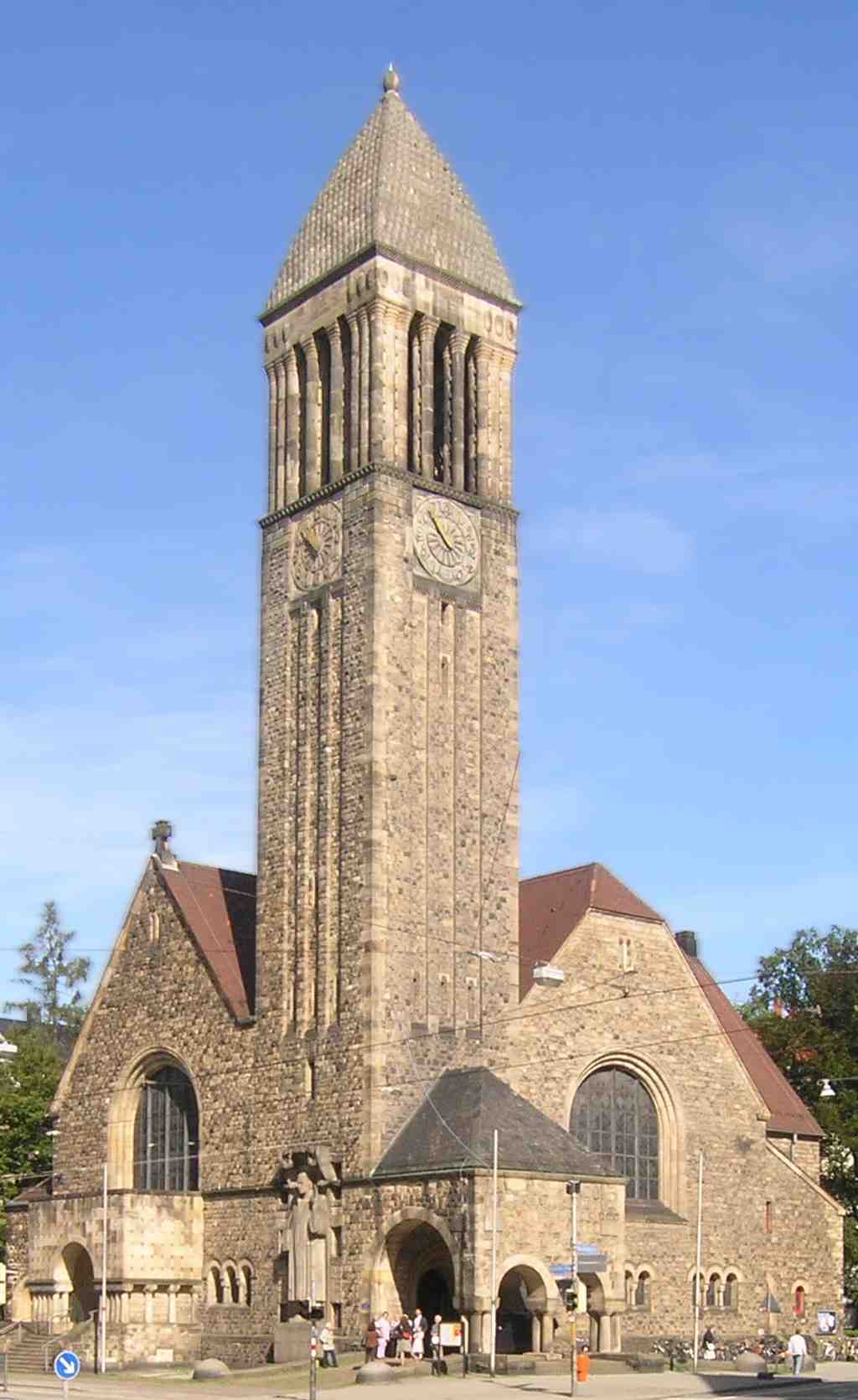
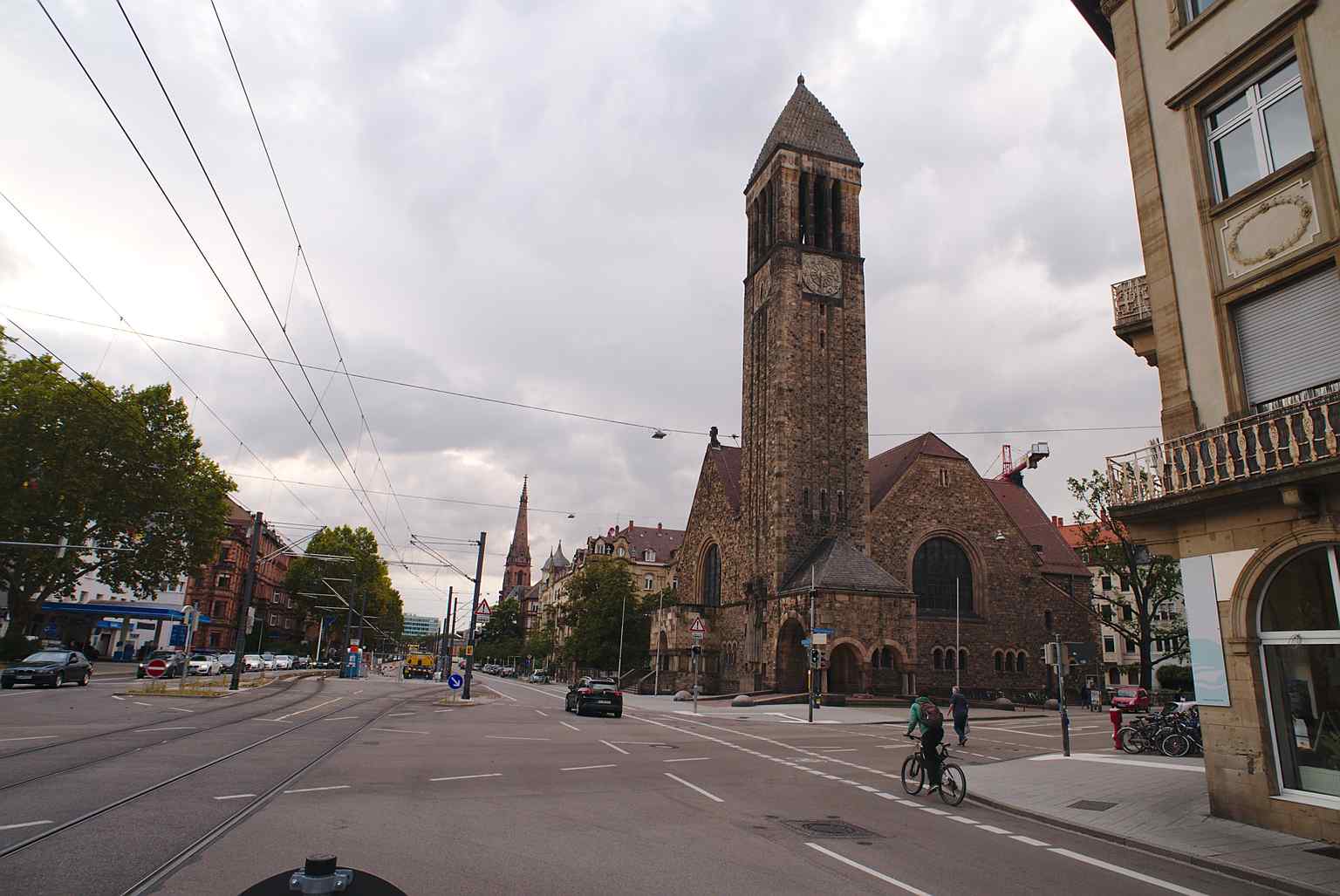
You are standing in front of a monumental church built from rough yellow sandstone, dominated by a towering fifty-three-meter square belfry and anchored by a massive stone figure carved directly into its base.
Welcome to the Luther Church. Designed by the architects Robert Curjel and Karl Moser between 1905 and 1907, it marks the starting line of a neighborhood that underwent a massive shift. Take a glance at the photo on your app to see the full scale of the exterior. You will notice elements of Art Nouveau, an architectural style from the turn of the twentieth century that favored organic, flowing lines over strict classical rules. But the architects faced quite a battle here.
Step back and look up at the massive Luther relief right in front of you. Notice his raised arm and stern expression, and see if you can feel the heavy weight of his absolute certainty. This colossal statue measures nearly ten feet tall on its own, resting on a five-foot pedestal while clutching a closed Bible in a severe, unyielding posture. That stern, forward-looking gaze is not just a casual artistic choice. It radiates a heavy, dogmatic authority, projecting a rigid, almost intimidating certainty that demands absolute compliance from anyone standing below. In a neighborhood that would eventually become a breeding ground for radical engineering and creative disruption, this uncompromising guardian of tradition feels like a deliberate warning.
It almost was not here. Originally, the building committee wanted a highly traditional crucifixion scene carved at the base of the tower. But in April 1905, the architects threw their weight around. They insisted the church's artistic program needed to be modern and unified. They forced a radical change, hiring sculptor Oskar Kiefer to carve this giant reformer instead. The reaction went about as you would expect. When it was unveiled, architectural critics begrudgingly admitted it was powerful, but complained it was far too stylized, harsh, and coarse.
It is harsh, but it is also exceptionally tough. During a devastating bombing raid in April 1944, the roof and the beautifully painted interior were completely destroyed by fire. Yet, these massive walls made of Palatinate sandstone, a notoriously durable rock quarried from the nearby hills, absorbed the shockwaves and survived.
Today, we are going to trace how this district evolved from this exact kind of strict, unbending dogma into an engine of modern progress. From the weight of religious authority, we will walk toward a different kind of ambition just down the street. Our next stop, the Private Brewery Hoepfner, is a nine-minute walk away. If you want to peek inside the church, it is only open on Sundays for an hour in the morning and a couple of hours in the afternoon.





