
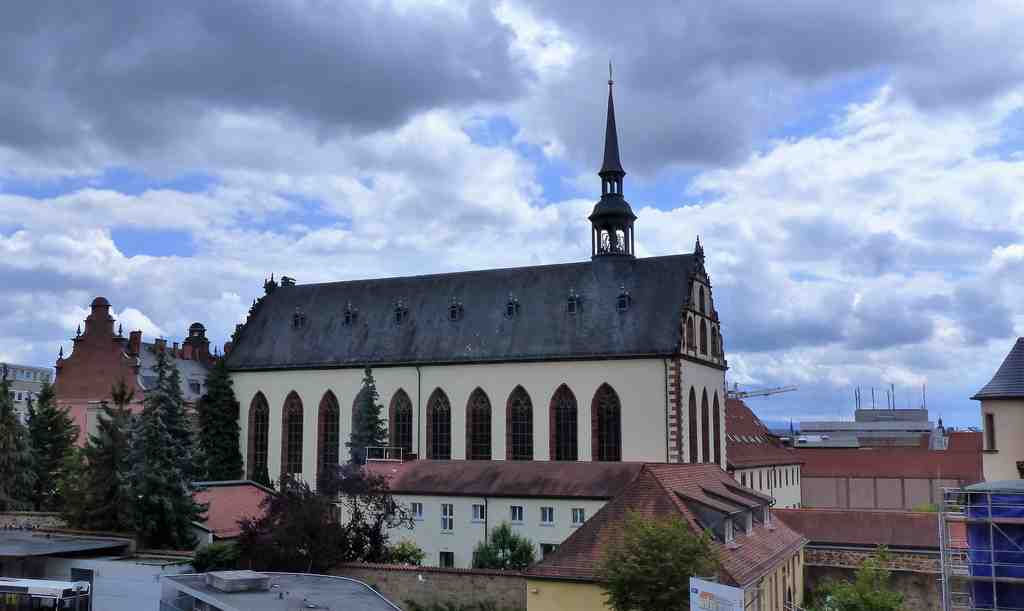
The Benedictine Abbey of Saint Mary stands ahead with its creamy facade, tall pointed windows, and a slender spire topping the roof-just look for the row of dramatic arched windows lined up along the side, right above the garden and courtyard.
Here, at the heart of Fulda, stands a building that’s seen almost as much drama as a soap opera binge-though with fewer commercial breaks. Imagine 1626: the air smells of fresh stone and timber, and the first stones of this mighty abbey are being laid by Johann Bernhard Schenk zu Schweinsberg, whose name is almost as grand as the building itself. Just a few years later, four Benedictine nuns arrive from Kühbach near Augsburg, led by Salome von Pflaumern, ready to start a community of prayer, learning, and-believe it or not-gardening.
But peace was a rare luxury in the early days. As the nuns went about their days, the thunder of troops and the screech of desperation during the Thirty Years’ War often forced them into hiding. The abbey was plundered multiple times, and just when it seemed things might calm down, the threat of secularization loomed in 1802. To survive, the clever sisters opened a girls’ school. They say necessity is the mother of invention-well, these nuns took it literally.
Fast forward to 1875, the Kulturkampf sweeps across Germany, and the sisters are forced into exile in France. It was only in 1887 that they returned, and by 1898, Pope Leo XIII decided it was time to grant the abbey full status. If you asked the nuns, they'd probably say he was just trying to catch up with their resilience!
The abbey continued to dodge danger even during World War II. In 1942, when expulsion seemed inevitable, the sisters cleverly offered part of their buildings to the German army, then later used them to shelter bombing victims and refugees. Bombs did hit in 1944, shattering windows and tearing rooftops, but by the 1950s, the spirit of renewal brought new glass and modern updates to the abbey church.
Did I mention the garden? Behind those walls lies a 2,000-square-meter paradise where the sisters still grow fruit, vegetables, and herbs. Their handiwork doesn’t stop at gardening; in the monastery shop, you’ll find crafts and local treats, all made with a sprinkle of faith and a good dose of patience.
Over the centuries, the abbey has joined the Beuronese Congregation, survived countless storms (literal and otherwise), and continues to be lovingly restored and looked after. Nowadays, under Abbess Benedikta Krantz, the place remains a living testament to devotion, ingenuity, and the occasional dash for cover. Living proof that you can uproot a nun, but you can’t keep her from tending her garden!


