
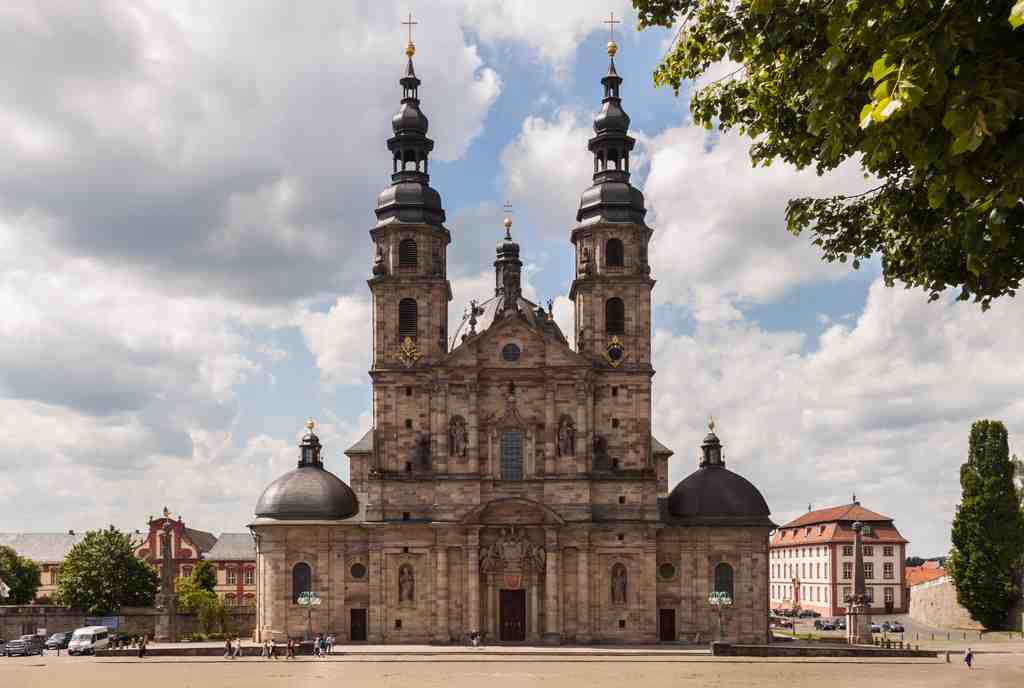
Look ahead for a grand Baroque church with two tall matching towers topped with dark, ornate spires, standing wide and proud at the very heart of the square-that’s Fulda Cathedral, an unmistakable symbol of the city.
Now, imagine the scene here back in the early 1700s. The rattling of stone carts, the shouts of craftsmen, and the smell of freshly cut wood from scaffolding would fill the air. This mighty cathedral wasn’t always here-in fact, under your feet lie the old foundations of the massive Ratgar Basilica, once the biggest north of the Alps. That building had to say goodbye (with a little help from the demolition crew) so that Abbot Adalbert von Schleifras could give Fulda a true masterpiece. He hired Johann Dientzenhofer, fresh from a study trip to Rome, who set out to make this cathedral a sort of “little sister” to St. Peter’s itself, only with fewer tourists queuing for hours.
By 1712, after eight grueling years, the new church was ready. Can you see those two towers in front of you? Stand between them-you're actually standing in front of the east end of the cathedral, which seems backward compared to most churches in Europe. That’s because Dientzenhofer deliberately wanted to echo the grand churches of Rome, and wasn’t afraid to throw medieval tradition out the window.
But Fulda Cathedral is much more than fancy architecture. It is the resting place of Saint Boniface, the “Apostle of the Germans.” His bones lie in a richly decorated crypt below the high altar, in a sarcophagus that would make even an Egyptian pharaoh jealous. That’s why thousands of pilgrims march through here on the Bonifatius pilgrimage every year. Even Pope John Paul II visited in 1980, and locals say the crowd that day was so big it made the town's bakeries run out of pretzels.
And here’s a sound you might hear if you were lucky-or in the Middle Ages: the “Golden Wheel.” This was a gigantic, turning star covered in hundreds of tiny bells, which would ring out in a dizzying spinning show of gold, music, and Gothic style. Sadly, it met a spectacular end in 1781 when, during a service, the supporting rope snapped and the whole glittering wheel came tumbling down. Let’s just say, health and safety regulations weren’t really a thing back then.
Then there’s the case of the fiery tower. In 1905, a firework misadventure set a tower ablaze, destroying two of the great bells-Osanna and Bonifatius. Miraculously, the rest of the church survived, and the burnt tower was soon rebuilt. Today, the mighty bells ring out in careful order, their sound marking everything from the Angelus to the bishop’s death-let’s hope you’re only here to hear the regular chimes.
Step inside (if you have time) and look up at the dome, packed with glowing frescoes and towering figures of angels whose job descriptions remain “look imposing, keep watch.” Legend has it that the builder faced some diabolical challenges while raising that dome-rumor says the devil himself tried to make a pact for a soul in exchange for a perfect roof. Luckily, prayer and perseverance prevailed, and the dome still sits snugly atop the building, while any ambitious demons are left outside to sulk.
All around, you’ll see baroque wonders and taste a bit of Rome-by-way-of-Hessen: white walls contrasting with black-and-gold accents, swirling pillars, ornate altars, and-in case you’re looking for extra drama-a collection of organs that have survived wars, upgrades, and more than a few choirmasters’ bad moods.
So here before you stands not just Fulda’s cathedral, but its heart, a place of beauty, mystery, drama, and maybe, just maybe, a stray firework or runaway bell. Even in the 21st century, this square is home to open-air pop concerts, and you can imagine that the echoes of history are sometimes interrupted by a drum solo from Sting or Nena-just how the Baroque masters would have wanted, I’m sure.
Ready to delve deeper into the architecture, equipment or the surroundings of the duomo? Join me in the chat section for an enriching discussion.


