
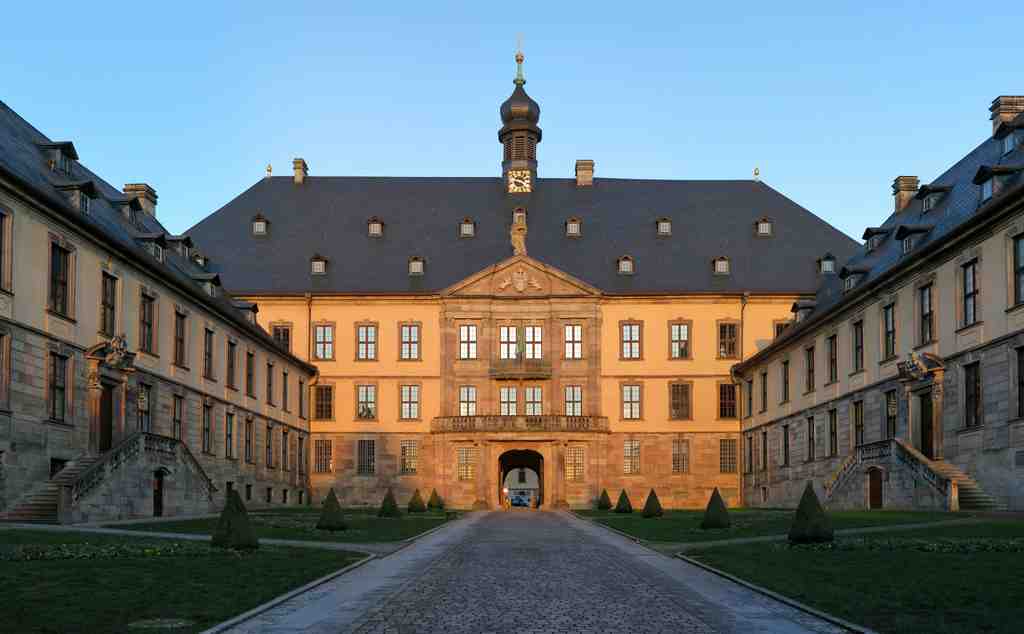
Right ahead of you is the Fulda City Palace: just look for a grand, three-story baroque building with a dark slate roof and central clock tower, flanked by two elegant wings and framed by stone staircases-it's hard to miss, especially as the evening sunlight dances across its golden facade.
Now, take a moment and imagine yourself back in the early 1700s. The smell of fresh-cut grass floats on the breeze, carriage wheels rumble over cobblestones, and the imposing silhouette of the Fulda City Palace towers before you like a chess king guarding his court. This wasn’t just a palace-it was a theatrical masterpiece, designed between 1706 and 1714 by the celebrated architect Johann Dientzenhofer. Commissioned by Prince-Abbots and later home to Prince-Bishops, this place was Fulda’s answer to, “How fancy can we get?”
But let’s rewind the clock a little more. Long before it became the baroque showstopper you see today, a stern fortress once stood here, built at the start of the 14th century. Legend has it that the abbot, Heinrich V., decided he needed somewhere new after a rather heated spat with his monks-sometimes real estate is all about location and avoiding awkward breakfast meetings! He picked this very spot, right on a strategic hill between the old monastery and the bustling town. Defense was the hot trend, so the “new castle” was built with thick stone walls that merged with the city walls, towers, a broad moat, and entry gates so secretive you almost needed a password (no, “Open Sesame” wouldn’t do). Excavations reveal the remnants of turret foundations and even a drawbridge, so you can picture knights keeping watch while the townsfolk hustled below.
Fast forward to the 1600s-power suits were out, ruffled collars and bigger castles were in. The original fortress was transformed into a four-winged palace, still with a whiff of danger on the outside but much more suited to grand dinners and politics than sword fights. Every few decades, a new abbot wanted to leave his mark, adding wings and courtyards, dreaming up ever more impressive facades. One even made sure the palace had its own chapel with beautiful pointed windows, a space for prayers-and perhaps a little bit of plotting.
And then came the age of elegance: Baroque! In 1706, Dientzenhofer was called in to give the palace an epic makeover-think palace plastic surgery, 18th-century style. The main wing blossomed with ornate staircases and neat rows of tall windows, the perfect spot for any noble to prepare a dramatic entrance. The central courtyard, where you’re standing, became the “Ehrenhof”-the Court of Honor. By 1714, Fulda’s rulers could stroll up those exterior staircases or gaze out the windows over their domain, feeling right at the center of the world.
And yet the palace was never done evolving. When Fulda became a principality, new wings were added in the cool, elegant late-classical style. By the 1800s, the palace hosted the crown prince of Hesse-a whole new chapter of royal intrigue and, I suspect, even fancier parties.
Today, the palace is still packed with secrets. It houses the city administration, but you can also sneak a peek at its dazzling rooms-almost all are original, filled with art, silk, and porcelain. If you think your bathroom mirror is impressive, wait until you see the Mirror Hall! Imagine getting dressed in a chamber covered floor to ceiling with mirrors, reflecting the candlelight and glittering with every move.
So, as you stand here, linger a moment. Breathe in the centuries of stories-of abbots, bishops, royal heirs, and yes, a disagreement or two that changed the shape of Fulda forever. Not bad for a building that started as an escape from the neighbors, wouldn’t you agree?


